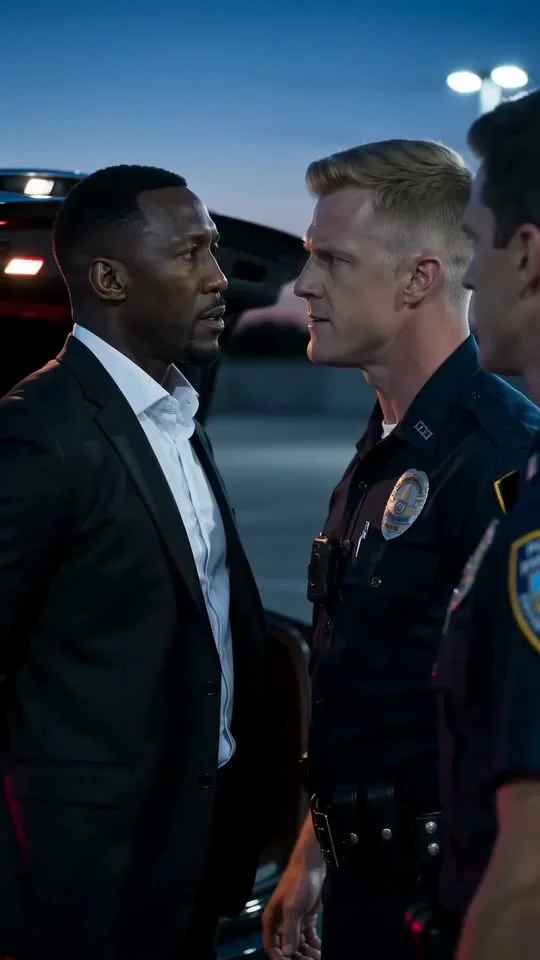
CHAPTER 4 – The Cost of Truth
The black case opened in the evidence laboratory beneath white cameras and the eyes of two federal witnesses.
Inside, fitted foam held encrypted drives, original affidavits, and a narrow steel box. Ortiz connected the first drive to an isolated terminal. Folders appeared one by one, each carrying a date, case number, and officer identifier.
Cole’s number appeared more than any other.
There were traffic-stop videos that had never reached prosecutors. Audio files captured threats made after cameras were supposedly turned off. Inventory photographs showed cash and narcotics before and after Cole entered the evidence room. The difference between the images was impossible to explain away.
Harris stood near the door, color draining from his face.
One file bore the name MALCOLM REED.
“My first arrest,” he said.
Damian opened it. Footage showed Harris, twenty-three and nervous, standing beside a handcuffed teenager. Cole moved behind the patrol car, removed a packet from his pocket, and slipped it under the back seat. Minutes later, he called Harris over and praised him for finding it.
Harris backed into the wall.
“He told me I missed it in the first search.”
No one answered.
“He testified that I found it.”
Damian stopped the recording.
Harris pressed both hands to his mouth. His shoulders rose once, sharply, before he forced them down. “Malcolm took a plea. Eighteen months.”
“He was released eight weeks ago,” Damian said. “His conviction is under review.”
“I stood in court.”
“You repeated what your training officer told you.”
“I stood there,” Harris said again. “His mother was crying, and I wouldn’t look at her.”
Damian stepped closer but left space between them. “What you do with that truth begins now.”
Ortiz entered carrying Harris’s body-camera dock. “Cole’s attorney is demanding suppression. He claims the stop was lawful and Brooks provoked an unauthorized search.”
Harris lowered his hands.
Ortiz set the dock on the table. “Your camera captured the stop, but there is a problem. Cole tried to disable it. The local copy is damaged. We can recover most of it, not necessarily the part where he discussed the plate.”
Harris looked through the observation window. Cole sat on the other side of the glass, speaking quietly with his attorney.
“I heard him,” Harris said.
“A statement from you establishes intent,” Ortiz replied. “It also opens every report you signed with him to scrutiny. Defense counsel will accuse you of participating and changing sides to save yourself.”
“How many reports?”
“Forty-six.”
Harris stared at the floor.
Cole’s attorney rose and opened the interview-room door. Cole leaned just far enough into the corridor to be heard.
“Nathan, think about your mother.”
Ortiz moved toward him, but Damian raised a hand.
Cole kept his eyes on Harris. “Her mortgage. Her medication. Who helped when your father died? Who got you through the academy?”
Harris’s lips parted, but nothing came out.
“I protected you,” Cole said. “You give them a statement, and they’ll strip your badge too. Your father would be ashamed.”
The words landed with brutal precision.
Harris turned away. His breathing became shallow. One hand found the edge of the table and gripped until his knuckles whitened.
Damian looked at the open black wallet beside the evidence terminal. A corner of an old photograph showed behind his credential.
“Your father,” Damian said quietly, “would have told you the badge is not something another officer gets to hold over your head.”
Harris looked at him sharply.
Cole saw the photograph too.
Something changed in his face.
“You don’t know anything about his father,” Cole said.
Damian’s gaze moved to him. “I know Samuel Harris filed the first protected complaint against you.”
The laboratory fell silent.
Harris slowly shook his head. “My father died in a highway accident.”
“He did,” Damian said. “Three days before he was scheduled to meet a federal investigator.”
Cole surged against the agent holding him. “That had nothing to do with me.”
No one had accused him.
His attorney closed his eyes.
Damian’s voice hardened. “What did you think we were going to say?”
Cole realized it too late. Panic broke across his face, bare and unmistakable.
Ortiz stepped closer. “Sit down.”
“It was raining,” Cole said. “He drove too fast. Everyone knew that.”
Harris stared at him. “The report never mentioned rain.”
Cole stopped breathing.
Outside, sunlight blazed through the high windows.
Harris crossed the corridor before anyone could prevent it. He stopped inches from Cole, his whole body trembling.
“Were you there?”
Cole looked past him. “Nathan—”
“Were you there?”
“I tried to protect him from himself.”
Harris recoiled as if struck.
Cole’s attorney grabbed his sleeve. “Do not say another word.”
But the power Cole had exercised for years was collapsing, and he could not bear silence when silence no longer belonged to him.
“Samuel copied files,” he snapped. “He threatened everyone in that building. He was going to destroy careers over mistakes.”
“What did you do?” Harris asked.
Cole’s mouth tightened.
Ortiz’s phone vibrated. She read the message, then turned the screen toward Damian. Federal technicians had recovered an archived vehicle-maintenance log. Cole’s patrol cruiser had received an unrecorded front-end repair the morning after Samuel Harris died.
Harris saw the date.
His knees nearly gave way.
Damian caught his arm and steadied him. Harris did not pull away. He stood with his head bowed, fighting for each breath while agents took Cole back into the interview room.
Behind the glass, Cole finally understood. The hidden videos, the altered evidence, the remote deletion, and his own words had joined into something no badge, favor, or frightened subordinate could erase.
His attorney moved his chair farther away from him.
Six weeks later, Cole entered a federal courtroom without a uniform.





