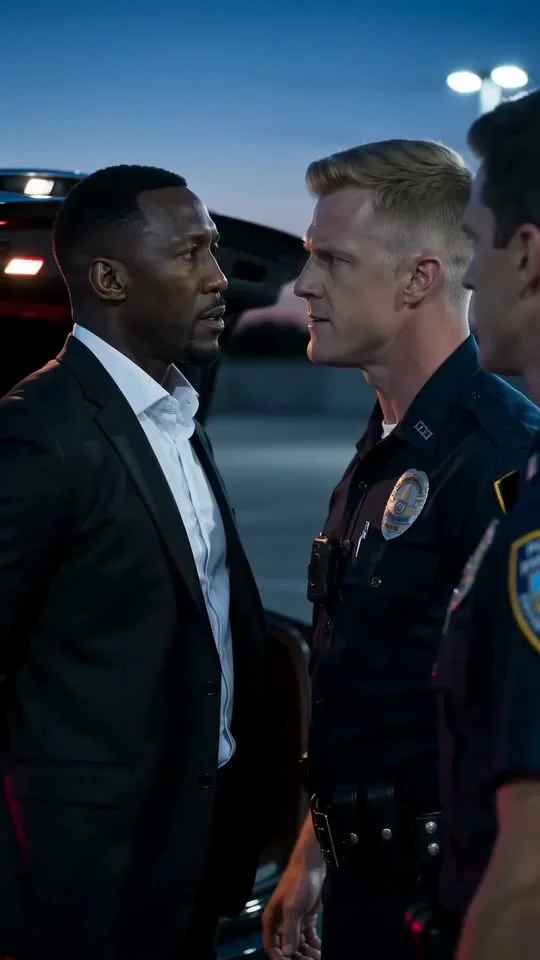
He pleaded guilty only after forensic analysis matched paint recovered from Samuel Harris’s car to the repaired patrol cruiser. The evidence drives established racketeering, obstruction, civil-rights violations, evidence tampering, and retaliatory arrests. His attempt to erase the archive added another charge. His statements in the corridor destroyed the last shelter his lawyers tried to build.
The judge imposed a sentence that ensured Cole would never again carry a badge or exercise authority over another citizen.
When the courtroom doors opened, Malcolm Reed stood beside his mother. His conviction had been vacated that morning.
Harris approached them without his uniform.
He had surrendered it voluntarily pending review, then given investigators every notebook, message, and memory he possessed. The department cleared him of deliberate participation but found that his unquestioning reliance on Cole had caused real harm. Harris accepted the finding.
Malcolm watched him come closer.
Harris stopped several feet away. “I believed him because believing him was easier than admitting I hadn’t done my job. You lost eighteen months because I chose easy.”
Malcolm’s mother held her son’s arm.
“I don’t expect forgiveness,” Harris continued. “I wanted you to hear me say that I know what I did.”
Malcolm studied him for a long time. “Then spend the rest of your life noticing what other people decide not to see.”
Harris’s eyes filled. He nodded once.
“I will.”
CHAPTER 5 – What Remained
Oakdale’s department did not survive unchanged.
A federal monitor took control of complaints and evidence. Wrongful convictions were reopened. Missing money was traced and returned. Officers who had lied resigned or faced charges; those who had objected in private were required to explain why private objection had never become public courage.
Harris chose not to return to patrol.
He began working with the county conviction-review office, where his first assignment was to locate people whose cases carried Cole’s badge number. The work was quiet and often humiliating. Some doors closed in his face. He knocked anyway.
Damian remained in Oakdale through the first months of the intervention. He attended hearings, listened to families, and never concealed the marks left by the handcuffs when photographs of the arrest became public.
One evening, rain tapped against the tall windows of the temporary federal office. Most of the building had emptied. Harris found Damian alone at a conference table, placing documents back into the black case.
The narrow steel box still rested inside.
“You never opened that,” Harris said.
“It wasn’t evidence.”
Damian lifted it out and set it between them.
Harris remained standing. “Cole knew my father had contacted someone federal.”
“He knew Samuel had gathered records. He did not know where Samuel sent them.”
“To you?”
“Eventually.”
Damian opened the steel box.
Inside lay a stack of letters tied with a faded blue ribbon, an old silver police shield, and a photograph. Harris recognized the picture that had been tucked behind Damian’s credential.
His father stood in it, younger and broader through the shoulders, beside a thin Black teenager in a borrowed graduation gown. Samuel had one hand on the boy’s shoulder. Both were squinting into the sun.
Harris lowered himself into the chair.
“That’s you.”
Damian nodded.
For several seconds, the rain was the only sound.
“When I was sixteen, an Oakdale officer stopped me outside a pharmacy,” Damian said. “I had a prescription for my mother in my pocket. He said I had stolen it. Three officers watched him put me against a wall.”
Harris looked at the old shield.
“Your father arrived. He checked the name on the bag. Then he made the officer uncuff me in front of everyone.”
Damian touched the edge of the photograph.
“I was furious. Not grateful. Furious. I asked him why one decent officer should get to decide whether I went home or disappeared into the system.”
A faint, wounded smile moved across Harris’s mouth. “What did he say?”
“He said, ‘One shouldn’t. That’s why you need to become the kind of man who changes the system instead of waiting for a decent man to find you.’”
Harris closed his eyes.
Damian untied the ribbon. The top letter was addressed in Samuel’s careful block handwriting.
“He kept in contact,” Damian said. “Helped me apply to college. Sent twenty dollars in every birthday card even when I was earning more than he was. When I joined the Justice Department, he started sending me notes about Oakdale.”
“Why didn’t I know?”
“He was trying to protect you. You had just entered the academy. He believed Cole was watching you.”
Harris rubbed a thumb across his father’s tarnished badge. “And the night he died?”
“The packet he intended to deliver vanished from his car. For years, all I had were his letters and suspicions. Not enough to prove what happened.”
“Until Cole spoke.”
“Until Cole could not stand being questioned by someone he thought he owned.”
Harris bowed over the table. A tear struck the silver shield and rested in the worn groove around its number.
Damian waited.
“I thought he died disappointed in me,” Harris said. “We argued that week. He told me Cole was teaching me loyalty without conscience. I told him he was jealous because Cole believed in me.”
His voice broke on the final words.
Damian pushed the last sealed letter across the table.
“He wrote this the night before he died.”
Harris stared at his name on the envelope. “You read it?”
“No. It belongs to you.”
His fingers shook too badly to open it cleanly. Damian handed him a letter opener, and Harris slid it beneath the flap.
The letter was short.
Nathan,
If I have been hard on you, it is because I know how badly you want to be worthy of the uniform. Do not confuse worthiness with perfection. You will make mistakes. The measure of you will be whether frightened people become safer when you finally understand the mistake.





