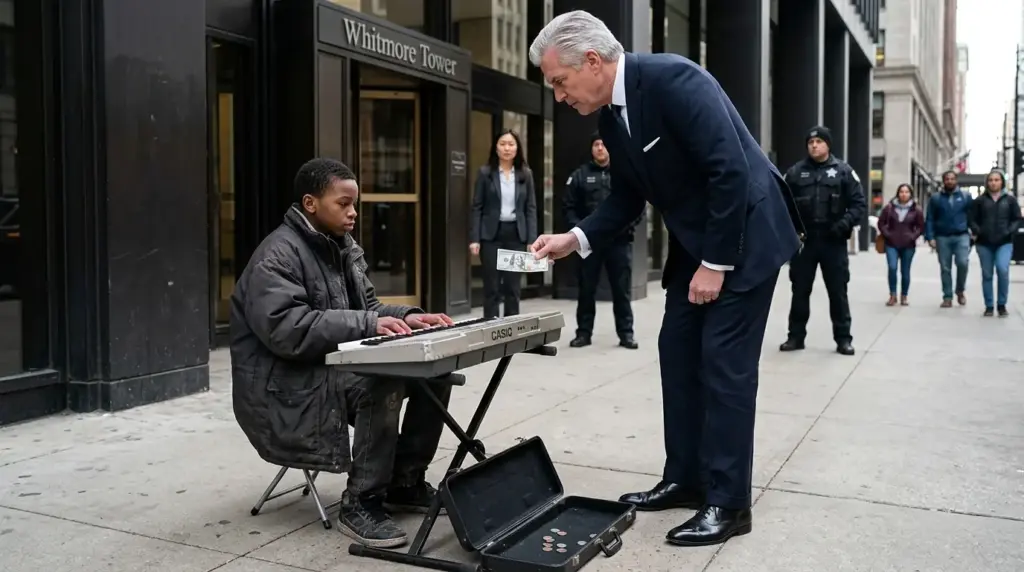
One week, one chance, one song that could change everything or destroy the only corner in the city where he felt safe. As the wind picked up again, Marcus packed his keyboard carefully into its duct taped case. His fingers found the photo tucked inside. His mother, smiling, sitting at the piano in their old apartment. “Real music requires culture,” Richard had said.
“If only he knew. ” Marcus stood slinging the keyboard case over his shoulder. One week to prove that music wasn’t about money or breeding or the color of your skin. It was about soul, about stories that needed to be told, about the human heart speaking when words weren’t enough. The question was, would anyone really listen? The St.
Mary’s homeless shelter on the south side was already crowded when Marcus arrived, his keyboard case banging against his hip with each step. The $100 bill felt like it was burning a hole in his pocket. He’d hidden it in his shoe, knowing that flashing that kind of money here could be dangerous. Marcus, there you are. Angela Robinson’s warm voice cut through the chaos of the dinner line.
The 35-year-old social worker had been looking out for Marcus ever since he’d first shown up at St. Mary’s 2 years ago, a 10-year-old boy clutching his mother’s keyboard like a lifeline. “Hey, Miss Angela. ” Marcus managed a small smile, but she knew him too well. “What’s wrong, baby? You look like you’ve seen a ghost. ” She guided him to a quieter corner past the long tables where dozens of men, women, and children were eating their evening meal, soup, and sandwiches tonight, same as every Tuesday.
Marcus sat down his keyboard case carefully and told her everything. As he spoke, Angela’s expression shifted from concern to anger to deep worry. Around them, the shelter bustled with its usual evening activity. Three other kids Marcus knew from the youth section. Trey, Diamond, and Little Jose, were doing homework at a nearby table.
Volunteers helping them with math problems. Richard Whitmore, Angela said the name like it tasted bad. That man’s foundation gives us funding, but I’ve heard stories. He likes his tax write-offs and his PR photos, but actually caring about people, that’s not in his vocabulary. But what if he’s serious?
Marcus asked, his voice barely above a whisper. What if this is my chance to get out of here? Angela took his hands in hers, noticing how cold they were despite the shelter’s heating. Baby, I know how hard this life is. I see you out there every day playing your heart out for spare change.
But men like Witmore, they don’t make offers like this to help. They do it for entertainment, to make themselves feel superior. Then I’ll surprise him, Marcus said with sudden determination. I’ll play something that’ll make him eat his words. One of the shelter staff members, Carl, a tall black man who worked security, overheard and shook his head.
Kid, I worked security for one of Whitmore’s events once. Man treated us like we were invisible, except when he wanted to complain about something. You sure you want to put yourself through that? What choice do I have? Marcus’ voice cracked slightly, showing his age.
You know what tomorrow is? Angela’s face softened. She knew. November 15th, 2 years since Marcus’s mother had died, leaving him completely alone. No father in the picture, no relatives who could or would take him in.
She was a music teacher, Marcus continued, his eyes distant. At Lincoln Elementary. Piano, voice, even some violin. She taught me everything. Said music was in our blood going back generations.
My greatgrandfather played jazz in the Cotton Club. Did you know that? You never told me that. Angela said softly. Mama didn’t like to talk about the past much.
Said we needed to focus on moving forward, but she made sure I knew about the music. Made sure I could read it, write it, feel it. He touched his keyboard case gently. This was hers. It’s all I have left.
Diamond, a 10-year-old girl with bright eyes, despite her circumstances, had wandered over. You going to play for some rich folks, Marcus. Maybe, Marcus replied. Play that song you wrote, she said eagerly. The one about the trains.
That one always makes me cry. You wrote a song? Angela asked surprised. Marcus shrugged embarrassed. A few.
Mama taught me composition. Said anyone could play other people’s music, but creating your own. That was how you talk to God. The shelter’s dinner hour was winding down. Volunteers were starting to clear tables, and people were settling in for the night.
Saint Mary’s had beds for 50, but on cold nights like this, they’d squeeze in 70 or more. Marcus had a cot in the youth section, a small area separated by curtains where they tried to keep the kids somewhat sheltered from the harder realities of adult homelessness. Marcus, Angela said carefully, if you’re serious about this, you need to prepare properly. A charity gala isn’t a street corner. These people, they expect certain things.
Classical pieces probably Mozart, Beethoven, that kind of thing. I know classical, Marcus said quietly. Mama made sure of that, but that’s not what I want to play. Carl laughed, not unkindly. Kids got guts.
I’ll give him that. You really think you can make Richard Whitmore listen to something you wrote? I have to try, Marcus said. What’s the worst that can happen? I’m already sleeping in a shelter, eating donation food, wearing donation clothes.
He said, “I can never play near his building again. ” Fine. Chicago’s a big city. But even as he said it, Marcus knew it wasn’t that simple. That corner had become his spot, the one place where he felt connected to something larger. The acoustics were perfect, the foot traffic steady, and sometimes, just sometimes, people actually stopped and listened.