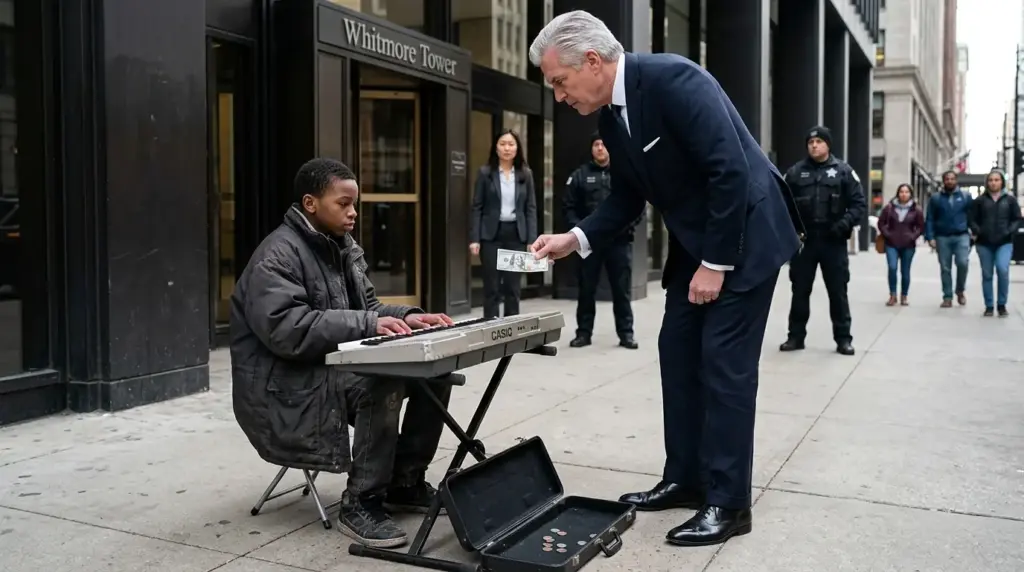
Benevolent businessman gives unfortunate child a chance. And if the narrative shifts, Jennifer asked, it won’t. I control the narrative. I always have. As the board members filed out, Victoria remained behind.
Mr. Whitmore, may I speak freely? You may not, but I sense you’re going to anyway. This feels wrong. That boy, he’s just a child.
Whatever point you’re trying to make. The point, Victoria, is that society has forgotten natural order. We pretend everyone is equal. That talent is distributed randomly across economic lines. It’s not.
Excellence breeds excellence. Poverty breeds poverty. That boy needs to understand his limitations. What if you’re wrong? Richard turned back to his window, looking down at the city below.
I’m never wrong about people like him. They’re all the same. Full of false hope, thinking they’re special, thinking they deserve more. Tomorrow, I’ll do that boy a favor. I’ll show him the truth.
Victoria gathered her papers and left, but not before sending a text to a number she’d saved but never used. Angela Robinson at St. Mary’s shelter. It read simply, “He’s expecting your boy to fail. ” Make sure Marcus knows what he’s walking into. Down on the street 40 floors below, Marcus stood at his usual corner, not playing, just looking up at Whitmore Tower.
Somewhere up there, people were planning his humiliation. But they didn’t know about the hours with James, about the song he’d perfected, about the fire that burned in his chest. Tomorrow would come, and with it either triumph or devastation. But Marcus had survived worse than rich men’s mockery. He’d survived loss, abandonment, nights when the cold seemed like it might kill him.
Whatever happened tomorrow, he’d survive that, too. The question was, would Richard Witmore survive being wrong? Friday night, Wilson’s music and more was officially closed, but lights spilled from the back room where Marcus sat at the restored Steinway, his fingers moving across keys that felt like silk compared to his battered keyboard. James Wilson sat nearby, not instructing now, just listening. Angela Robinson had arrived an hour ago with Chinese takeout that sat mostly untouched, everyone too nervous to eat.
“Play it again,” James said softly. “But this time, remember, you’re not just playing notes. You’re telling them your story. ” Marcus closed his eyes, his mother’s face appearing in his mind. The piece he’d written started soft, almost fragile, a child’s lullabi, simple and pure. Then it began to evolve.
Complexity creeping in like shadows at dusk. The melody fractured, reformed, became something that spoke of loss so profound it could hollow you out, leave you gasping. Jesus, whispered Mike, the security guard who’d stopped by again. He’d been standing in the doorway, frozen. “Kid, that’s that’s something else. ” “It’s about mom,” Marcus said quietly, his fingers never stopping.
About the day she died. She was humming this melody, something she made up when I was a baby. She couldn’t speak anymore. The cancer had taken that, but she could still hum. And then she couldn’t even do that.
The music shifted, grew stronger, not happy, but defiant, resilient. It spoke of a boy who refused to break, who found music in the darkest corners of the city, who survived when survival seemed impossible. The transition here, James pointed to a particularly complex passage that’s jazz influence, but structured like Bach. How did you Mom had recordings, Marcus explained. Old vinyl she’d saved from her father.
Art Tatum, Oscar Peterson, but also Glenn Gould playing Bach. She’d play them side by side. “Show me how jazz and classical weren’t enemies, but cousins. ” “All music is conversation,” she’d say. “The only question is what story you’re telling. ” Angela’s phone rang. She stepped away to answer, her face growing concerned.
“That was Victoria Chen, Whitmore’s assistant. She wants us to know. Richard’s turned this into a circus. Media full coverage. He’s billing it as charity meets reality TV.
Let him, Marcus said with sudden fierceness. Let them all come. They want a show. I’ll give them one. Marcus, Angela warned.
These people, they’re not coming to appreciate music. They’re coming for blood sport. Rich people watching a poor kid fail. That’s their entertainment. Then they’re in for disappointment.
Marcus turned back to the piano. Mr. Wilson, Dad. He stumbled over the word, still not used to it. Will you show me that fingering technique again?
For the crescendo, James moved to sit beside him on the bench, their hands side by side on the keys. See how my wrist stays level? Power comes from your whole arm, not just your fingers. Your mother knew this. She had perfect technique.
Tell me about her, Marcus asked suddenly. From before when you knew her. James’ hands stilled. She was fire, he said simply. Walked into Buddy Guys Legends one night, asked if she could sit in.
The regular pianist laughed. This properly dressed teacher wanting to play blues. Then she started playing and nobody laughed anymore. She played like her soul was trying to escape through her fingers. That’s how you met?
I was playing saxophone that night. Badly. James smiled at the memory. She made everyone sound better just by being there. After the set, I asked her to teach me piano.
Three lessons in, I was in love. 3 months in, we were planning a future. So, what happened? Marcus’s question held no accusation now, just curiosity. I was an addict, James said bluntly.
Functional, I told myself, just pills to stay awake, alcohol to come down. Your mother, she tried to help. But when she told me about you, about being pregnant, I panicked. Thought I’d ruin you both. So I ran.
His voice broke. Stupidest, most cowardly thing I ever did. But you got clean. Too late. By then, she’d vanished, and she was right to keep you from me.