James sat heavily on a stool, gesturing for Marcus to do the same. I met your mother at a jazz club in 1999. She was playing piano, and I swear I’d never heard anything like it. We were together for 2 years. Happy years.
Then then what? I wasn’t ready to be a father, James admitted, shame heavy in his voice. I was drinking too much, running with the wrong crowd. Your mother, she was going places, had a teaching job lined up, a future. I was just a jazz musician with more dreams than sense.
When she told me she was pregnant, I panicked. I left. Marcus felt something hard form in his chest. You just left. Worst mistake of my life.
I got clean a year later. Came back to find her, but she’d moved. Changed her number. I hired someone to look for you both, but Denise had covered her tracks well. I’ve been searching ever since.
He pulled out his wallet, and Marcus gasped. Inside was a photo. His mother, young and radiant, at a piano. She died, Marcus said flatly. Two years ago, cancer.
James’ shoulders shook. I know. I found the obituary 6 months ago. By then, you disappeared into the system. I’ve been trying to find you, but the foster system, the shelters, they don’t give out information easily.
I’ve been at St. Mary’s, Marcus said, playing music on the streets. Surviving. Oh, God. James buried his face in his hands.
Your mother must have hated me. Marcus thought about it. She never mentioned you, not once, but she made sure I knew music. Said it was in my blood. Can you play?
Instead of answering, Marcus opened his battered keyboard case. He set it up on James’s workbench and began to play one of his mother’s favorite pieces, a deucey prelude she taught him when he was seven. His fingers flew across the keys, the small keyboard somehow producing sounds that seemed too big for its speakers. James watched, transfixed. When Marcus finished, there were tears streaming down the older man’s face.
“You play like her, but there’s something else there, too. Something that’s all you. I write my own pieces,” Marcus admitted. “Show me. ” Marcus played a composition he’d been working on. A piece about the city at night, about loneliness and hope existing in the same space.
It was complex with jazz influences mixed with classical structure, something entirely his own. That’s extraordinary, James breathed. You wrote that. Marcus nodded. I want to play it at the gala.
Not what Witmore expects, but this, my truth. James was quiet for a long moment. Then that piano in the corner, it’s a Steinway Model B. 7 ft of perfection. I’ve been restoring it for 3 years.
If you’re going to play for those people, you need to practice on something real, not that keyboard. I can’t afford. You’re my son, James interrupted. You never have to pay for anything in this store ever. The words hung between them, heavy with meaning.
The customer at the front called out asking for help. Damn, James muttered. Look, can you come back tonight after I close? We’ll work on your piece. Make sure it’s ready.
And Marcus, after this gala, whatever happens, we need to talk about your future. You shouldn’t be on the streets. You have family now. Family? The word felt foreign in Marcus’s mouth.
Why should I trust you? You left once because I’ve spent 12 years regretting it,” James said simply. “Because your mother never let me make it right. And maybe she had good reason. But you’re here now and I’m here.
And maybe that’s God giving me a second chance I don’t deserve. ” That evening, Marcus returned. The store was closed, but James was waiting. They worked for hours. James teaching Marcus techniques his mother hadn’t, showing him how to pull emotion from keys in ways that could make grown men weep. An offduty security guard, Mike, stopped by James’s friend, who sometimes watched the store.
He listened to Marcus play, shaking his head in wonder. “Kids got it,” Mike said. “Whatever it is, he’s got it in spades. ” “He’s playing for Richard Whitmore’s charity gala,” James explained. Mike whistled low. That racist bastard.
Good luck, kid. Man wouldn’t recognize real talent if it bit him. Maybe, Marcus said, his fingers never stopping their practice. Or maybe he just hasn’t heard the right song yet. As the night wore on, James taught Marcus about performance, about commanding a room, about making every note count.
Your mother,” he said at one point. She could make a room full of people hold their breath. “You have that same power. Don’t let anyone tell you different. ” When Marcus finally left, it was past midnight. James walked him to the door, then did something unexpected.
He hugged him. “Quick, awkward, but genuine. ” “Saturday,” James said. “I’ll be there in the audience. You won’t be alone. ” Marcus nodded. Unable to speak past the lump in his throat.
As he walked back to the shelter, his keyboard case felt lighter somehow. He had a father, a complicated, flawed, guilt-ridden father, but a father nonetheless. And in two days, he’d show Richard Whitmore and all his rich friends what real music sounded like. The kind that came from pain and joy, loss and discovery. The kind that told the truth even when the truth was hard.
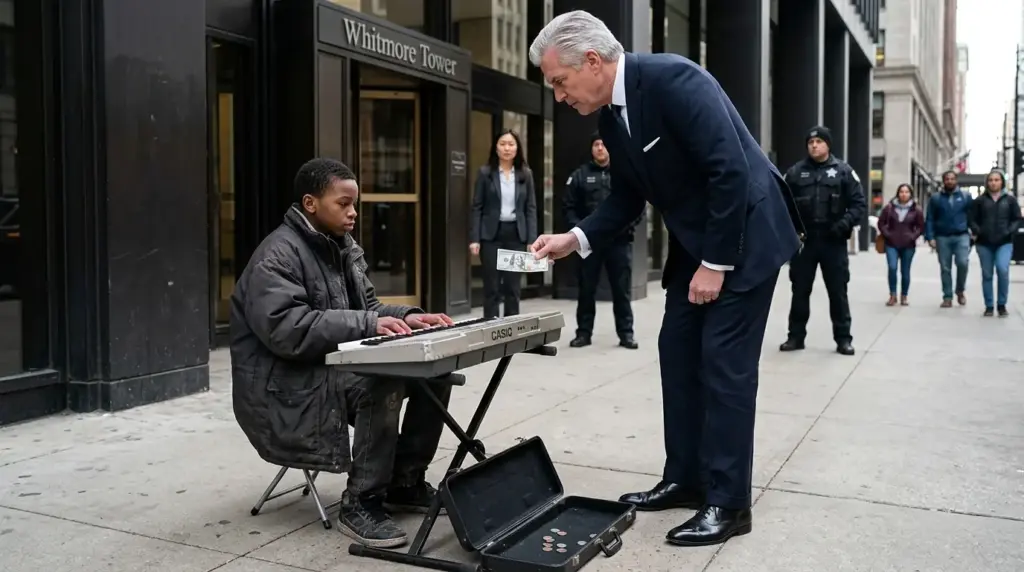
The question was, would they be able to hear it, or were their hearts too closed, their prejudices too strong? Saturday would tell. Richard Whitmore’s corner office occupied the entire 40th floor of Whitmore Tower. Its floor toseeiling windows offering a view of Chicago that made visitors feel like gods looking down on mortals. Friday morning, the day before the gala, Richard stood at those windows, his reflection superimposed over the city he’d helped build and destroy, depending on who you asked.