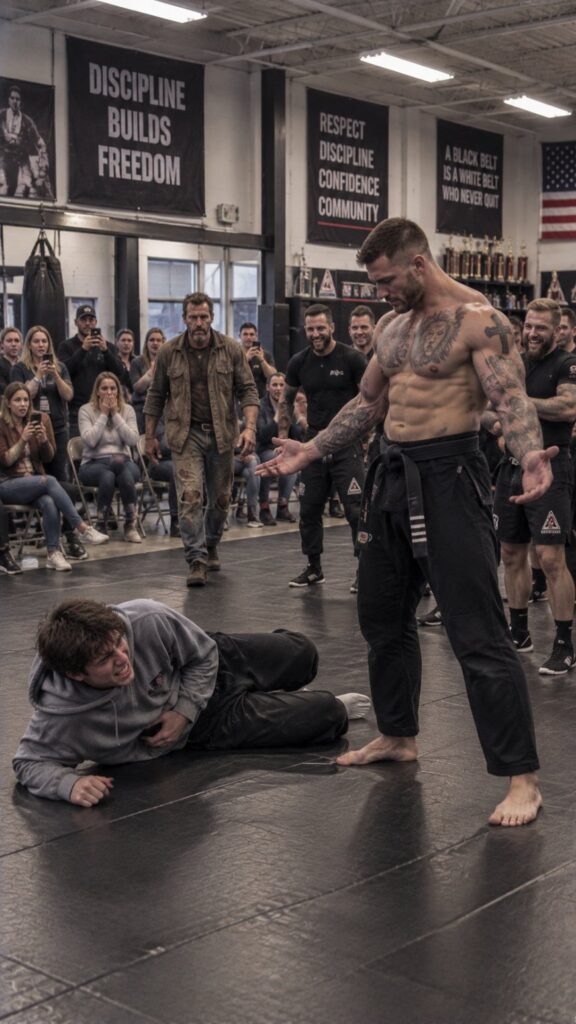
They followed him through the door. The gym was plain and clean and smelled like honest work. There were no trophies on display. No photographs. There was a framed quote on the wall near the entrance, printed in plain black text on white paper, unpretentious as a grocery list.
Noah read it as he passed, and he slowed for just a moment. I looked at it, too.
It said: “The goal is not to become someone others fear. The goal is to become someone you can trust.”
Noah didn’t say anything. He just walked on through the door after Raymond. But I saw the slight shift in my son’s shoulders. That inside-out straightening. The same one from the truck two weeks ago. And I felt something I had no precise language for — something that was larger than relief and quieter than joy.
I walked through the door behind him.
Saturday morning continued to arrive, patient and certain, the way good things always do. Not all at once, but piece by piece. Each one adding itself to the last. Until eventually you look back and can’t remember what the world felt like before them.
Raymond Okafor made coffee the way he did everything else — without ceremony, without commentary, without any of the performative busyness that people used to fill silence they weren’t comfortable with. He moved around the small back room of the gym with the economy of someone who had lived in enough austere environments to have permanently shed the habit of unnecessary motion.
Three cups. Coffee. He offered Noah a glass of water without asking, because a nineteen-year-old at 6:58 in the morning did not need coffee, and Noah accepted it with a quiet thank you that made Raymond glance at me with a look that communicated something brief and complete.
They sat at a plain table. Raymond wrapped both hands around his mug.
“So,” he said. He looked at Noah directly. “Tell me what you’re looking for.”
Noah looked back at him without flinching. “I want to learn how to not feel small when someone is trying to make me feel small.”
A pause. Raymond nodded once. “That’s the most honest answer I’ve gotten from a student in probably three years.”
“My dad says honest answers are faster.”
“Your dad’s right.” Raymond glanced at me. “Most kids come in here and tell me they want to be strong, or they want to fight. And that’s fine. That’s the surface of it. But underneath, it’s always the same thing you just said. They want to stop feeling small.” He looked back at Noah. “You already understand what you actually want. That puts you ahead.”
“Ahead of what?”
“Ahead of where most people are when they walk through that door.” He took a sip of coffee. “I had a student two years ago. Fourteen years old. Came in with his arms crossed and his chin up and told me he wanted to be the best fighter in San Diego. I asked him why. He said because nobody would mess with him anymore. I asked him who was messing with him. He wouldn’t answer.”
Raymond set his mug down. “We spent four months just on that question before we ever threw a punch. By the time we got to the actual training, he was a different person. Not harder. Clearer.”
Noah was watching him with that total, unblinking attention. “Did he get good?”
“He got excellent. He competed last spring. Won three or four matches.” Raymond paused. “But the win he cared about most didn’t happen on a mat.”
“What happened?”
“His father came to watch him train one Saturday. The man had never come before. Never showed up. Not once in four months. And when he walked in the door, this kid who’d been terrified of his father’s opinion his entire life — he just kept training. He didn’t stop. Didn’t look over. Didn’t perform. He just kept doing the work.”
Raymond’s voice was steady and direct. “Afterward, his father said, ‘You’ve changed.’ And the kid said, ‘No. I can just see myself clearly now.’ That was the win.”
The room was quiet for a moment. Noah said quietly, “I want that.”
“Then let’s build it,” Raymond said. He stood up. “Come on. I’ll show you around before the others get here.”
He led them out of the back room and into the main gym space. And the first thing I noticed was what wasn’t there. No trophies on shelves. No photographs of victories. No championship banners. The walls held only two things: the framed quote near the entrance that Noah had read coming in, and a simple hand-lettered sign near the training area that read: “Leave better than you arrived.”
That was it.
Raymond moved them through the space with a few sentences about the structure of the program. Three sessions per week. Mixed ages in the same class, because Raymond believed younger students learned something essential from watching older ones work through difficulty, and older students learned something equally essential from being asked to explain what they knew in terms a ten-year-old could follow.
“Teaching is how you find out what you actually understand versus what you think you understand,” Raymond said. He paused near the mat area and looked at Noah. “I’m going to ask you to teach things before you feel ready to teach them. That’s by design.”
Noah frowned slightly. “What if I teach it wrong?”
“Then we correct it together, and you learn it twice as well as you would have if I just told you the first time.” He said it simply, with no drama. “There’s no such thing as a mistake in this gym. There’s only information.”





