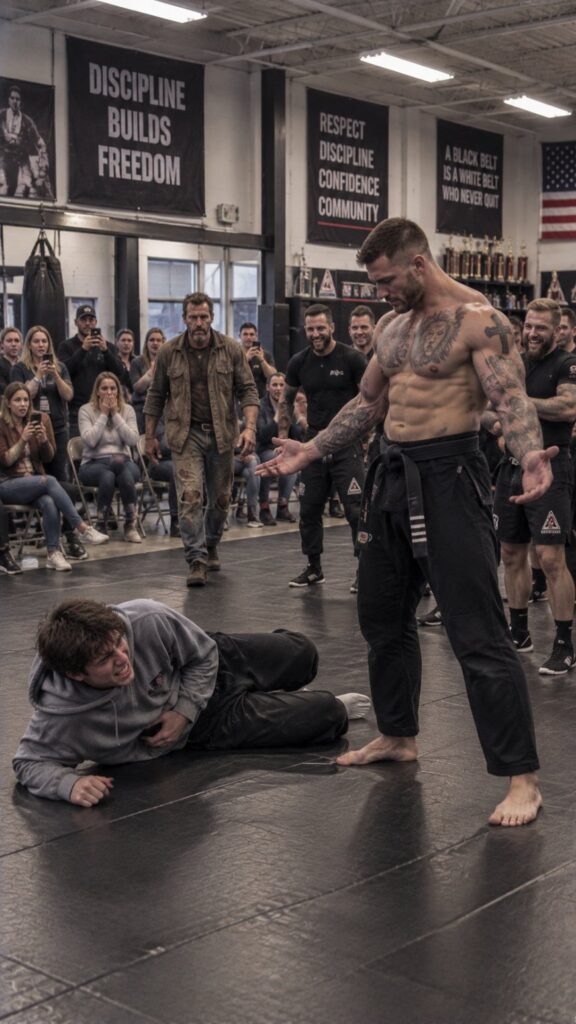
“Neither of those is the answer,” Raymond continued. “The answer is what you’re all building here. Which is the ability to stand in a room with that kind of energy and remain exactly who you are. Not unchanged — growth changes you, and growth is the point. But yourself. Your actual self. The one that exists independent of what that person needs you to be.”
He paused.
“That is harder than any technique I will ever teach you. It is also more important. And it is possible. It is entirely possible. You are doing it right now — in this room, every time you correct a movement without shame, and every time you help someone else correct theirs.”
He looked at Tyler for a moment. Not singling him out. The look moved through the whole circle. But Tyler received it and held it and didn’t look away.
“The world will try to tell you who you are before you’ve had a chance to find out for yourself,” Raymond said. “Your job is to keep finding out anyway.”
He stood. “Thursday,” he said.
And that was all.
The room began to dissolve into movement. Into bags being picked up and shoes being retrieved and the warm noise of people in the aftermath of shared effort. Sandra reached Tyler before he’d fully stood up, and he let her put her hand on his shoulder, which she took for the permission it was and did not make more of than it needed to be.
Noah found me at the edge of the mat.
“He laughed,” Noah said.
“I saw.”
“Khloe made him laugh.” Noah’s expression was something between amazement and affection. “She’s eight and a half.”
“Eight and a half,” I confirmed.
Noah looked around the room. At Daniel Hong, stretching with the focused economy of a serious athlete. At Priya, who had arrived midway through the session after Diane had apparently gotten Raymond’s number through Clare Ashford within forty-eight hours of me putting the idea in motion, and who had spent the last half of the session working combinations with Raymond, watching him acknowledge each one specifically, precisely, correctly — in a way that had made the girl stand differently with every acknowledgement. Taller. Clearer. More solidly present in her own right to occupy space. At Khloe, who was now explaining something to Tyler with both hands moving, Tyler’s face fully open in a way it hadn’t been when he arrived. At Raymond, speaking quietly to Sandra near the doorway, his posture calm and direct. No performance. Just presence.
Noah was quiet for a moment.
“It’s different now,” he said. “For the ones in this room.”
“Yes.”
“And the ones who come next.”
Noah paused. “Because this is here now. And they’ll come here instead of there.”
I looked at my son steadily. “Yes.”
Noah nodded. The nodding of someone integrating something large and real and not entirely comfortable, but entirely necessary.
“Okay,” he said.
“Okay.”
They drove home the long way, because Noah asked for it, and I had no reason to say no. The long way took them through Mission Hills proper, through the older neighborhoods with the tall trees and the houses that had been there long enough to look like they meant it. Through the Saturday morning that was now fully open and warm and specific in the way that days are specific when they’ve contained something that matters.
Noah was looking out the window.
“What are you thinking?” I asked.
“About what Raymond said. About remaining yourself.” He paused. “I was trying to remember who I was before Titan. Before Marcus. What I was like.” He paused again. “And I couldn’t clearly separate it. Like I couldn’t find the exact line between before and after.”
I looked at the road. “What does that tell you?”
“I’m not sure. Maybe that it changed me more than I thought.” He paused. “Or maybe that the before and after aren’t the right way to think about it. Maybe it’s not before and after. Maybe it’s more like— added to.” He worked on it. “Like I’m not less than I was before Marcus. But I know something now that I didn’t know before. About how it feels when someone tries to rewrite you. And knowing that— even though how I learned it was bad, the knowing itself isn’t bad.”
I kept my eyes on the road. Kept my hands steady on the wheel. Kept my face doing what my face always did in moments like this. Quiet. Present. Completely there without requiring anything from the moment except to let it be what it was.
“That,” I said, “is exactly right.”
Noah looked over at me. “You think so?”
“I don’t say things I don’t mean.”
“I know.” A pause. “It’s kind of annoying sometimes.”
“I know.”
Noah almost smiled. “But useful. Occasionally.”
They drove. The city moved around them. The morning was full of the ordinary world. Other cars. Other families. Other Saturdays happening in their own directions. And somewhere in that ordinary world, a twelve-year-old named Tyler was going home, having laughed for the first time in months. And a girl named Priya was going home, having finally been seen clearly by someone whose opinion of her ability was accurate and worth receiving. And a man named Raymond was going to spend Monday morning figuring out how to expand a Saturday session that had outgrown its current configuration. And a man named Marcus was probably writing a thirteenth draft of something that the twelfth had started to get right.
And a nineteen-year-old young man named Noah Walker was going home from a Saturday morning with his father, wearing his oversized hoodie, looking out the window at the city he’d grown up in, carrying something new in the architecture of who he was. Not the weight of what had been done to him. But the weight of what he now knew he was capable of.





