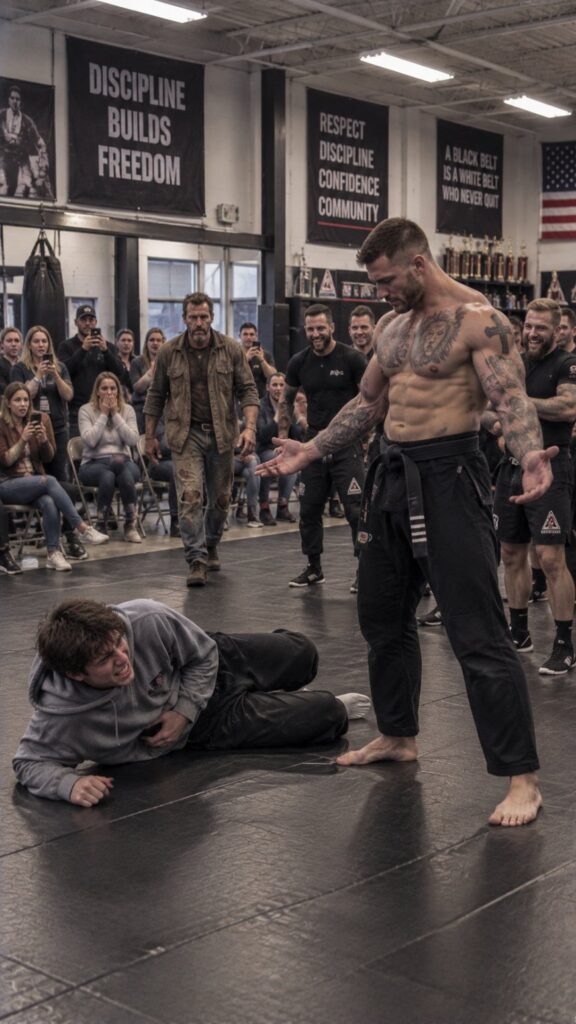
I had not been aware I was doing that. I moved my hand. “I’m fine, Dad. Bruised at most. I’ve had worse from furniture.”
Noah made a sound that was halfway to a laugh. “From furniture?”
“Your grandmother’s dining table. 2009. I was carrying it up a staircase alone because I was twenty-two and stupid.”
This time, Noah actually laughed. Brief and genuine. The kind of laugh that surprised you. It released something in the atmosphere between us. The tension of the last hour giving way at the seams.
Across the gym, Marcus had found a chair and was sitting in it with his elbows on his knees and his face in his hands. His two teenage students were beside him, unsure what their role was, unsure what the script for this moment required. Neither of them seemed to be finding anything useful to say. One of them kept glancing over at me, then away, then back again.
The nurse was speaking quietly to Marcus. I couldn’t hear what she was saying, but her posture was professional and kind. The posture of someone who separated their job from their opinion about the patient, which was the right way to do it.
Diane appeared at my elbow. She was carrying her daughter Priya’s equipment bag over one shoulder, which meant they were also leaving, which I noted without comment.
“I want to say something,” Diane said, “and I’m going to try to say it without making it weird.”
I waited.
“My daughter has been coming here for fourteen months,” she said. “She’s genuinely good. Her combinations—” She stopped. Restarted. “He never acknowledged her. Not once. And I let it go because I thought— I thought maybe that was just his style. Maybe the not-praising was the point. Maybe it made her tougher.”
She looked across the room at Marcus. “And then I watched you on that mat tonight, and I thought: that’s what actual toughness looks like. And it doesn’t look anything like what he’s been selling.”
I didn’t say anything. I wasn’t sure a response was required.
Diane shifted the bag on her shoulder. “Thank you for staying. For not walking out when he said those things.” She looked at Noah. “Your dad is a remarkable man.”
Noah looked at me with a small, complicated expression. “Yeah,” he said. “He’s okay.”
I kept a straight face. “Deeply appreciated.”
Diane almost smiled. Then she was gone, guiding Priya toward the exit, and the space they’d occupied filled again with the ambient sound of the gym processing its own aftermath.
Noah was still looking at me. “She called you remarkable.”
“She did.”
“Do you feel remarkable?”
I stood up, picked up my jacket from my son’s lap, and shrugged it on. My left side protested. I kept my face neutral. “I feel like a man who is going to put ice on his ribs and then make spaghetti for dinner.”
“We don’t have spaghetti.”
“Then I’ll feel like a man who makes a grocery list.”
Noah stood too, pulling his equipment bag over his shoulder. We moved toward the exit together — the way we always moved, me half a step ahead, not controlling, just positioned, present at the door.
I paused. I looked back.
Marcus had lifted his face from his hands. He was looking across the gym, and his eyes found mine at the door. And the two of us held that contact for a moment that had no performance in it from either direction. No anger. No triumph. No accusation. Just two men at the end of something, on opposite sides of a lesson that only one of them had needed to learn tonight.
I held the door open for my son. We walked out into the evening air of San Diego, and the door closed behind us.
Inside the gym, Marcus Vain sat in his chair and stared at the mat where he’d been very certain, not twenty minutes ago, that he was the most dangerous person in the room.
He sat there for a long time after most of the lights went off.
Outside, Noah looked up at the sky and said, “Spaghetti would actually be really good right now.”
“We’ll find something.”
We crossed the parking lot together. Our footsteps made the same sound on the asphalt — father’s heavier, son’s quicker. The evening was cool and clean, and the kind of ordinary that felt significant after something extraordinary. The way ordinary always felt in the immediate aftermath of moments that changed the shape of things.
Noah stopped at the passenger door of the truck. “Dad?”
“Yeah.”
“That girl. Priya. The fast one. What about her? She should get a better instructor.” He said it simply, with the plain conviction of someone stating a fact that was obvious enough to require no argument. “She’s good. She deserves someone who actually sees that.”
I looked at my son over the roof of the truck. “You’re right,” I said. “She does.”
We got in. I started the engine. I could feel the bruise on my left side sharpening now that the adrenaline had finished metabolizing. Not serious. I’d cataloged the impact correctly when it happened, and my assessment hadn’t changed. But real enough to require ice and probably a couple of days of patience.
I backed out of the parking space. Noah was already on his phone, presumably checking something with the focus of a young man who had moved on from the emotional weight of the evening with a speed that I occasionally envied. Processing velocity. Noah had always had it.
But after a minute, he put the phone down. And then he said quietly, not looking up from his lap:
“I didn’t cry, Dad.”
I looked straight ahead at the road. “I know.”
“Even when I hit the mat. Even when it was hard to breathe. I didn’t cry.”
“I know, son.”
“He said I did. But I didn’t.”





