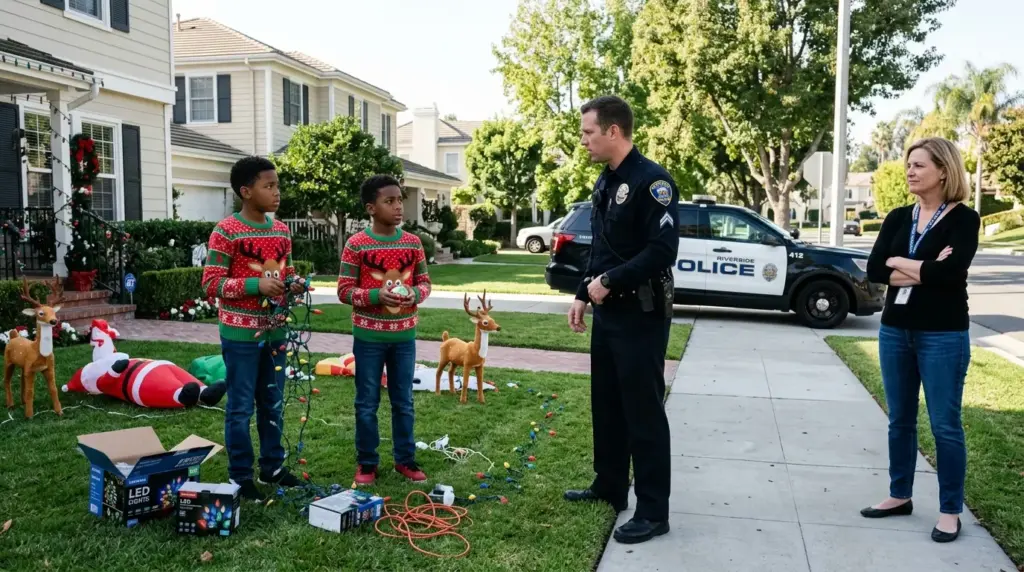
“I need to report a theft in progress.” Patricia’s voice is calm, controlled. She’s done this before. “Two Black juveniles are stealing Christmas decorations from a residence on Riverside Oaks Drive.”
“Can you describe what you’re seeing, ma’am?”
“Two boys, maybe 12 or 13 years old. They’re taking items from the front yard: lights, decorations. They’ve been there for thirty minutes. They’re being very bold about it, just loading everything up.”
“Are they putting items into a vehicle?”
“No, they’re just rummaging through everything. I think they’re scouting the house, seeing what they can take. This is a very nice neighborhood. We’ve had problems with break-ins.”
The lie comes easy. There haven’t been any break-ins.
“What’s the address?”
Patricia gives the address—her own neighbor’s house. She’s reporting activity at Tanya Davis’s home, a home she’s walked past a hundred times, a home with a welcome mat and a mailbox that says Davis Family in neat letters.
“And you’re certain these juveniles don’t live there?”
“Absolutely certain. I know every family on this street. These boys don’t belong here. This neighborhood doesn’t have those types of families.”
The dispatcher pauses, just for a second. “Officers are en route.”
Patricia hangs up, walks to her front door, opens it, steps onto her porch. She wants to watch this.
Three minutes and twenty seconds later, a squad car turns onto Riverside Oaks Drive. Lights off, no siren, just the low rumble of the engine.
Officer Brandon Hayes steps out. He’s 34, nine years on the force. He sees two Black kids with their hands full of Christmas lights and decorations. He sees exactly what Patricia wanted him to see.
“Hey! You two! Come here!”
Jordan looks up, confused. “Us?”
“Yeah, you! Come here! Now!”
Jordan and Julian walk toward the officer, slow, careful. They’ve never been in trouble; they don’t know what they did wrong.
“What are you doing here?” Hayes asks.
“We’re decorating,” Jordan says. “For Christmas.”
“Decorating what?”
“Our house.” Jordan points behind him. “That’s our house.”
Hayes looks at the house, looks at the boys, doesn’t believe them. “Whose house?”
“Ours! We live here. We live at 1247 Riverside Oaks Drive.”
“You live here?” Hayes’s hand moves to his belt, rests near his radio. “Who’s your parents?”
“Our mom, Tanya Davis. She’s at work.”
“Uh-huh. You got any ID?”
Julian’s eyes go wide. “We’re ten!”
“Then how do I know you’re telling the truth?”
“We can show you inside,” Jordan offers, his voice shaking a little. “We can show you our room.”
“Stay right there. Don’t move.”
Hayes walks toward his patrol car, reaches for his radio.
That’s when Patricia Brennan steps off her porch, crosses her lawn, stands on the sidewalk with her arms crossed—watching, waiting. She wants to see this.
That’s when Tanya’s car turns onto Riverside Oaks Drive.
She sees the squad car first, then she sees her sons standing on their own lawn, hands visible, a police officer ten feet away. She sees Patricia Brennan on the sidewalk, smiling.
Tanya’s foot hits the brake. The car jerks to a stop in her driveway. Tanya steps out of her car. She doesn’t run, doesn’t shout. She walks across her lawn with the same calm she uses in county board meetings, but her heart is hammering.
“Officer?” Her voice is steady, professional. “Is there a problem?”
Hayes turns, looks at her. “Ma’am, do you live here?”
“I do. This is my home. These are my sons. What’s the issue?”
“We received a call about suspicious activity involving—”
Hayes stops mid-sentence. His face changes. “Wait… are you County Administrator Davis?”
“I am.”
The air shifts. Hayes straightens. His hand moves away from his belt. “Ma’am, we were responding to a report. Someone called about possible theft.”
“Theft?” Tanya looks at her sons, looks at the Christmas lights in their hands, looks back at Hayes. “My 10-year-old sons decorating our front yard for Christmas is theft?”
“The caller reported—”
“Who called?”
“I can’t disclose that information.”
Tanya’s eyes move past him to Patricia Brennan, still standing on the sidewalk, still watching. The smile is gone now, but she doesn’t move, doesn’t go back inside.
“I see,” Tanya says. “Are my sons being detained?”
“No, ma’am.”
“Are they suspected of any crime?”
“No, ma’am.”
“Then we’re done here.”
Hayes gets back in his car, drives away. Patricia finally walks back to her house. She doesn’t look at Tanya, doesn’t apologize, just closes her door.
Tanya kneels down, puts her hands on her sons’ shoulders. “Are you two okay?”
Jordan nods, but his hands shake. Julian just stares at the Christmas lights scattered on the ground.
Sunday morning brings the doorbell footage.
The Carters live next door. Their Ring camera captures the edge of Tanya’s front yard. David Carter checks it after his wife mentioned seeing police cars yesterday.
The timestamp tells the whole story:
-
2:45 p.m.: Jordan and Julian walk out their front door with decorations.
-
3:15 p.m., thirty minutes later: a squad car arrives.
David downloads the clip, posts it to the Riverside Oaks community Facebook group with a simple caption: These kids were at their own house. Someone called the police on children decorating for Christmas.
Two hours later, the post has 200 shares. By evening, it has 2,000.
The comments come fast:
“This is disgusting.”
“They’re children at their own house.”
“Who does that?”
But not everyone agrees:
“If they didn’t do anything wrong, why worry about the police?”
“Better safe than sorry.”
“This is blown out of proportion.”
Then someone does the math, points out the timestamp gap: whoever called watched for thirty full minutes before dialing 911.
That changes the conversation:
“So someone saw them come out of the house and still called?”
“That’s not being careful; that’s being racist.”
Sunday evening, Patricia makes her move. She posts on Nextdoor:





