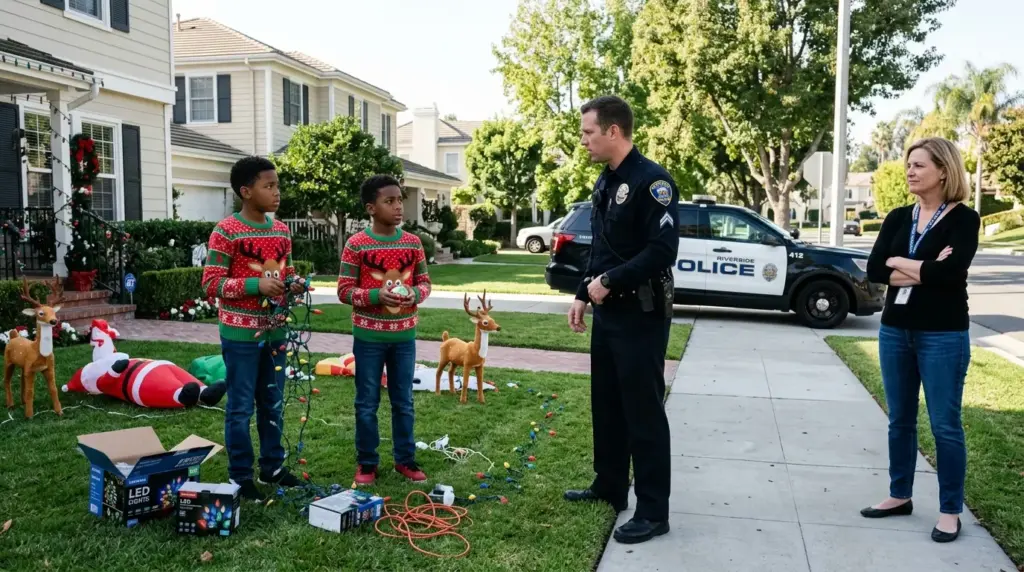
Carmen’s voice is steady on the phone: “I got the body cam footage. Full recording. Hayes talked to Patricia before approaching the kids. You need to hear what she said.”
“Send it to me,” Tanya says.
“I will. But there’s something else: I filed a request for your original footage request, the one you submitted as county administrator. They told you about a technical issue, that footage wasn’t available. They lied. The request log shows your submission was received, logged, assigned, then marked fulfilled with a note about technical limitations. But the footage exists. I got it through the Tribune’s separate request. Someone deliberately blocked you.”
“Who signed off?”
“Captain Morrison. Reports directly to the chief.”
Tanya sits in her dark kitchen processing this: the department she oversees, the budget she approves, they deliberately denied her request for footage involving her own children.
Saturday morning, Jordan sits at breakfast, doesn’t eat, pushes cereal around his bowl.
“You okay?” Tanya asks.
He shrugs. “Kids at school saw the videos, asked me about it.”
“What did you say?”
“I said it was a misunderstanding. But it wasn’t.” He looks up, eyes wet. “That lady watched us for thirty minutes, saw us come out of our house. She called anyway. That’s not a misunderstanding; that’s on purpose.”
Tanya has no counter. He’s right.
Julian appears in the doorway, still in pajamas, 10:00 a.m. Normally, he’s up by 7:00; now, he just stays in bed.
“Baby, you need to eat something,” Tanya says.
“I’m not hungry.”
“You didn’t eat dinner last night, either.”
“I said I’m not hungry!” His voice cracks. He turns, goes back to his room, the door closes.
Tanya follows, knocks. “Julian, can I come in?”
No answer. She opens anyway. Julian is curled up on his bed, face to the wall. She sits on the edge, hand on his shoulder. “Talk to me.”
“I don’t want to go outside anymore.”
“It’s okay to go outside. It’s your yard.”
“But people are watching! What if she calls again? What if next time they don’t believe you? What if they take us away?”
“Nobody’s taking you away.”
“You don’t know that!” He rolls over, looks at her—10 years old with eyes that hold too much fear. “You’re important. You have a big job. They still didn’t believe you. If they don’t believe you, they won’t believe us.”
Then he asks about it—the question that breaks her completely: “Mom, can I be white? If I was white, she would have believed me. The police would have believed me. I hate being Black. I hate that people look at me and think I’m bad.”
Tanya pulls him close, feels his body shaking. He’s crying, really crying—the kind that comes from somewhere deep and broken.
“I’m sorry,” she whispers. “I’m so sorry. It’s not your fault.”
But it feels like it is.
Later that afternoon, she stands in the garage: boxes of Christmas decorations half-used, abandoned, inflatable Santa still in packaging, extension cords tangled. She thinks about her own childhood, growing up three miles south—different neighborhood, different world: followed in stores, her brother stopped by police walking home from school, her mother’s face explaining why people saw them differently. She worked her entire life so her sons wouldn’t need those conversations, so they could just be kids.
She failed.
Her phone rings: Carmen. “Did you listen to the body cam audio?”
“Not yet.”
“Listen to it. Then call me back. What Patricia said on that tape, Tanya… it’s worse than we thought. But it’s also exactly what we need.”
Sunday morning, Carmen publishes the body cam transcript. The article includes timestamps, full quotes, and context for every exchange.
The key moment comes at minute two: Hayes arrives, gets out of his car; Patricia approaches before he even reaches the boys.
“Thank you for coming so fast,” Patricia says, her voice clear on the recording. “Those two have been here for over thirty minutes. I watched them come out, but I wanted to make sure you could catch them in the act.”
“You saw them exit the residence?” Hayes asks.
“Yes, but they don’t live there. I know everyone on this street.”
“How do you know they don’t live there?”
Patricia pauses, just for a second: “Because the family that lives there doesn’t have children who look like that.”
Hayes doesn’t challenge this, doesn’t ask what she means, just nods, walks toward Jordan and Julian.
The transcript goes viral in minutes:
“She admitted she saw them come out of the house.”
“She watched for thirty minutes and called anyway.”
“This is premeditated harassment.”
By noon, the comment sections explode. But something different happens: people start sharing their own stories:
“This happened to my son in our neighborhood. He was seven.”
“My daughter was questioned for playing in our own yard. The police didn’t believe her.”
“We moved out of a neighborhood because one woman called the police on us five times in three months.”
Carmen sees the pattern, posts a request: “If you’ve experienced similar incidents in Riverside County or surrounding areas, please contact me. Your story matters.”
Within forty-eight hours, thirty-one families reach out. Carmen verifies each one, asks for documentation: police reports, HOA complaints, emails, text messages, anything with dates and details. Twenty-three provide documentation; eight more have witnesses willing to confirm. Carmen builds a database, creates a timeline, maps the incidents geographically.
The pattern is undeniable. Not all involve Patricia, but they all involve the same dynamic: white residents calling police on Black and brown families for normal activities—playing in yards, walking dogs, having barbecues, existing.
Monday morning, Diane Foster calls Tanya. Diane is president of the Riverside County NAACP chapter, 52 years old, a retired teacher. She’s been tracking these incidents for years.
“We want to help,” Diane says. “Legal support, documentation, whatever you need.”
Tanya hesitates. She’s been handling this quietly, professionally; going public feels different.





