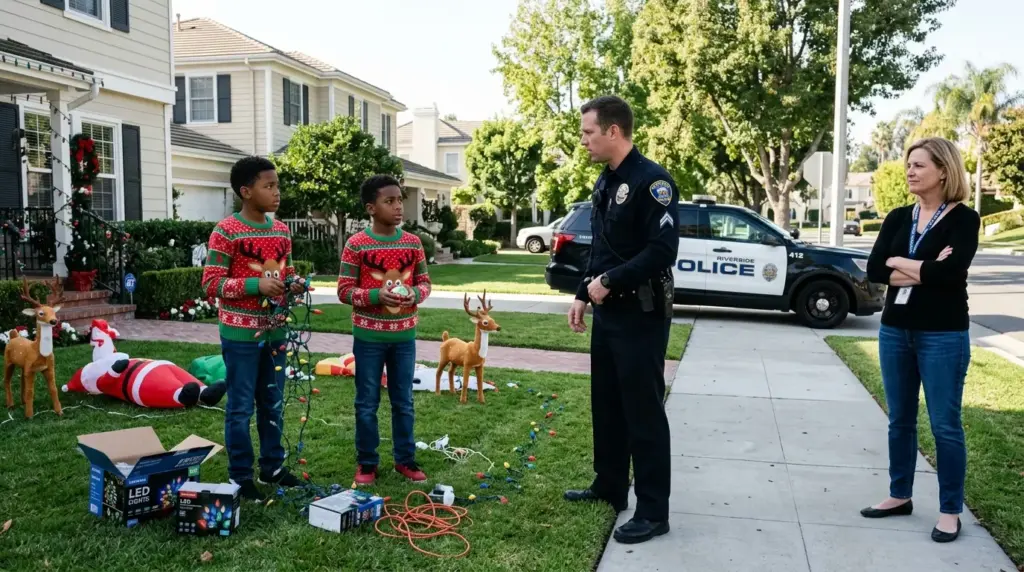
The police union responds within two hours: “Officer Hayes has served with distinction for nine years. These allegations are cherry-picked and taken out of context. We will not allow good officers to be crucified by the media for political purposes.” They don’t address the pattern; they don’t explain why all seven involve children of color.
Monday evening, Carmen publishes the HVAC incident. She obtained the 911 recording from 2020. Patricia’s voice is clear, confident: “There’s a Latino man trying to break into my neighbor’s house using tools, trying to pry open a window. I need someone now.”
Officers respond in 2.8 minutes—lights and sirens, high priority. They find Marco Gutierrez installing an air-conditioning unit. He has a work order, company identification, and a truck with Precision HVAC painted on the side parked in the driveway. The homeowner confirms she hired him, told neighbors, including Patricia, someone would be working.
Patricia claims she forgot, apologizes to officers—not to Marco. Marco quit two weeks later, told his supervisor he didn’t feel safe in that neighborhood; the company stopped taking jobs in Riverside Oaks.
Carmen finds Marco, interviews him: “I was doing my job. Had my work order. Had my company shirt on. She looked at me and decided I was a criminal because of how I look.”
Tuesday brings the financial connection: Patricia’s husband, Gerald Brennan, owns a property management company. He sits on the board of Concerned Citizens for Law Enforcement, a political action committee funding police union activities. Federal records show Gerald donated $22,000 over two years. The PAC funds campaigns, endorsements, and attack ads against reform candidates.
The same union that protected Hayes seven times receives funding from Patricia’s household. When Hayes faces discipline, the union decides whether to grieve; Gerald has influence there. The circle of protection becomes visible.
Wednesday, Carmen finds the lawsuit: civil court records from 2021, filed in March, dismissed in July with a confidential settlement. The plaintiffs were the Washington family, a Black family who lived two houses from Patricia. They moved in January 2021; by March, they were suing for harassment.
The complaint detailed Patricia’s behavior: weekly HOA violations filed against them, photos taken of their property, their children, their cars, notes left on their door, police called for “noise,” “parties,” and “music gatherings.” The Washingtons proved every complaint was false or selectively applied; white neighbors had identical issues with no complaints filed. Patricia targeted them exclusively.
Case settled; terms confidential. The Washingtons moved out in August 2021, six months after arriving.
Carmen contacts them. Mrs. Washington talks in the background; the settlement has non-disclosure terms, but she confirms the story: “We wanted to raise our kids in a nice neighborhood. She made it hell. Every day, something new. We left for our mental health.”
By Wednesday evening, Carmen has published seven articles in five days, each backed by documents, recordings, court filings, and data. She’s not editorializing, just presenting facts. The pattern speaks for itself:
-
12 911 calls over seven years, 100% targeting people of color.
-
Seven sustained complaints against Hayes, all involving minority children.
-
$22,000 in political donations to the union protecting him.
-
One harassment lawsuit.
-
Response-time disparities across racial lines.
It’s not one bad call anymore; it’s a system, a pattern, a machine that criminalizes Black and brown people while protecting those who do it.
Tanya Davis still hasn’t made a public statement, but Wednesday night she sends Carmen an email. Subject line: Thank you. The message is brief: “Your work matters. Please keep going.”
Carmen replies: “I’m not done yet.”





