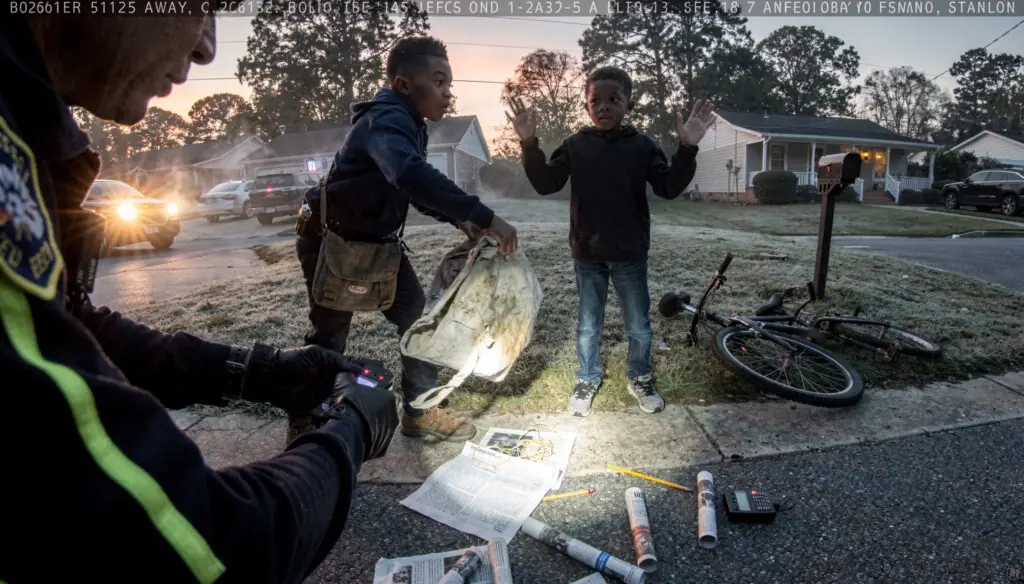
And Micah knew with the instinct of a boy raised by a man whose entire life was built on observation and consequence that the folder on his laptop was about to become something more than a private record. Wendell woke at 5:15 p.m. He showered, changed into a clean shirt from his bag, and found Micah in the kitchen doing homework. He sat down across from him.
He did not say, “I missed you.” He did not say, “How have you been?” He looked at the boy’s face at the small scab behind his right ear, at the way Micah’s left hand held his pencil with a pressure that was slightly too tight for someone doing math problems.
“Tell me,” Micah told him. Not everything. not the feelings, the facts, dates, tame’s badge numbers, what was said, what was done. He recounted each stop in order, starting with the first one in October, 8 months ago, and ending with this morning. He described Tull.
He described Briggs. He described the way the flashlight felt in his eyes and the way the satchel strap had caught his ear. He described the voice recorder and the files on his laptop. Wendell listened without interrupting.
His face did not change. His breathing did not change. His hands stayed flat on the table, palms down. The way they stayed when he was in a room where listening was the most important thing he could do and any visible reaction would interfere with the person speaking.
When Micah finished, Wendell was quiet for a long time. Then he said, “Show me the files.” Micah brought the laptop. Wendell put on his reading glasses. He opened the folder.
He played each recording. He listened to all seven. He noted the dates. He noted the badge numbers.
He noted the language, the tone, the escalation pattern, the absence of reasonable suspicion in every single stop. He closed the laptop. You did everything right, he said. Every single time.
Micah looked at the table. It didn’t stop them. No. Wendell took off his glasses.
He folded them the same way Micah folded them. Arms crossed, lenses up. It wasn’t supposed to stop them. It was supposed to build a record and it did.
He did not tell Micah what he was going to do with that record. He did not mention the credential case in his carry-on bag. He did not explain that the pattern Micah had documented, seven stops of the same black minor on the same route over 8 months with zero articulable suspicion was not just a personal grievance. It was evidence.
The kind of evidence that in the right hands could initiate a federal inquiry. Instead, he said, “Tomorrow morning, I’m driving you on your route.” The next morning, Thursday, Wendell drove Micah to the Collier Ridge entrance at 5:20 a.m. He parked the black sedan on the street outside the pedestrian gate and waited while Micah did his deliveries. He did not enter the subdivision. He sat in the car with the windows down and watched.
At 5:44 a.m., a white Lexus SUV pulled out of the Collier Ridge entrance and stopped beside Wendell’s sedan. The driver’s window lowered. Naen Ashford looked across at him with an expression that managed to combine curiosity, suspicion, and territorial authority into a single glance. Can I help you?
I’m waiting for my nephew. He’s delivering newspapers. Ashford’s eyes moved from Wendell’s face to the sedan’s plates to the sedan itself. cataloging details the way she cataloged everything quickly, reflexively, and with the specific attention of a woman who believed that anything unfamiliar in her perimeter was a potential threat until proven otherwise. The newspaper boy, his name is Micah.
“I’m aware of his name. I’m also aware that his route takes him through private property before dawn, and several residents have expressed concerns.” The pedestrian gate is unlocked. The road is contracted through the register. He has a delivery manifest with every address listed.
Ashford smiled. It was the kind of smile that had nothing to do with warmth. I’m not questioning his employment. I’m noting that community members have a right to feel safe in their own neighborhood.
And an unfamiliar vehicle parked outside our entrance at 5 in the morning doesn’t exactly put people at ease. Wendell looked at her. His expression did not change. His voice did not rise.
I understand your concern, ma’am. I’ll be here every morning until I’m confident my nephew can complete his route without being stopped by a police. The smile held, but the eyes shifted. Ashford studied him for two more seconds, then raised her window and drove away.
Wendell wrote down her license plate number. He entered it into a note on his phone along with the date, the time, and a transcription of what she had said. He saved the note in a folder labeled with a string of letters and numbers that did not look like any filing system a civilian would use. At 5:58 a.m. Micah returned to the car.
His satchel was empty. His route was done. Anyone bother you? No.
Good. Wendell pulled away from the curb. Same thing tomorrow. But tomorrow was different.
At 6:02 a.m. on Friday, Tull’s patrol car was parked inside the Collier Ridge subdivision, idling at the corner of Windham Lane in Birfield Court. He was not responding to a call. There was no dispatch record for his presence. He was sitting, engine running, watching the pedestrian gate.
Micah entered at 5:21 a.m. Tull did not move. Micah delivered his first eight papers. Tull watched. Micah reached house number nine, the house directly across from Tull’s cruiser, and placed the paper on the doorstep.
Hold up. Tull’s voice came from the open car window. He did not get out. He did not activate his lights.





