“I’ve prepared a detailed filing, seven incidents documented over eight months. I’m requesting that the complaint be forwarded to your precinct commander and to the Internal Affairs Division for review.” Annayia opened the envelope. She read the first page. She read the second page.
By the third page, she had stopped scanning and was reading every word. She looked up. I’ll make sure this reaches Captain Granger. I’d appreciate a receipt confirming delivery.
Annayia paused. Civilians did not ask for receipts. Civilians filled out the one-page form, left it at the window, and went home. I can note your name and the date.
That would be fine. The name is Wendell Ka. K A I N E. She wrote it down.
She filed the envelope. She gave him a copy of the intake stamp. Wendell walked out. Captain Niles Granger received the complaint at 10:40 a.m. He read it in his office with the door closed.
He read all seven pages. He noted the statutory citations. He noted the formatting. He noted that the complaint named Sergeant Barrett Tull by badge number in six of the seven incidents and officer Colton Briggs by badge number and two.
He put the complaint in his desk drawer. He did not forward it to internal affairs. He did not call Wendell Kaine. He called Tull.
Barrett, you’ve been stopping a newspaper kid in Collier Ridge. Yes, sir. Resident complaints. I’ve been monitoring the situation.
The kid’s uncle filed a complaint. Seven stops documented. He cited statute numbers. A pause.
What kind of civilian cites statute numbers? The kind that’s going to be a problem. Back off the route. I’ll talk to the HOA chair I chair about the 911 calls.
Copy. Granger hung up. He believed in the way that institutional men believe things that protect the institution that this was handled. A complaint had been received.
An adjustment had been made. The uncle was thorough but ultimately civilian. And civilians, no matter how detailed their paperwork, operated within a system that was designed to absorb complaints the way sand absorbs water. It passes through.
It disappears. The surface dries. Nothing changes. But Wendell Kaine was not a civilian.
And the manila envelope was not a complaint. It was a calibration. The first document in a sequence that Wendell had already mapped in a notebook no one at the Collier Ridge precinct would ever see. a sequence that would eventually include body camera footage requests under the Georgia Open Records Act, OCGA February 5017, dispatch logs for every 911 call originating from Collier Ridge in the past 12 months, and a formal referral to a division of the United States Department of Justice whose letter head alone had the power to restructure an entire department. He did not tell anyone this.
He went home. He sat at the kitchen table. He opened the laptop and listened to Micah’s seventh recording. He heard Tull’s voice.
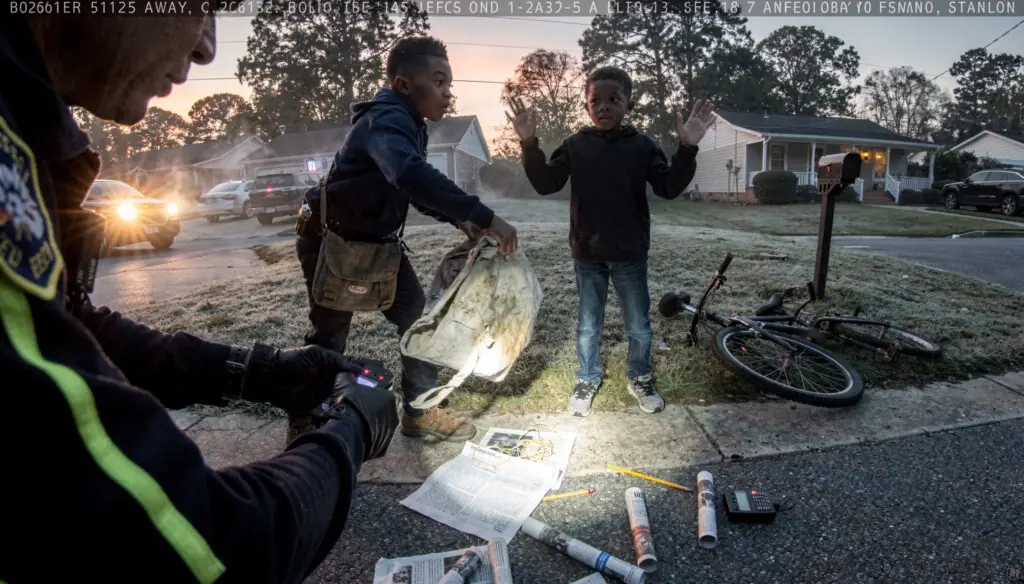
He heard the threat. He heard the 12-second pause where his nephew held his ground and did not retreat. He closed the laptop. He looked out the window at the lawn that needed cutting and the gutter that needed fixing and the street that ran north toward the subdivision where his 12-year-old nephew had been stopped seven times in 8 months for the crime of delivering newspapers while black.
He picked up his phone and made a call. The number was not local. The area code was 202. The call lasted 4 minutes and 11 seconds.
He did not raise his voice once. The call to Granger should have ended it. In a functioning system, a precinct commander receiving a detailed statute citing complaint about pattern stops of a minor would initiate a review, contact the complainant, and issue corrective guidance. That is what the manual says.
That is what the training says. That is what the policy binder on Granger’s shelf, the one with the department seal on the cover and the signatures of three successive chiefs on the first page, describes in language that is unambiguous and mandatory. None of that happened. What happened instead was this.
On the following Monday, Deputy Ross Embry, the county liaison officer assigned to the Collier Ridge precinct, accessed the incident reports associated with Micah’s stops. He opened the files on his desktop computer at 11:40 a.m. He reviewed the original language, which in each report described the encounter as a field interview, no enforcement action. He added supplemental narratives to three of the seven reports. The supplemental used language that had not appeared in any of the originals.
Subject exhibited furtive movements consistent with surveillance of residential properties. Subject was evasive when asked to identify purpose of presence. Subject was observed carrying a bag of unknown contents and declined initial requests for inspection. Embry saved the supplementals at 12:17 p.m. He did not inform Tull.
He did not inform Briggs. He did not inform Granger. He filed them under his own access credentials, which meant the modification log would show his name, his badge number, and the exact time of each edit. This would matter later.
2 days after that, Wendell filed a Georgia Open Records Act request with the Collier Ridge precinct. He requested all dispatch logs for 911 calls originating from Collier Ridge subdivision addresses in the preceding 12 months. All incident reports involving pedestrian or bicycle stops within the subdivision during the same period and all body camera footage associated with the Sergeant Barrett Tull’s patrol assignments on the dates of Micah’s documented stops. The request was typed.
It was formatted correctly. It cited the Georgia Open Records Act and the provision requiring a timely response. Corporal Annayia received the request at the front desk. She logged it, stamped it, and forwarded it to the records division.





