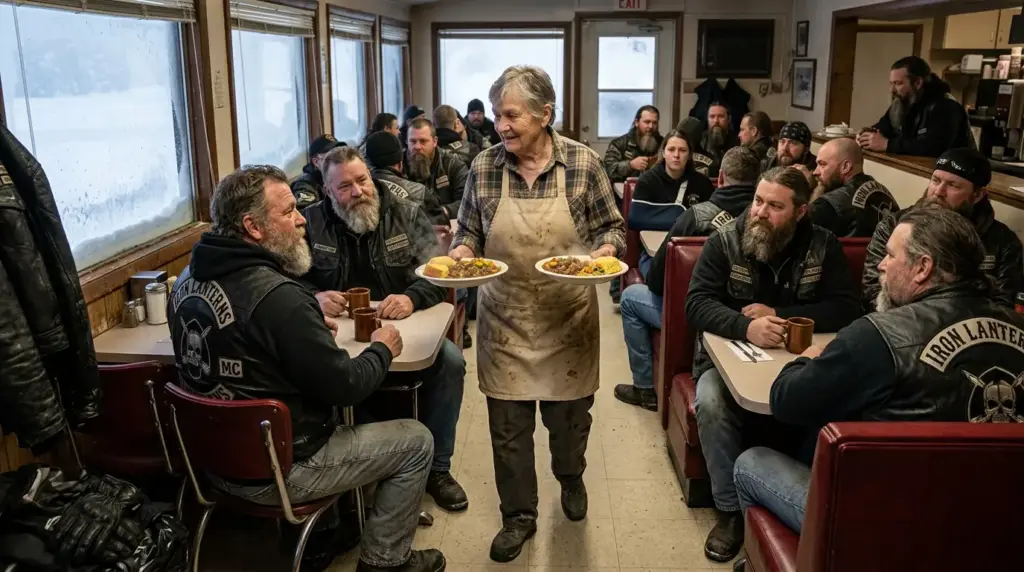
She had been turning the sign from OPEN to CLOSED when a pair of headlights vanished behind a wall of white, followed by the ugly scrape of metal on frozen pavement. A second light stopped. Then a third. Within seconds the highway outside disappeared again beneath blowing snow, as if the mountain had swallowed the riders whole.
Eleanor stood very still with one hand on the sign.
The weather service had been warning people off Elk River Pass since sunset. By ten o’clock, Highway 12 had become a narrow black ribbon between drifts, and now even that ribbon was gone. The storm had arrived faster than forecast, dumping snow sideways beneath fifty-mile-an-hour wind gusts that shook the diner’s old neon star hard enough to make it buzz against the brick.
At seventy-two, Eleanor had lived through enough Montana winters to know the difference between bad weather and a killing storm.
This one could kill.
She turned the sign back to OPEN.
The diner was empty except for her, three cooling pots on the stove, and the hum of an ancient refrigerator that had threatened to die every winter since 2009. Eleanor had sent her only waitress home before dark. Her cook had called in sick. She had stayed because staying late was what she did, even though the North Star had barely served twenty customers all day.
She was supposed to close the place for good after New Year’s.
The papers were already in the office drawer.
Thirty-eight years of coffee, stew, burned toast, truckers, hunters, deputies, runaways, newlyweds, funerals, and high-school kids had finally become heavier than her knees could carry. Eleanor had not told many people yet. She had no one to leave the diner to, and there was no point pretending otherwise.
Her husband, Frank, had been dead eleven years.
Their only son, Michael, had been gone much longer.
Thirty-one years, seven months, and four days, though Eleanor hated herself for still knowing the count.
The wind slammed something hard against the glass.
A fist.
Then another.
Eleanor crossed the dining room.
Through the door she saw a man in a black leather vest over a soaked winter jacket. Snow clung to his gray beard and eyebrows. Behind him, shapes moved in the storm—large men dragging motorcycles, one rider limping, another holding someone under the arms.
The man lifted both hands so she could see them.
“Ma’am,” he shouted through the glass. “We need help.”
Eleanor unlocked the door.
Wind exploded inside, driving snow across the tile.
“How many?” she demanded.
The man blinked. “Fourteen.”
“Anybody bleeding?”
“One bad shoulder. Maybe broken. One might have frostbite.”
“Bring them in.”
He hesitated.
Eleanor glared at him. “You want me to knit invitations first?”
That moved him.
He turned and shouted into the storm. Men began appearing from the white darkness in pairs, hauling each other and dragging helmets, saddlebags, gloves, and wet jackets inside. Their leather cuts carried the same patch: a black lantern surrounded by iron-gray wings, with IRON LANTERNS MC stitched above it.
They were intimidating men.
There was no use pretending otherwise.
Most were in their forties and fifties, broad through the shoulders, tattooed, road-worn, and built like people who had spent their lives fixing engines, fighting weather, or both. Two were younger. One was a woman with short dark hair plastered to her face, her left arm held tight against her ribs.
She was the one Eleanor noticed first.
“You,” Eleanor said. “Sit.”
The woman started to argue.
Eleanor pointed at a booth. “Sit before you fall and make me clean blood off the floor.”
The woman sat.
The gray-bearded man who had knocked came in last after helping two others roll the fallen motorcycle beneath the diner’s side awning. He pushed the door shut with both hands and leaned against it, breathing hard.
Eleanor locked it.
“Boots off if they’re soaked through. Jackets on the backs of chairs, not my grill. Bathrooms are down the hall. Coffee is still hot. Nobody touches the thermostat.”
For three seconds, fourteen bikers stared at her.
Then one of them, a giant bald man with a beard nearly to his chest, said, “Yes, ma’am.”
That broke the tension.
The riders moved.
Eleanor took the injured woman’s chin gently between two fingers.
“Name.”
“Scout.”
“Your mother name you that?”
A tiny smile appeared despite the pain. “Leah.”
“Better. Eleanor.”
She pressed around Leah’s shoulder carefully. Leah winced but did not cry out.
“Bike went down?”
“Front tire lost the road.”
“Did you hit your head?”
“No.”
“Any numbness in the fingers?”
“A little.”
“Can you move them?”
Leah flexed slowly.
Eleanor nodded. “Probably dislocated, maybe fractured. Coat off.”
The gray-bearded leader stepped closer. “You medical?”
“No.”
He raised an eyebrow.
“I ran this diner on the only plowed road through three counties for almost four decades,” Eleanor said. “You think people only break bones near hospitals?”





