Leah froze.
Eleanor pulled the letters back.
“I’m allowed to hate him before I forgive him.”
“Yes.”
“If I forgive him.”
“Yes.”
Eleanor stared at the young woman.
“You look like him.”
Leah smiled through tears. “He said I looked like you when I was angry.”
Eleanor almost smiled.
Almost.
Outside, dawn began turning the snow blue.
The county plows reached the diner shortly after seven. Deputies arrived for the students. Parents followed behind them in trucks and SUVs, crying, shouting names, wrapping children in coats and arms. Word spread quickly that the North Star Diner and a motorcycle club had found the missing bus.
By nine, local television vans were climbing the pass.
Eleanor wanted none of it.
She stood in the kitchen reading the first letter.
It was dated 1996.
Mom,
I’m alive. I know that is not enough. I know it might make things worse instead of better. I keep thinking I will come home when I have something to show you that proves I didn’t waste what you gave me. Right now I don’t. I have a motorcycle that barely runs, two shirts, and a room over a repair shop. I still make your eggs wrong. I still put too much pepper in gravy. I still hear you saying, “Low heat means low heat, Michael.” I don’t know why I can’t put this in a mailbox.
Eleanor folded the page.
Then opened the next.
1998.
Then 2001.
Then 2003.
Michael found work repairing motorcycles. He stopped drinking. He got married. His wife, Rachel, died in a car accident when Leah was four. He nearly disappeared into grief. The Iron Lanterns pulled him back.
He wrote about Leah’s first day of school.
He wrote about teaching her to ride a bicycle.
He wrote about burning gumbo because he tried to recreate Eleanor’s recipe from memory.
He wrote about driving within forty miles of the North Star once in 2007, then turning around at a gas station because he saw a newspaper with Frank’s obituary notice and believed he had lost the right to come back.
That letter made Eleanor furious.
She slammed it onto the table.
“Idiot.”
Leah, sitting quietly nearby, looked up.
“He thought Dad died hating him.”
“Your grandfather died calling his name.”
Leah’s face crumpled.
Eleanor hated herself for saying it so harshly.
But truth did not become kind because someone was dead.
“He kept Michael’s room exactly the same for twelve years,” Eleanor said more softly. “Then I finally packed it because I couldn’t breathe in there anymore.”
Leah looked toward the diner windows.
“I wish he knew.”
“So do I.”
The last letter had been written six weeks before Michael died.
Eleanor could not read it at first.
Cross left it sealed on the counter and did not pressure her.
By noon, the highway reopened fully.
The Iron Lanterns should have left.
Instead, they stayed.
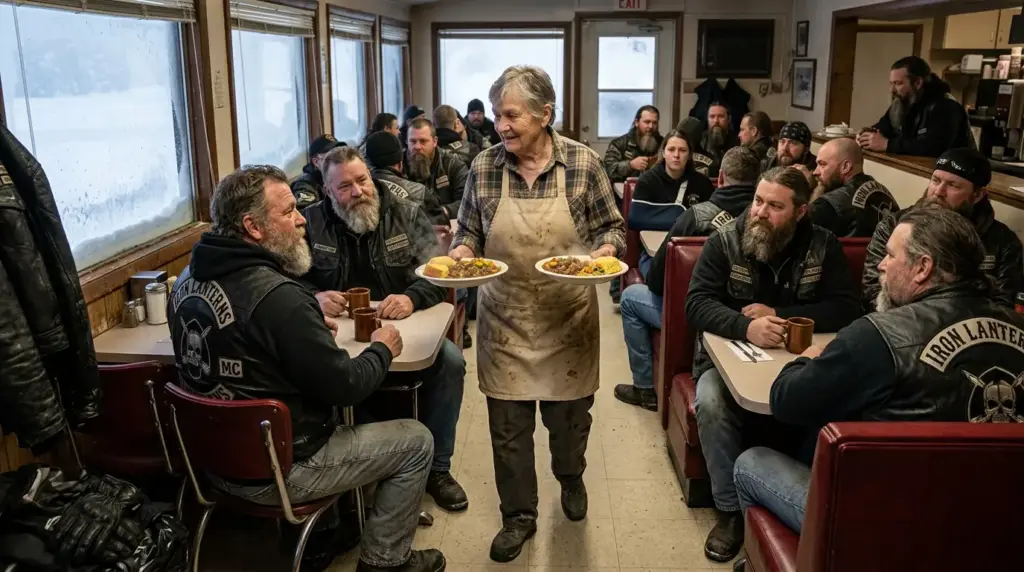
Some helped county workers tow the school bus out of the ravine. Moose repaired a broken hinge on the diner’s rear door. Benny replaced the generator’s fuel line with a spare he somehow had in his saddlebag. Cross sat in booth seven drinking coffee and saying almost nothing.
Leah stayed near Eleanor without following her.
That mattered.
At two in the afternoon, Eleanor finally opened Michael’s last letter.
Mom,
I don’t know if this will reach you because I’ve spent most of my life proving I can write letters without mailing them. Leah says that’s the stupidest talent a man can have. She’s right.
I’m sick. Worse than I’ve told the club. Doctors say months, maybe less. I finally told Cross my name. I finally told Leah about you. She is furious with me for keeping you from her. She should be.
I need you to know something that I was too proud and too ashamed to understand when I was young. Dad was angry at me for what I did. I was angrier at myself. I spent years turning his words into permission to stay gone because coming home meant admitting I was wrong. The truth is I was afraid you would open the door.
That probably sounds backward.
But if you had slammed it in my face, I could have hated you and kept living the way I was. If you opened it, I would have had to feel everything I had done to you.
I was more afraid of your love than your anger.
I’m sorry.
I built a life. Some of it was good. Leah is the best thing I ever did, though she deserves credit for most of it herself. The Iron Lanterns became my brothers. We started a winter roadside program because I told them about the light you and Dad kept on at the diner during storms. I never told them where the idea came from. That was cowardice too.
Every December for twenty years, we’ve carried blankets, fuel, food, and first-aid gear on winter routes for stranded drivers. The club rule is simple: if the light is on, nobody stays in the cold.
You taught me that.
You taught all of us that without knowing.
If the North Star still exists, I want to go home one last time.
I won’t ask you to forgive me.
Just let them bring me back to the place where I first learned what home was.