Cross followed anyway.
They found Owen four hundred yards away near the frozen creek shelf, curled against a stump with one shoe missing.
He was conscious but confused.
Eleanor slapped his cheek lightly.
“You picked a terrible night for a walk.”
The boy began crying.
“My phone wouldn’t work.”
“Neither does mine. Yet somehow I stayed indoors.”
Cross knelt and wrapped the boy in his own outer jacket.
Moose carried him back.
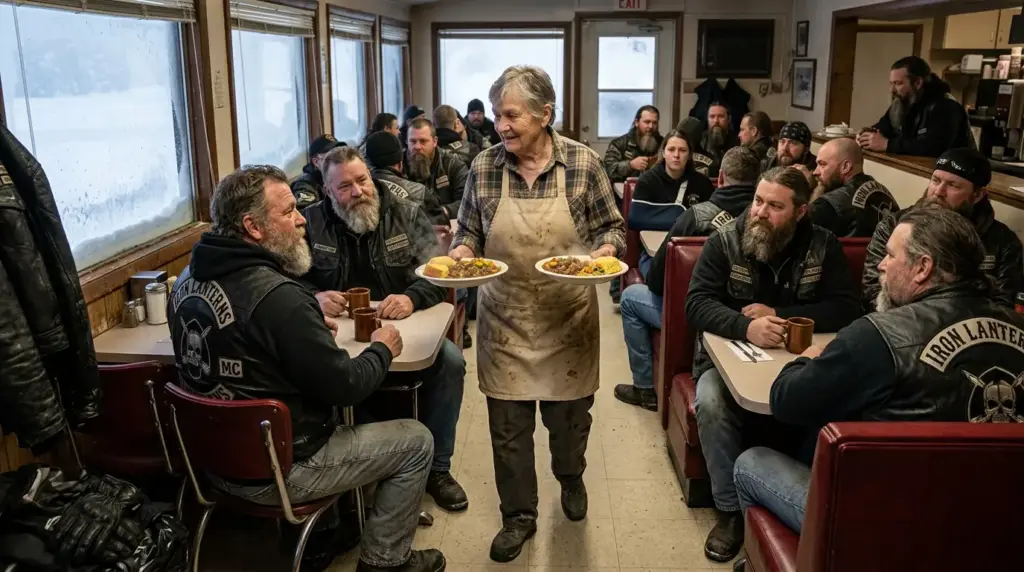
By 2:15 in the morning, the North Star Diner held fourteen bikers, ten students, a coach, a bus driver, Eleanor, and enough wet winter gear to drown a laundromat.
Leah and the riders who stayed behind had pushed tables against the walls and laid blankets across the floor. The children ate stew and cornbread. The driver drank coffee with shaking hands. One girl fell asleep against Moose’s arm while he sat rigidly in a booth, apparently terrified that moving would wake her.
Eleanor saw him look down at the sleeping child.
His hard face changed.
“Granddaughter?” Eleanor asked.
He nodded. “About that age.”
“Then stop looking like you’re holding a bomb.”
Moose relaxed slightly.
The storm continued until dawn.
No one slept much.
Around four, Eleanor found Leah alone near the old wall of photographs beside the cash register.
The wall was the history of the North Star.
Frank in a paper cook’s hat in 1988.
Eleanor standing beside the diner’s first new coffee machine.
Hunters with antlers strapped to trucks.
A state trooper holding a newborn baby after a woman went into labor in booth six during the winter of 1994.
And one photograph Eleanor almost never looked at anymore.
Michael Price at twenty.
Tall.
Dark hair falling into his eyes.
A crooked smile.
One hand resting on the hood of a rebuilt 1971 Triumph motorcycle.
Leah was staring at it.
Not casually.
Her good hand gripped the edge of the counter.
Eleanor stopped.
“You know something about motorcycles?”
Leah turned too fast.
“Enough.”
Eleanor nodded toward the photograph. “That one nearly killed my son three times before he got it running.”
Leah’s face changed.
“Your son?”
“Michael.”
Leah swallowed.
Eleanor felt something small and cold move through her.
“Why are you looking at him like that?”
Leah looked toward the crowded dining room.
Cross was awake in a corner booth.
He had been watching them.
Leah met his eyes.
Cross stood.
Eleanor’s voice hardened.
“What is it?”
Cross walked over slowly.
“Eleanor.”
She hated the way he said her name.
People used that tone before telling you the doctor wanted to speak privately.
“What?”
Cross glanced at Leah.
Leah’s eyes were wet now.
Eleanor’s heart began pounding.
Cross said, “We didn’t come through Elk River Pass by accident.”
The diner seemed to become very quiet even though twenty-five people were still breathing inside it.
Eleanor stared at him.
“What does that mean?”
Cross rubbed one hand over his beard.
“We were headed here.”
“Why?”
He did not answer quickly enough.
Eleanor looked at Leah.
“Why?”
Leah reached inside her vest with her good hand.
She removed a small brass key on a faded leather cord.
Eleanor recognized it instantly.
She took one step backward.
The key was from an old Coca-Cola keychain Frank had bought at a gas station in 1985. Michael used it for the diner’s rear door when he worked weekends in high school.
Eleanor had not seen it in thirty-one years.
Her knees went weak.
“No.”
Leah held the key out.
Eleanor did not take it.
“No.”
Cross spoke quietly.
“Michael Price rode with us for twenty-eight years.”
The room disappeared.
Eleanor heard only the refrigerator.
The little hum behind the counter.
Steady.
Ordinary.
Impossible.
Cross continued.
“He went by Miles for most of that time. Later, people called him North.”
Eleanor’s mouth opened.
Nothing came out.
“He died seven weeks ago.”
Leah started crying silently.
Eleanor stared at Cross.
Thirty-one years.
Seven months.
Four days.
She had imagined Michael dead in rivers, deserts, alleys, prisons, hospitals, anonymous graves, foreign countries, and a thousand places mothers invent when no answer is worse than any answer.
Now a stranger was telling her he had lived.
He had lived for nearly three decades.
Without coming home.
Eleanor slapped Cross.
The sound cracked through the diner.
Several bikers stood.
Cross did not move.
Eleanor’s hand shook.
“You had my son.”
Cross looked at her. “Yes.”
“For twenty-eight years.”
“Yes.”
“And nobody came here?”
“We didn’t know.”
“You expect me to believe that?”
“He never used his real name with us until he got sick.”
Eleanor’s face twisted.
“Twenty-eight years.”
Leah whispered, “Grandma—”
Eleanor turned on her.
“Do not call me that.”
Leah flinched.
The word hung between them.
Grandma.
Eleanor looked at her more closely.
Dark hair.
Brown eyes.
The shape of the jaw.
That laugh.
Oh God.
Eleanor gripped the counter.
Leah was crying openly now.
“My name is Leah Price.”
Eleanor shut her eyes.
“No.”
“Michael was my father.”
The old woman sank slowly onto the stool behind her.
For a long time, nobody spoke.
Then Eleanor began to laugh.
It was not happiness.
It was the broken laugh of a person whose grief has been given a new shape too quickly to understand.
“He had a daughter.”
“Yes.”
“He had a daughter and never told me.”
Leah wiped her face.
“He didn’t tell me about you until three months before he died.”
Eleanor looked up sharply.
“What did he tell you?”





