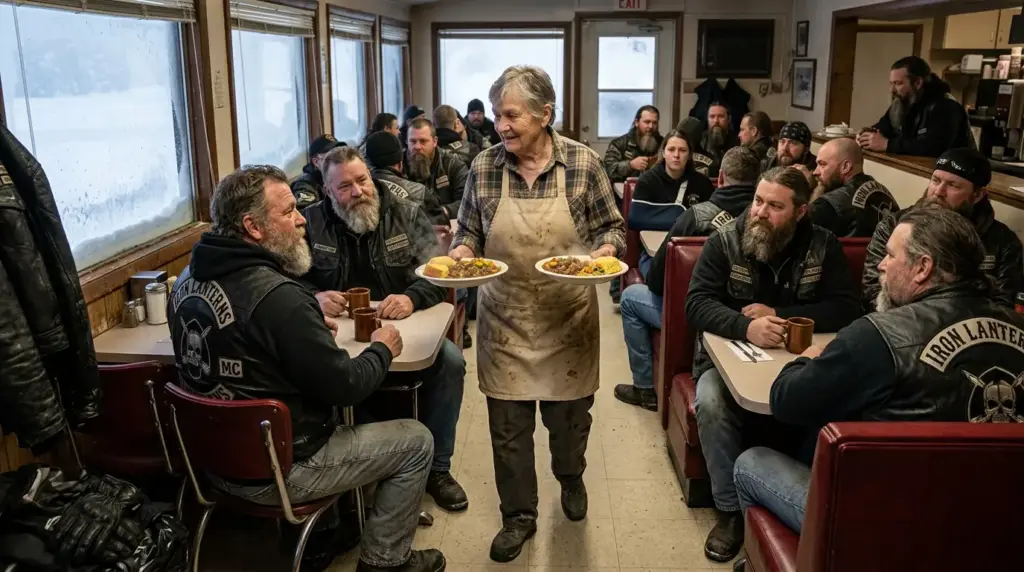
Five minutes later, the back storage room was crowded with men and flashlight beams. The generator coughed, sputtered, and refused to start. Cross removed the side panel. Moose found a wrench. A wiry rider named Benny crawled halfway beneath the unit.
Leah appeared in the doorway.
Eleanor pointed at her sling. “You are decoration.”
“I can hold a light.”
“Fine. Decorative lamp.”
Leah grinned and held the flashlight.
For twenty minutes, the men worked while Eleanor watched them argue about fuel lines, clogged filters, and starter relays with the seriousness of surgeons. Finally the generator coughed twice and roared awake.
Lights flickered back across the diner.
Everyone cheered.
Eleanor looked at the generator.
“You’ve been waiting eight years to embarrass me in front of company.”
Cross wiped his hands on a rag. “It needs a fuel-line replacement.”
“It needs an exorcism.”
When they returned to the dining room, the old weather radio behind the counter began squawking.
Eleanor turned it up.
A dispatcher repeated an emergency bulletin through heavy static.
School activity bus overdue.
Ten students, one coach, one driver.
Last contact twenty-three minutes earlier near the north approach to Elk River Pass.
Vehicle believed to have left the roadway.
Search crews delayed by whiteout conditions.
The diner went silent.
Eleanor’s hand stopped on the radio.
Cross looked at her.
“You know that road?”
“I know every ditch on that road.”
The dispatcher repeated the location.
Mile marker thirty-eight.
Eleanor’s stomach tightened.
“There’s an old logging cut fifty yards west of that marker,” she said. “Road looks straight there, but it isn’t. Snow fills the curve and drivers follow the wrong edge.”
Cross moved toward the window.
“You think the bus slid off?”
“I think if it did, you won’t see it from the highway.”
“Can emergency crews reach it?”
“Not from the north until the plows come through.”
Cross looked at his riders.
No discussion.
Moose was already putting his jacket back on.
Eleanor said, “Absolutely not.”
Cross looked at her.
“You nearly froze getting here.”
“There are kids out there.”
“And if fourteen men freeze looking for them, that doesn’t improve the math.”
Cross pointed toward the diner’s wall.
An old county map hung beside the pie case.
“Show me the logging cut.”
Eleanor stared at him.
“You said people break bones out here because hospitals are far away,” Cross said. “We’ve got rope, tow straps, lights, blankets, first-aid kits, and more cold-weather gear than a school bus does.”
Leah stood up.
Cross pointed at her. “Not you.”
“I can walk.”
“You’ve got one arm.”
“I have two legs.”
Eleanor slammed her palm onto the counter.
Everyone stopped.
“Enough.”
She looked at the map.
Then the windows.
Then the faces around her.
Thirty-eight years earlier, before half these men had gray in their beards, Frank had made her memorize every service road through Elk River Pass because he said anybody who kept a diner open in winter had no business being helpless when the road turned mean.
Eleanor hated him for being right so often now that he was dead.
She reached under the counter and pulled out a ring of old keys.
“There’s a county snowcat in the maintenance shed behind the diner.”
Cross stared at her.
“It hasn’t belonged to the county since 2004. They auctioned it. Frank bought it for six hundred dollars because he was an idiot.”
Moose smiled. “Does it run?”
Eleanor picked up her coat.
“It will when it realizes I’m driving.”
Cross blocked her path.
“No.”
Eleanor looked at him.
“You’re seventy-something.”
“Seventy-two.”
“That is not helping your argument.”
“You know how to find the logging cut?”
“No.”
“You know where the creek shelf drops behind it?”
“No.”
“You know where the old ranger gate is buried under three feet of snow?”
Cross exhaled.
Eleanor held out her hand.
“Move.”
He moved.
The snowcat started on the ninth try.
Eleanor drove.
Cross sat beside her. Moose and two other riders rode in the back with ropes, blankets, a medical kit, and thermoses of coffee. The rest stayed at the diner with Leah, preparing floor space and hot food in case the missing children were found.
The storm swallowed the snowcat fifty yards from the parking lot.
Driving became an act of memory.
There were no lane markings. No shoulder. No horizon. Eleanor followed the shape of telephone poles when she could see them and the slope of the land when she could not. Twice Cross asked if she was sure they were still on the road.
“Not remotely,” she said.
He stared at her.
She smiled without humor. “But I’m sure where we’re going.”
At mile marker thirty-eight, Eleanor turned hard left into what appeared to be a wall of snow.
Cross grabbed the dash.
The snowcat dropped sharply.
“Logging cut,” Eleanor said.
“You could have warned me.”
“I just did.”
Moose laughed from the back.
They found the bus six minutes later.
It had broken through a stand of thin pine trees and slid nose-first into a shallow ravine. One rear wheel hung in the air. Snow already buried half the roof. No lights showed inside.
Cross was out before Eleanor stopped moving.
They reached the bus through waist-deep snow.
The driver had a broken wrist.
The coach had a bleeding cut above one eye.
Nine students huddled beneath coats and seat covers near the rear.
The tenth was missing.
A fourteen-year-old boy named Owen had gone out fifteen minutes earlier to look for cell service.
The coach had tried to stop him.
He had panicked.
Eleanor stared into the white darkness beyond the bus.
“How long?”
“Fifteen, maybe twenty minutes.”
Cross swore.
Eleanor looked at the boy’s tracks.
They were already disappearing.
“Take everyone to the snowcat,” she ordered. “Count twice.”
Cross looked at her. “Where are you going?”
“To get the fool child.”
“You’re not going alone.”
“I didn’t say I was.”
She pointed at Moose. “You look like a windbreak. Come on.”
Moose blinked. “Yes, ma’am.”





