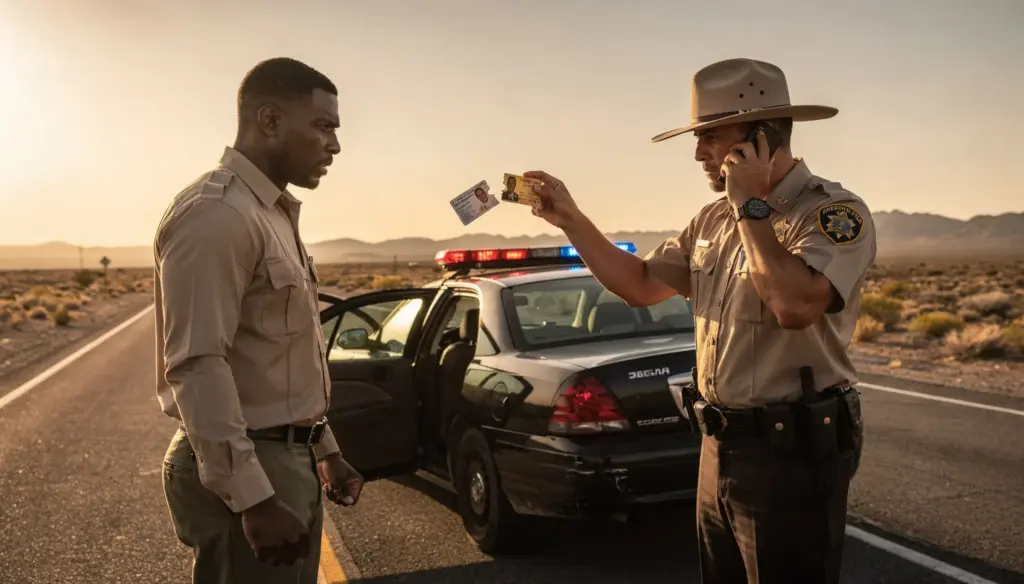
For one second he assumed the man was testing it.
Then Sheriff Dale Harlan bent it farther.
The card snapped.
The sound was small beneath the desert wind, almost insignificant beside the occasional truck roaring along the two-lane highway outside Red Mesa, Arizona.
Harlan looked down at the two pieces in his hands.
Then he smiled.
“Well,” he said. “Now we’ve got a problem.”
Malcolm sat behind the wheel of his faded beige Ford pickup with both hands resting where the sheriff could see them.
He did not move.
The truck’s air conditioner had stopped working fifteen miles earlier, and sweat had darkened the collar of his charcoal T-shirt. His phone sat facedown in the center console. A canvas overnight bag lay behind the passenger seat, beside a locked leather briefcase he had not touched since leaving Phoenix that morning.
Malcolm looked at the broken license.
“That was valid.”
Harlan’s smile widened slightly.
“That what you’re going with?”
“It was issued eighteen months ago.”
“You expect me to believe this thing?”
Malcolm looked at him.
The sheriff was in his early fifties, sun-weathered, lean, wearing mirrored aviators and a tan uniform that looked too clean for a man who claimed to have spent the morning patrolling county roads. A gold star sat over his left chest pocket. His hand rested casually near his belt.
Malcolm had been stopped six minutes earlier.
He knew the exact time because he had looked at the dashboard clock when the lights appeared in his rearview mirror.
10:42 a.m.
He had been driving three miles below the posted speed limit.
His registration was current.
Insurance current.
Seat belt fastened.
No phone in his hand.
No alcohol.
No drugs.
Nothing hanging from the mirror.
The truck’s left brake light worked because Malcolm had replaced the bulb himself before leaving Phoenix.
Sheriff Harlan initially said Malcolm had “drifted toward the center line.”
When Malcolm asked where, Harlan changed it to an “equipment concern.”
Then a “license verification issue.”
Now the license lay broken in two.
Malcolm said, “You can run the number.”
“I already did.”
“And?”
Harlan tilted his head.
“System’s showing questions.”
“What questions?”
“You ask a lot.”
“When somebody destroys my identification, yes.”
The smile disappeared.
“Step out of the vehicle.”
Malcolm did not move immediately.
“Am I under arrest?”
“Step out.”
“Am I being detained?”
“You are now.”
“For what?”
Harlan leaned toward the open window.
“Do you want me to add obstruction?”
Malcolm stared at him for a moment.
Then he nodded once.
“Okay.”
He opened the door slowly.
Harlan stepped back.
Malcolm climbed down.
He was thirty-nine, six foot two, broad-shouldered without looking like someone who spent his life in a gym. His clothes were simple. Dark jeans. Work boots. Black watch.
Nothing about him looked particularly wealthy or particularly poor.
That seemed to irritate people who preferred deciding quickly.
Harlan looked him over.
“Hands on the truck.”
Malcolm complied.
The hood was hot beneath his palms.
“Spread your feet.”
He did.
Harlan searched him.
Wallet.
Keys.
A folded receipt.
Nothing else.
“What’s in the briefcase?”
“Work.”
“What kind?”
“Legal files.”
The sheriff paused.
“You a lawyer?”
“Yes.”
Harlan laughed softly.
“Of course.”
Malcolm turned his head slightly.
“What does that mean?”
“Eyes forward.”
Malcolm faced the truck again.
The sheriff continued searching his pockets.
“You traveling for work?”
“Yes.”
“Where?”
“Red Mesa.”
“You’re already in Red Mesa County.”
“I know.”
“Who are you meeting?”
Malcolm hesitated.
Not because the answer was secret.
Because he was increasingly interested in what Harlan would do without it.
“Several people.”
The sheriff stepped closer.
“Names.”
“I’d prefer to know why I’m being questioned beyond the traffic stop.”
Harlan grabbed Malcolm’s left wrist.
“Turn around.”
Malcolm looked down at the hand.
Then at Harlan.
“Sheriff.”
“I said turn around.”
Malcolm did.
Metal closed around one wrist.
Then the other.
The cuffs were tighter than necessary.
Malcolm inhaled slowly.
“Why am I being arrested?”
Harlan leaned close enough that Malcolm could smell coffee on his breath.
“Driving without valid identification.”
“You broke the identification.”
“It was fraudulent.”
“You said your system had questions.”
“It does.”
“What questions?”
“You can explain all of that downtown.”
Malcolm looked across the empty road.
Low mountains floated pale blue in the distance. Creosote bushes spread across the sand. Heat shimmered above the asphalt.
There were no witnesses.
At least none obvious.
Harlan opened the passenger door of his patrol SUV.
“Get in.”
Malcolm stayed where he was.
“My truck.”
“It’ll be impounded.”
“On what authority?”
Harlan stared.
“You planning to make every sentence difficult?”
“No.”
Malcolm’s voice remained calm.
“I want the reason documented.”
“It will be.”
“Body camera?”
The sheriff’s jaw shifted.
“What?”
“Is your body camera recording?”
Harlan looked toward his own chest.
There was no visible camera.
Malcolm already knew.
“I don’t wear one.”
“Dash camera?”
“Broken.”
“That seems unfortunate.”
Harlan’s eyes hardened.
“For you.”
Malcolm looked at him.
“No.”
He shook his head slightly.
“Usually for everybody.”
Harlan opened the SUV door wider.
“Get in.”
Malcolm did.
He said nothing during the twenty-two-minute drive to the Red Mesa County Sheriff’s Office.
Harlan did most of the talking.
Not directly to Malcolm.
Into the radio.
“Male driver.”
“Uncooperative.”
“Possible fraudulent identification.”
“Vehicle hold.”
Each phrase made the encounter sound slightly different than the one Malcolm had experienced.
Malcolm listened carefully.
Words mattered.
He had built most of his career around that fact.
The sheriff glanced at him in the mirror twice.
“You got something to say?”
Malcolm shook his head.
“No.”
“That’s a first.”
Malcolm looked out the window.
The sheriff’s office sat beside a county courthouse built from pale stucco and brown brick. An American flag moved lazily above the parking lot.
The building looked ordinary.
That struck Malcolm.
People often expected places where bad things happened to look different.
Darker.
More threatening.





