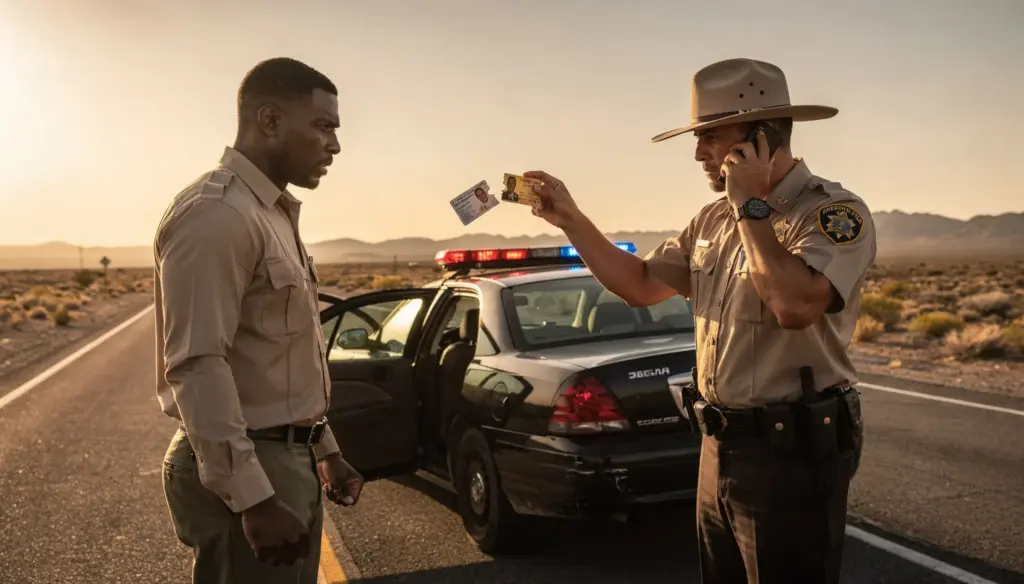
“I did not tell you to describe me over the radio as uncooperative.”
Harlan looked away.
Malcolm continued:
“If you believe this was a setup, then the person who set it up was you.”
Nobody spoke.
That afternoon, Malcolm sat inside a conference room at the county courthouse with a temporary state identification printout beside him.
His truck had been returned.
The briefcase remained sealed.
Judge Harper participated by secure video from Phoenix.
County Attorney Sullivan.
Marshal Bennett.
Two federal civil-rights attorneys.
Malcolm’s own counsel, Rebecca Shaw.
Deputy Ruiz was not present.
Sheriff Harlan had been advised to obtain independent representation.
Judge Harper began:
“Mr. Reed, can you continue in your role objectively after today?”
Malcolm had expected the question.
“Yes.”
Rebecca looked toward him.
The judge continued:
“Explain.”
“I was hired to evaluate systems.”
“Today gives me firsthand experience of one interaction.”
“It does not tell me every deputy behaves the same.”
“It does not prove every allegation we received.”
“And it does not make allegations unrelated to my stop more true.”
Judge Harper nodded.
“What does it tell you?”
“That Sheriff Harlan personally broke a valid identification card before establishing legal grounds to seize it.”
“That he converted uncertainty about identity into a custodial arrest rather than using available verification tools.”
“That he characterized lawful questions as obstruction.”
“That he changed his response after learning my position.”
“And that at least one deputy appeared aware the stated charge was atypical.”
“Deputy Ruiz.”
“Yes.”
The judge looked toward the county attorney.
“Has the license status been verified?”
Sullivan answered.
“Yes.”
“Valid?”
“Yes.”
“No mismatch?”
“None.”
Malcolm looked down.
Even he felt something then.
Not surprise.
Confirmation.
Judge Harper asked:
“Was Mr. Reed’s license queried roadside?”
Sullivan hesitated.
“We do not yet know.”
“Dispatch record?”
“No plate or driver query appears before arrival at the jail.”
Silence.
Malcolm lifted his eyes.
Sheriff Harlan had said he ran it.
That was now another problem.
Judge Harper continued:
“Preserve everything.”
The meeting lasted two hours.
By sunset Malcolm was exhausted.
He checked into a motel rather than drive back to Phoenix.
Room 214.
Ice machine outside.
Air conditioner loud enough to shake the curtains.
He sat on the edge of the bed and finally called his mother.
Lorraine Reed answered:
“You alive?”
Malcolm smiled.
“Hello to you too.”
“You missed your four o’clock call.”
“I know.”
“You never miss.”
“I know.”
“What happened?”
He considered giving the short version.
Traffic stop.
Delay.
Work.
Instead:
“A sheriff broke my license and arrested me.”
Silence.
Then:
“What?”
Malcolm told her.
Not every legal detail.
Enough.
Lorraine listened without interrupting.
At seventy, she had developed that skill after spending four decades as a school counselor.
When Malcolm finished, she asked:
“Were you scared?”
He leaned back.
That question surprised him.
“Not exactly.”
“Don’t lawyer me.”
He smiled.
“Yes.”
“When?”
“Roadside.”
“Why?”
“He had me cuffed.”
“No witnesses.”
“No camera.”
His mother breathed slowly.
Malcolm stared at the motel carpet.
“I knew I could eventually make a call.”
“I knew there were people expecting me.”
“I knew if I disappeared, someone would notice within hours.”
Lorraine said nothing.
“That was what scared me.”
“What?”
“That I was thinking about how protected I was.”
He swallowed.
“Because most people he stops do not have that.”
His mother’s voice softened.
“No.”
Malcolm closed his eyes.
The independent monitoring case had begun eight months earlier.
Not because of one headline.
Because complaints accumulated.
Drivers saying cash disappeared during searches.
People held overnight on minor traffic matters.
Vehicle impounds becoming expensive before charges were dismissed.
A public defender reporting that Latino defendants repeatedly arrived with no property receipts.
A Black truck driver claiming a deputy cut his state ID in half and later cited him for failure to produce valid identification.
That complaint had stood out.
The deputy named in it was not Harlan.
But now Malcolm understood the detail differently.
His mother said:
“You’re thinking too much.”
“Occupational hazard.”
“You going home?”
“Tomorrow.”
“Good.”
“Mom?”
“Yes?”
“Dad ever tell you about Red Mesa?”
Silence.
Malcolm sat straighter.
“Mom?”
“He did.”
His father, Isaiah Reed, had died seven years earlier.
Heart attack.
Sixty-three.
A mechanic for most of his life, then vocational-school instructor.
The old Ford pickup Malcolm drove had been his.
“What happened?”
Lorraine sighed.
“Before you were born.”
“When?”
“Nineteen eighty-five.”
Malcolm frowned.
“What?”
“Your father drove through Red Mesa County coming back from California.”
“Got stopped.”
“By who?”
“I don’t know.”
“Old sheriff.”
She paused.
“He came home without his wallet.”
Malcolm went still.
“What do you mean?”
“He said the deputy found four hundred dollars in cash.”
“Money he’d saved from a transmission job.”
“They accused him of carrying drug money.”
“Did they charge him?”
“No.”
“They kept the cash?”
“Yes.”
Malcolm stood.
His heart began beating faster.
“Why have you never told me this?”
Lorraine laughed softly.
“Because your father hated the story.”
“Did he file anything?”
“No.”
“Why?”
“You think 1985 was 2026?”
Malcolm closed his eyes.
Fair.
Lorraine continued:
“He was twenty-two.”
“Black.”
“Driving a truck worth less than the cash in his pocket.”
“He came home angry and ashamed.”
“Your grandfather told him to be grateful they let him go.”
Malcolm sat again.
“Did he remember the deputy’s name?”
“No.”
“Maybe.”
“I don’t know.”
“Was it Harlan?”
“Harlan would’ve been a teenager.”
“His father?”
Lorraine became quiet.
“What?”
Malcolm waited.
“There was a sheriff named Harlan.”
The motel room suddenly felt too small.
“Mom.”
“I don’t know if he stopped Isaiah.”
“But your father used to say that county belonged to the Harlans.”
Malcolm looked toward his overnight bag.
The monitoring case had already produced references to Sheriff Dale Harlan’s father, Ray Harlan, who served as sheriff from 1981 to 1996.
He had treated that as historical context.
Now it was family context too.
His mother said:
“Malcolm.”
“Yes?”
“Do not turn this into your father’s case.”
He almost laughed.
“You sound like Judge Harper.”
“Smart woman.”
“I’m serious.”
“So am I.”





