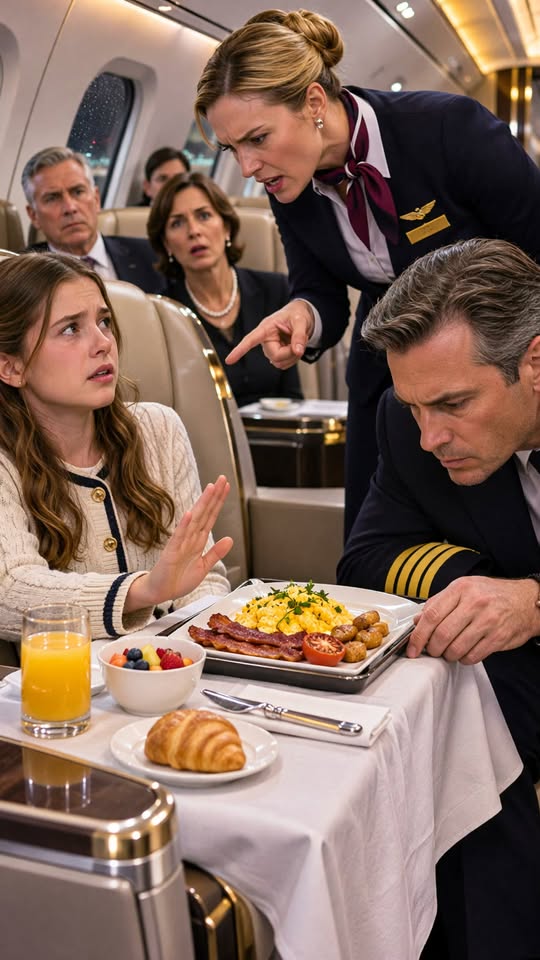
Then his tablet chimed.
A new message appeared from the catering control center.
He read it once.
Then again.
His expression changed.
“Captain,” he said quietly, “there’s another problem.”
Reeves looked at him.
“What problem?”
Bennett turned the tablet toward him.
**”The hold status was manually removed at 5:18 this morning.”**
Reeves stared at the record.
“By whom?”
Bennett swallowed.
**”The authorization came from a senior management account.”**
For a moment, neither man spoke.
Then Reeves asked the question that would transform a food safety incident into something much more serious.
**”Was that account authorized to release a quarantined shipment?”**
Dr. Daniel Carter was reviewing medical safety reports in his office when his phone rang.
The caller identification showed the airline’s operations center.
He answered immediately.
“This is Daniel Carter.”
A woman introduced herself as **Rebecca Shaw**, the airline’s director of safety compliance.
“Doctor, I’m calling about an incident involving your daughter.”
Daniel stood so quickly that his chair rolled backward.
“Is Ava all right?”
“She’s safe,” Rebecca assured him. “But she identified a possible problem with a breakfast meal on her flight.”
Daniel closed his eyes briefly.
“Has she eaten any of it?”
“No.”
He exhaled.
Rebecca continued.
“Captain Reeves stopped meal service after examining the tray. We’ve confirmed that the catering shipment was under a quality hold.”
Daniel’s expression hardened.
“Which shipment?”
Rebecca gave him the identification code.
Daniel went completely still.
He recognized it.
The code belonged to a batch he had discussed during a safety conference call the previous evening.
His team had reviewed a report of irregular temperature readings during storage and transportation.
The available evidence did not establish that every meal was contaminated.
But it was sufficient to require the shipment to remain isolated until the investigation was complete.
Daniel had supported that decision.
He had also insisted that no meals from the affected batch be released without documented clearance.
“Rebecca,” he said slowly, “that shipment was never supposed to leave the catering facility.”
“I know.”
“Who released it?”
“We’re investigating.”
Daniel looked toward the report on his desk.
The warning was clearly documented.
He remembered the meeting.
Several managers had complained about the cost of discarding a large premium catering order.
Daniel had explained that the cost of a precautionary hold was insignificant compared with the potential consequences of serving unsafe food.
One executive had asked whether the airline could simply replace the meals that smelled unusual.
Daniel had refused.
A compromised temperature record could affect the entire batch.
Selective inspection would not provide sufficient assurance.
Now that same shipment had reached an aircraft carrying his daughter.
The coincidence made his stomach tighten.
“Has anyone become ill?” he asked.
Rebecca explained that several passengers had eaten the meals and were being assessed.
No serious illness had been confirmed.
Daniel was relieved, but he remained concerned.
“Please preserve the food, the temperature logs, the loading records, and every communication related to the release.”
Rebecca agreed.
“That’s already underway.”
Daniel looked at the photograph of Ava on his desk.
She was smiling beside him at an aviation museum, holding a model airplane.
He remembered teaching her how to recognize warning signs in everyday situations.
He had never imagined that those lessons would become relevant during a flight.
“Can I speak with her?” he asked.
Rebecca arranged the call.
A few minutes later, Ava’s voice came through the phone.
“Dad?”
Daniel’s chest tightened.
“Hi, sweetheart.”
Her voice trembled.
“I didn’t eat it.”
“I know.”
“Are you mad?”
He felt his heart break.
“Why would I be mad?”
“Because everybody was upset, and the flight attendant said I was causing trouble.”
Daniel closed his eyes.
“Ava, listen carefully. You did exactly what I taught you.”
She sniffled.
“I was scared.”
“I know.”
“I thought they were going to make me leave.”
Daniel took a slow breath.
“I’m sorry you were frightened.”
For a moment, he could hear only the quiet sounds of the cabin around her.
Then Ava whispered something that brought tears to his eyes.
**”I remembered what you said about not ignoring danger just because someone older tells you to.”**
Daniel pressed his fingers against his forehead.
He had spent years teaching airline employees about safety culture.
He had spoken at conferences, written reports, and reviewed countless incidents.
But his daughter had demonstrated the principle more clearly than any presentation.
“I’m proud of you,” he said.
Ava began crying softly.
Daniel wished he could reach through the phone and hold her.
He promised that she would not be left alone and that he would remain available until she was safely with her grandmother.
After the call, Daniel contacted Rebecca again.
“I need to know whether this was an accidental release or a deliberate override.”
Rebecca hesitated.
“We’ve found a manual authorization.”
Daniel’s expression darkened.
“Whose?”
“The account belongs to **Martin Kessler**, the regional director of catering operations.”
Daniel knew the name.
Kessler had participated in the previous evening’s meeting.
He had argued that holding the shipment would create serious operational costs.
Daniel remembered his words.
“We cannot shut down premium service every time a sensor produces an unusual reading.”
Daniel had responded firmly.
“Then we need better sensors and better procedures, not lower standards.”
Kessler had looked irritated.
Now his account appeared on the release record.
Daniel leaned against his desk.
“Has Kessler been contacted?”
“Yes. He says he didn’t authorize the release.”
“Then the account may have been compromised.”
“That’s one possibility.”
Daniel appreciated her caution.
He had seen investigations ruined by premature conclusions.
“Please make sure the review remains independent,” he said.
Rebecca agreed.
But she had another concern.
The release record was not the only unusual entry.
Someone had also modified the temperature log associated with the shipment.
The original record showed a prolonged period outside the required storage range.
The revised version presented a much shorter deviation.
Daniel felt a cold sensation in his chest.
“Who changed the record?”
“We’re tracing the access.”
He looked toward the window.
Outside, aircraft moved across the airport apron.
The aviation industry depended on thousands of people performing small tasks correctly.





