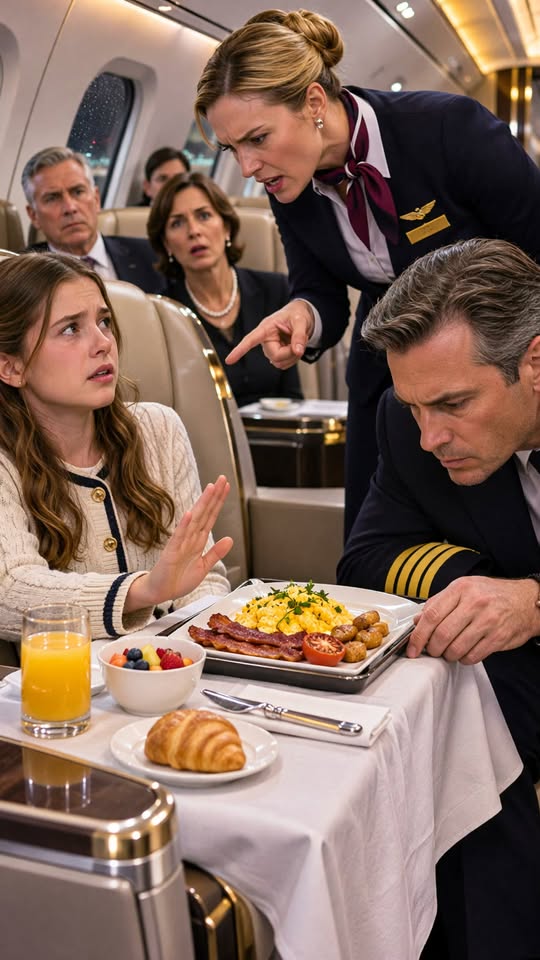
She also wrote that the incident had forced her to confront how she treated people who questioned her authority.
Daniel found the letter sincere.
But he knew that sincerity did not erase harm.
He asked Ava whether she wanted to read it.
She nodded.
They sat together on the sofa.
Ava read the letter slowly.
When she finished, she remained quiet for several minutes.
Then she looked at her father.
“Can I write back?”
Daniel smiled gently.
“Of course.”
Ava took a sheet of paper.
She thought carefully before writing.
Her response was short.
**”I was scared, but I hope next time you listen when someone says something might be wrong.”**
Daniel read the sentence.
His eyes filled with tears.
Ava had not written about revenge.
She had written about listening.
And Daniel realized that his daughter understood the most important lesson of the entire incident.
But the story was not finished.
The following morning, Rebecca received a final report from the transportation investigators.
It contained a discovery that none of them had expected.
**The unauthorized warehouse stop had been reported months earlier by an employee who was later dismissed.**
And the name on that report was someone Daniel Carter knew very well.
The employee’s name was **Emily Foster**.
She had worked as a quality assurance specialist for the catering supplier.
Six months before Ava’s flight, Emily had reported irregular transportation practices.
Her report described unauthorized warehouse stops, incomplete temperature documentation, and pressure to approve deliveries without sufficient verification.
She had recommended an independent audit.
Instead, her concerns were dismissed.
Several weeks later, her employment ended.
The supplier claimed that the decision was related to restructuring.
Emily believed she had been removed because she refused to approve questionable records.
She had attempted to raise the issue through several channels.
One of those channels led to Dr. Daniel Carter.
Daniel remembered receiving a message from her.
At the time, he had been working on a separate aviation safety project.
Emily’s message described concerns about catering transportation practices.
She asked whether he could advise her on the appropriate reporting process.
Daniel had responded with guidance.
He encouraged her to preserve records and contact the relevant safety and compliance authorities.
But he had not been assigned to investigate her employer.
He did not know that the same supplier would later provide meals for Ava’s flight.
When Rebecca told him about Emily’s report, Daniel felt a surge of regret.
He wondered whether more could have been done.
Rebecca reminded him that he had not possessed the authority or evidence necessary to resolve the matter himself.
Still, Daniel felt troubled.
The warning had existed.
The system had failed to act.
Rebecca arranged an interview with Emily.
She arrived carrying a folder of documents.
Emily was thirty-seven, with dark hair and tired eyes.
She had spent months trying to rebuild her career after losing her job.
The incident involving Ava had brought back painful memories.
“I knew something like this could happen,” she said.
Rebecca asked her to explain.
Emily described the unauthorized warehouse stops.
She said the subcontractor sometimes used the facility to consolidate deliveries and reduce transportation costs.
The practice created temperature-control risks.
She had documented several incidents.
Her supervisors initially promised to investigate.
But the practice continued.
Emily eventually refused to sign off on incomplete records.
She believed that decision damaged her standing with management.
Rebecca reviewed the documents.
They included emails, photographs, temperature logs, and meeting notes.
Several records matched the findings from the current investigation.
Emily’s evidence strengthened the case that the transportation problems had been known for months.
Rebecca asked why she had continued preserving records after leaving the company.
Emily looked down.
“Because I was afraid someone would get hurt.”
The room became quiet.
She continued.
“I didn’t want to be right. I wanted them to fix it.”
Rebecca felt a deep respect for her.
Emily had lost her job, endured financial uncertainty, and continued trying to raise concerns.
She had done so without public recognition.
Her experience revealed another failure in the system.
The supplier had not protected an employee who reported safety concerns.
Instead, the organization appeared to have treated her as a problem.
Rebecca shared the findings with the airline’s leadership.
Jonathan Mercer looked deeply troubled.
“We need to address this,” he said.
Rebecca agreed.
The airline expanded its review to include whistleblower protections and supplier accountability.
It also requested that the catering company examine Emily’s dismissal independently.
The supplier agreed to cooperate.
The investigation eventually concluded that Emily’s concerns had been legitimate and inadequately addressed.
The company offered a formal apology and reached a confidential resolution with her.
Emily did not seek publicity.
She wanted to return to meaningful work.
Daniel learned about the outcome through Rebecca.
He asked whether Emily would consider joining a new independent safety advisory program.
The program was being developed to strengthen oversight of airline catering suppliers.
Rebecca contacted Emily.
At first, she hesitated.
She had spent months feeling that her professional judgment had been ignored.
But the opportunity appealed to her.
She could help prevent similar failures.
After several discussions, Emily accepted a role as a senior quality specialist.
The appointment was based on her experience and qualifications.
Daniel was pleased.
He believed that people who raised legitimate concerns should not be punished for doing so.
Meanwhile, the airline continued implementing reforms.
The new catering safety system included independent release approvals, protected reporting channels, and stronger transportation monitoring.





