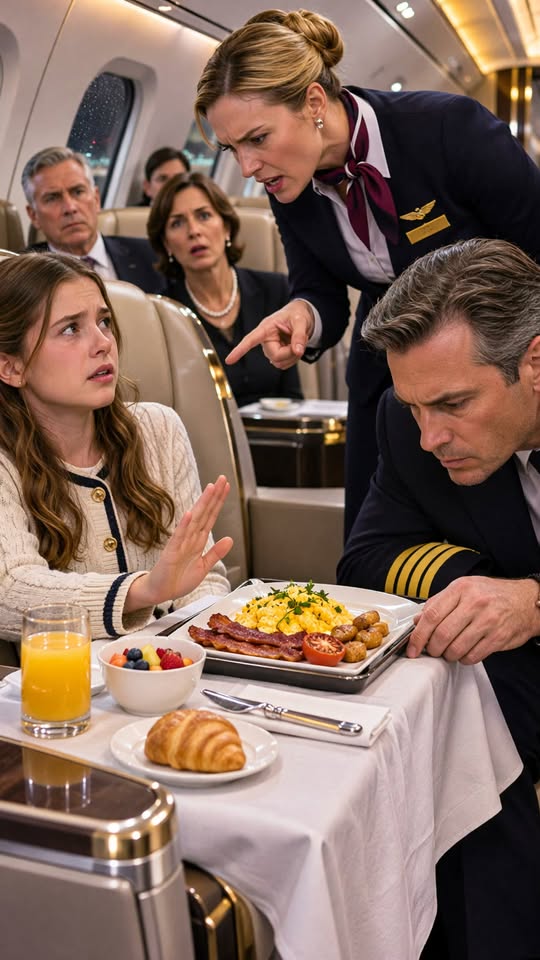
The investigation needed to distinguish mistakes from deliberate misconduct.
Rebecca’s team continued reviewing the records.
They discovered that the unauthorized warehouse stop was not an isolated event.
Similar stops had occurred on several previous deliveries.
Most had not resulted in documented safety problems.
But the practice violated the approved transportation process.
The supplier had failed to monitor it effectively.
The airline had relied on paperwork that did not reflect the actual route.
The weakness was systemic.
Rebecca presented the findings to Jonathan Mercer.
He listened with growing concern.
“We trusted the supplier’s delivery records,” he said.
Rebecca nodded.
“And the supplier trusted the subcontractor.”
Mercer looked at the report.
“Nobody verified the route.”
“Not consistently.”
He sighed.
The airline had invested heavily in premium service.
It had spent millions improving cabin interiors, menus, and passenger amenities.
But those investments meant little if the underlying safety systems were unreliable.
Mercer authorized an immediate review of all catering transportation contracts.
He also required independent verification of temperature controls and delivery routes.
The changes would be expensive.
But he understood that the cost of ignoring the problem could be far greater.
Meanwhile, Dr. Daniel Carter continued advising the independent safety team.
He reviewed the laboratory findings and transportation records.
The evidence confirmed that Ava’s concern had been reasonable.
But Daniel remained troubled by the broader implications.
The system had depended on people following procedures.
When several people ignored those procedures, the safeguards failed.
He prepared a report emphasizing the importance of reporting concerns without fear of punishment.
The report included a section on passenger observations.
Daniel argued that passengers should be encouraged to report unusual food odors, packaging problems, or other safety concerns.
Crew members should respond by verifying the issue rather than dismissing it.
The principle was simple.
But it required a change in culture.
Daniel also recommended stronger protections for employees who raised concerns.
The investigation had revealed that a quality supervisor warned about the shipment.
Her warning had been ignored.
A transportation employee had questioned the unauthorized stop.
His concern had not been escalated.
Several opportunities to prevent the incident had been missed.
Daniel believed those missed opportunities were as important as the final mistake.
He shared the report with Rebecca.
She read it carefully.
“This is exactly what we need,” she said.
Daniel nodded.
“But it has to become more than a document.”
Rebecca agreed.
The airline began implementing new procedures.
Safety holds could no longer be removed by a single manager.
Any release required independent verification from the quality team.
Temperature records were protected against unauthorized modification.
Transportation routes were monitored more closely.
Employees received additional training on reporting concerns.
The changes were substantial.
But the investigation also had a human dimension.
Ava had become the subject of public attention after passengers shared accounts of the incident.
Her father tried to protect her privacy.
He declined requests for interviews.
He explained that Ava was a child who had acted responsibly, not a public figure seeking recognition.
But the story continued spreading.
Some people praised her courage.
Others criticized the flight attendant.
Daniel worried that the attention would overwhelm his daughter.
He wanted her to return to ordinary life.
He wanted her to attend school, spend time with friends, and enjoy her visit with her grandmother.
Ava, however, had questions.
One evening, she sat beside Daniel at the kitchen table.
“Dad, did I really stop something bad from happening?”
Daniel considered his answer.
“You helped identify a problem before the flight departed.”
Ava looked down.
“But some people already ate the food.”
“Yes.”
“Could they have gotten really sick?”
Daniel took a breath.
“We don’t know what would have happened to every person. That’s why we investigate and take precautions.”
Ava nodded slowly.
She appreciated that her father did not exaggerate.
He had always taught her that safety depended on facts.
After a moment, she asked another question.
“Why didn’t the flight attendant believe me?”
Daniel looked at her.
“Sometimes people become so focused on being in charge that they forget to listen.”
Ava considered that.
“Even when they’re wrong?”
“Especially then.”
She leaned against him.
“I don’t want her to lose everything because of me.”
Daniel wrapped an arm around her shoulders.
“Her choices are her responsibility, sweetheart.”
Ava was quiet.
Then she whispered, “I hope she learns.”
Daniel kissed the top of her head.
“So do I.”
Several weeks later, Rebecca contacted Daniel with an update.
The airline had completed the first phase of its safety review.
The findings confirmed multiple failures in the catering process.
The supplier had accepted responsibility for transportation and quality-control weaknesses.
The airline had acknowledged deficiencies in its oversight.
Martin Kessler’s employment had been terminated following the internal disciplinary process.
Regulatory and legal reviews continued.
Vanessa Cole had also been dismissed from flight duties after the airline concluded that her treatment of Ava violated its standards.
Daniel listened carefully.
He did not celebrate.
He understood that accountability could be painful.
But he also believed it was necessary.
Rebecca then mentioned something unexpected.
“Vanessa has written a letter to Ava.”
Daniel hesitated.
“What’s in it?”
“An apology.”
He considered the request.
“Send it to me first.”
Rebecca agreed.
The letter arrived the following day.
Daniel read it privately.
Vanessa admitted that she had dismissed Ava’s concern because she assumed the girl was being difficult.
She acknowledged that threatening to remove a child was unacceptable.





