“A traffic camera?” Sarah paused, her spoon hovering over her cup. “Are you certain?”
A cold, stinging drizzle had begun to slick the asphalt by the time Marcus left the diner and walked toward his parked car. The Manhattan evening was settling into a restless gloom, neon signs bleeding long, distorted reflections across the wet pavement.
As he unlocked the driver’s side door of his black sedan, a hand gripped his shoulder firmly from behind.
Marcus spun around instinctively, his heart hammering against his ribs, half-expecting to see Callahan’s stocky frame looming out of the shadows.
Instead, standing beneath a broad black umbrella, was a woman in her late forties wearing a drab trench coat. Her short blonde hair was damp at the temples, and her eyes were sharp, carrying the weary vigilance of someone who had spent too many decades working the night shift in municipal government.
“Mr. Vance?” she asked, her voice pitched low to cut through the hum of passing traffic. “Don’t turn around too fast. My name is Detective Elena Vasquez. I work internal affairs down at One Police Plaza, though right now, my badge feels about as useful as a chocolate teapot.”
Marcus stared at her, his hand resting on the car door handle.
“Internal Affairs. Did Callahan send you to finish the job?”
“If Callahan sent me, I’d be holding a pair of cuffs instead of an umbrella,” Vasquez said dryly, pulling a small, unmarked USB drive from her pocket and sliding it discreetly into the outer pocket of Marcus’s suit jacket.
“That drive contains the exact DOT traffic camera footage you were just discussing with your partner over lukewarm coffee. And before you ask—yes, we monitor certain conversations when high-value targets start making noise about police pensions.”
Marcus felt a cold chill run down his spine.
“You’re tapping our communications?”
“I’m protecting my precinct from rotting from the inside out,” Vasquez corrected sharply, her gaze piercing through the dim light.
“Callahan is a dinosaur who thinks the badge makes him immune to gravity. But taking him down the standard way will just result in a three-day suspension with pay and a quiet early retirement in Boca. If you want real accountability, you need to prove that Callahan wasn’t acting alone. He has a handler. Someone much higher up in the department command structure.”
“Who?” Marcus asked, stepping closer.
“Deputy Chief Harrison,” Vasquez whispered, her voice barely audible over the hiss of rain on pavement.
“Harrison signed off on the eviction task force that cleared out the Lexington tenements. Callahan is his personal enforcer. If you drop that video at the 6:00 AM news broadcast tomorrow without exposing Harrison’s connection, Callahan will take the fall as a ‘bad apple,’ and the syndicate will simply replace him with someone smarter and more ruthless.
You need to connect the dots all the way to the top before you pull the trigger.”
Marcus returned to his brownstone in Brooklyn late that night, the house dark and silent around him. He poured himself two fingers of bourbon, letting the amber liquid burn his throat before walking into his small home office. The room was dominated by a large mahogany desk cluttered with law books, financial spreadsheets, and a small, newly framed photograph of his daughter Maya, identical to the one that had been smashed on the sidewalk earlier that day. He set the replacement frame down gently, running his thumb over the glass.
Maya was twelve, old enough to read the news online, old enough to ask difficult questions about why her father’s face was bruised when she video-called him from her boarding school upstate. He had told her he walked into a door frame while rushing to catch a flight, a clumsy lie that tasted bitter on his tongue.
Integrity wasn’t just a professional ideal he preached in corporate boardrooms; it was the baseline inheritance he wanted to leave his child. Growing up as a black man in suburban Philadelphia, his father had taught him that respect was never given freely—it had to be protected through excellence, vigilance, and an unyielding refusal to bow to arbitrary authority.
Marcus inserted the USB drive Detective Vasquez had given him into his encrypted laptop. The screen flickered to life, displaying the high-definition traffic camera footage from 52nd and Third.
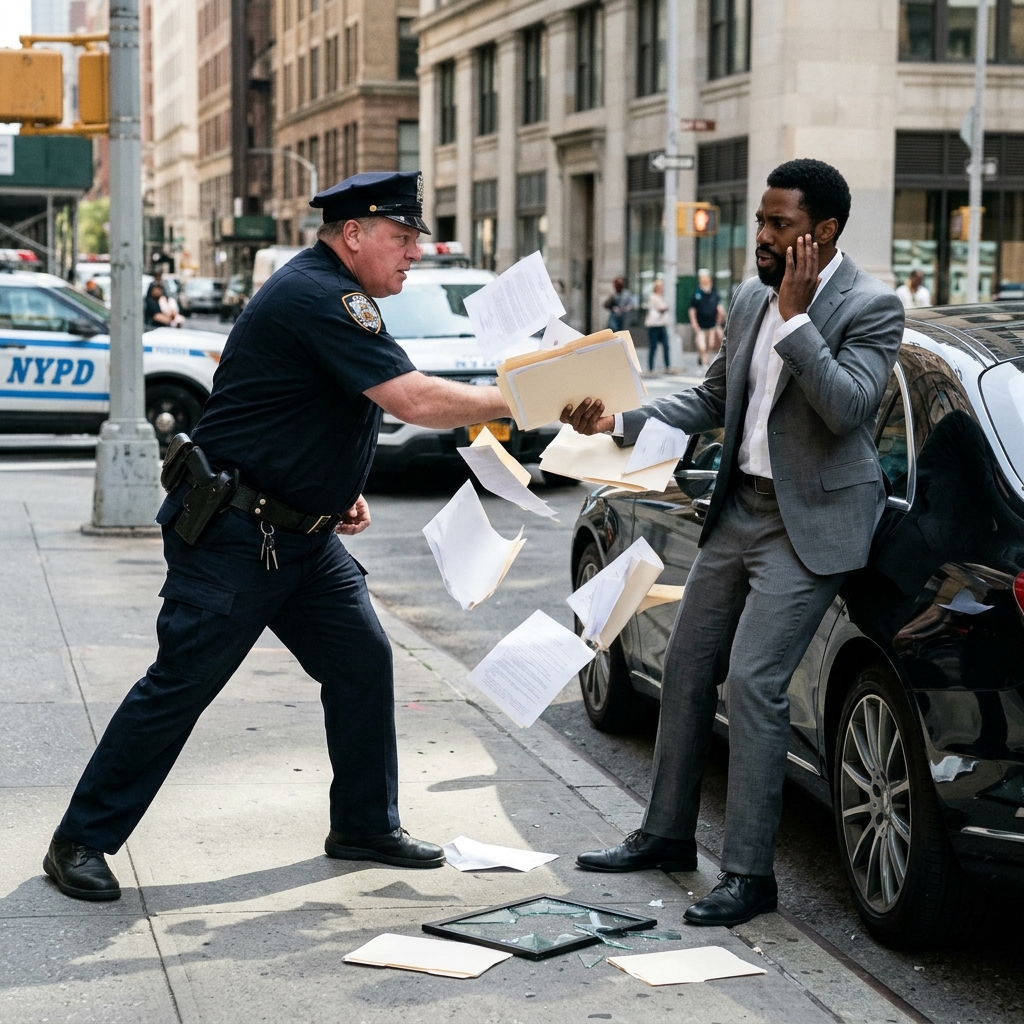
Watching himself on screen was an eerie, disembodying experience. He saw the precise moment Callahan’s heavy hand connected with his face, saw his own head snap back, saw the papers scatter like autumn leaves across the grey concrete.
He paused the frame on Callahan’s face—the sneering, arrogant grimace of a man who believed the law applied only to the people he patrolled.
Then, Marcus opened the financial dossiers he and Sarah had compiled. He cross-referenced the dates of the East Harlem tenement evictions with the wire transfers originating from Meridian Development’s shell accounts.
The math was undeniable.
Every time a building was cleared by police tactical units under the guise of “code enforcement,” a corresponding payout was funneled through a police benevolent slush fund directly controlled by Deputy Chief Harrison’s brother-in-law.
It was a clean, viciously efficient pipeline of corruption. Callahan was merely the blunt instrument at the end of a long, expensive chain of command.
If Marcus released the video tomorrow morning as planned, it would cause a media firestorm, but Harrison and the developers would survive unscathed, writing off Callahan as an embarrassing liability.
To truly dismantle the machine, Marcus needed the master ledger—the physical ledger that Harrison kept in his personal office safe at One Police Plaza.
And there was only one person with the security clearance to retrieve it without triggering a departmental lockdown: Detective Elena Vasquez.
Before the first pale rays of Manhattan sunlight managed to slice through the smog and concrete canyons, Marcus sat in the back of an all-night diner three blocks from police headquarters, nursing a black coffee.





