The bell above the door chimed softly, and Detective Vasquez slid into the booth across from him. She looked exhausted, her trench coat damp from the lingering morning mist, dark circles bruised beneath her sharp eyes.
She set a heavy, leather-bound ledger on the table between them, its pages yellowed at the edges.
“You’re out of your mind, Vance,” Vasquez whispered, her voice tight with suppressed panic. “Do you have any idea what it took to get this out of Harrison’s wall safe? If I’m caught, I’m not just losing my pension—I’m looking at twenty years in a federal penitentiary for industrial espionage and theft of police property.”
Marcus opened the ledger carefully, his fingers tracing the handwritten entries penned in heavy black ink. The names, the dates, the property addresses, and the specific cash amounts distributed to various precinct commanders lined up with mathematical precision.
This wasn’t digital data that could be wiped remotely; it was a physical, undeniable paper trail documenting a decade of systemic municipal extortion.
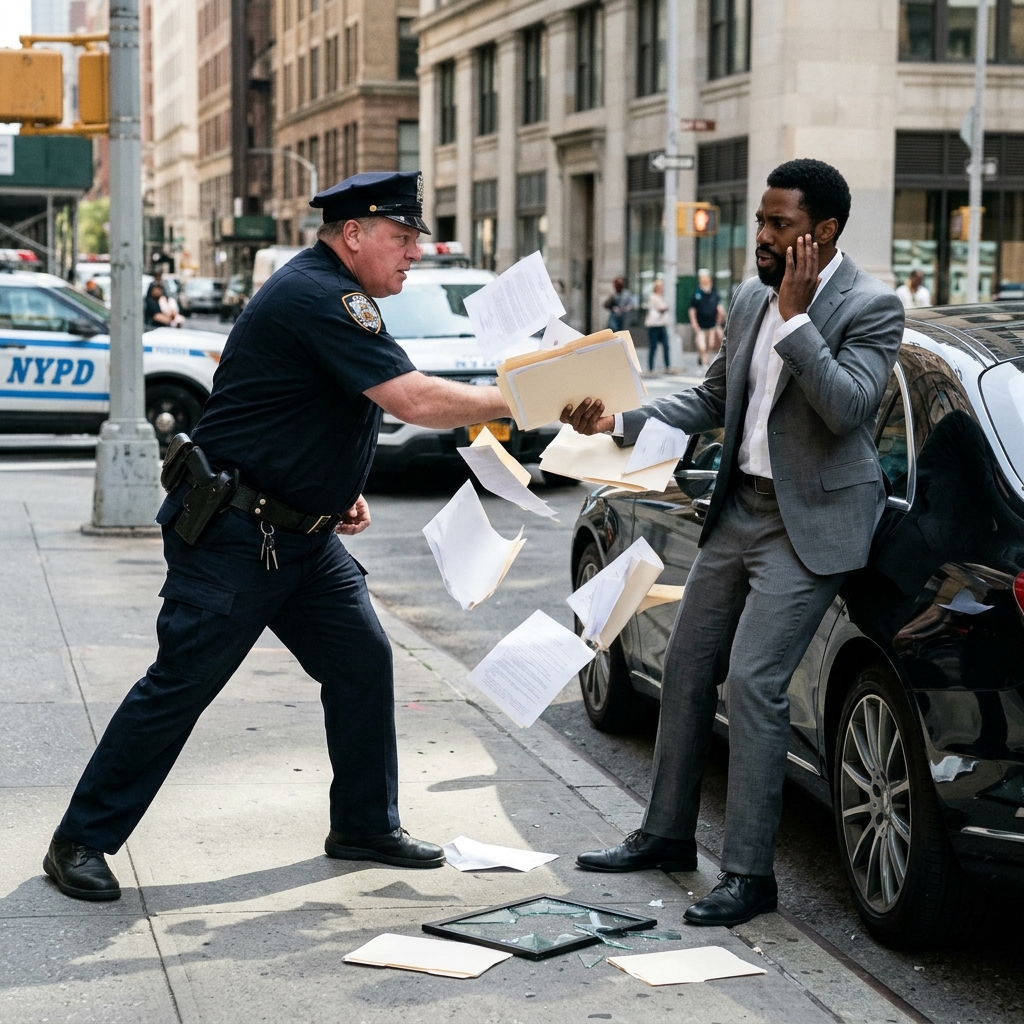
“You didn’t just steal a book, Elena,” Marcus said, looking directly into her eyes. “You exposed a cancer. This ledger proves that Callahan’s slap yesterday wasn’t an isolated incident of racial profiling or bad temper. It was standard operating procedure for a protection racket run out of the highest offices of the NYPD.”
“It proves that Harrison is connected to the syndicate,” Vasquez corrected, leaning in close across the formica table. “Which means the moment this book hits the light of day, every single cop loyal to Harrison—and that’s about half the department—is going to come looking for the person who leaked it. They won’t care about legal procedure or warrants. They operate like an organized crime syndicate because, at this point, that’s exactly what they are.”
Marcus slid the leather ledger into his briefcase, snapping the brass latches shut with a crisp, reassuring click.
That’s why we aren’t handing it to the local precinct or the local DA. I’m flying to Washington this afternoon to hand these documents directly to the United States Attorney for the Southern District of New York, along with the federal civil rights division. Federal jurisdiction is the only shield thick enough to keep us from getting buried under a truck before noon.”
Vasquez stared at him for a long moment, the tension in her shoulders slowly easing as she realized there was no turning back.
“Then you better move fast, Marcus. Because Callahan has already filed a counter-report claiming you assaulted him first, and an arrest warrant with your name on it is sitting on a desk three floors above Harrison’s office right now.”
The subterranean parking garage beneath Marcus’s corporate office building was cold, echoing with the distant drip of an overhead water pipe and the occasional rumble of subway trains shaking the foundations beneath the concrete floor. Marcus walked briskly toward his black sedan, his briefcase clutched tightly in his left hand, his eyes scanning the shadows between parked SUVs. He had received a hurried text from Sarah Lin ten minutes earlier stating that the federal prosecutor had agreed to an emergency morning meeting, but Marcus needed to reach the airstrip in Teterboro by nine o’ando’clock to make it happen.
As he reached his car, the fluorescent light directly overhead flickered and died with a sharp electric pop, plunging the row of parking stalls into sudden, heavy gloom. Marcus froze, his hand hovering over the door handle.
Footsteps echoed behind him—heavy, deliberate, and entirely unhurried.
Marcus turned slowly. Out of the darkness stepped Officer Thomas Callahan, no longer wearing his police cap, his uniform jacket unbuttoned at the collar. In his right hand, Callahan held a heavy steel tire iron, letting it drag lazily against the concrete floor, producing a harsh, grating screech that set Marcus’s teeth on edge.
“You don’t know when to quit, do you, lawyer?” Callahan’s voice was low, laced with a dangerous, controlled malice that was far more terrifying than his public outburst on the sidewalk. “You think you’re smart because you wear a suit and talk to federal judges. But out here on the pavement, rules are written by men who carry heavy iron.”
Marcus kept his body loose, his weight balanced evenly on the balls of his feet, remembering the self-defense lessons his father had insisted he take as a teenager in Philadelphia. “You’re out of your jurisdiction, Callahan,” Marcus said, keeping his voice steady, refusing to give the officer the satisfaction of hearing panic. “And carrying a weapon while under active internal affairs investigation is a very good way to guarantee a federal prison sentence.”
Callahan chuckled, a dry, humorless sound that echoed off the concrete pillars. “Internal affairs only matters if there’s someone left to file the report. Drop the briefcase, Vance. And maybe I’ll only break your arm instead of your skull.”
Instead of dropping the briefcase, Marcus shifted his weight, his eyes locked on Callahan’s right shoulder, calculating the exact trajectory of the impending swing. He knew he couldn’t win a prolonged physical fight against a trained, heavier police officer in an enclosed space. His only advantage was surprise and the heavy, steel-reinforced frame of his briefcase. As Callahan lunged forward with the tire iron raised, Marcus didn’t run; he stepped directly into the strike, using the momentum to slam the heavy briefcase squarely into the officer’s chest.
The impact of the heavy briefcase against Callahan’s sternum knocked the wind out of the veteran cop with a sharp, explosive gasp. Staggering backward, Callahan swung the tire iron in a blind arc, grazing Marcus’s shoulder and tearing the fabric of his grey suit jacket, sending a dull, burning pain radiating down his arm. Marcus didn’t hesitate; he drove his heel backward into Callahan’s shin, hearing a satisfying grunt of pain as the officer lost his footing on the slick concrete and crashed heavily against the side of a parked pickup truck.





