“I wouldn’t miss it for the world, sweetheart,” Marcus said, his voice softening with paternal warmth as he looked at her through the screen. “And I promise I didn’t bump into any more doors this time.”
A month after the federal indictments were handed down, Marcus found himself walking down 52nd and Third during his lunch break, returning to the exact spot outside the municipal records building where the entire ordeal had begun. The sidewalk was busy with pedestrians walking briskly past in business attire, yellow cabs honking in the distance, and the rhythmic hum of downtown traffic filling the autumn air.
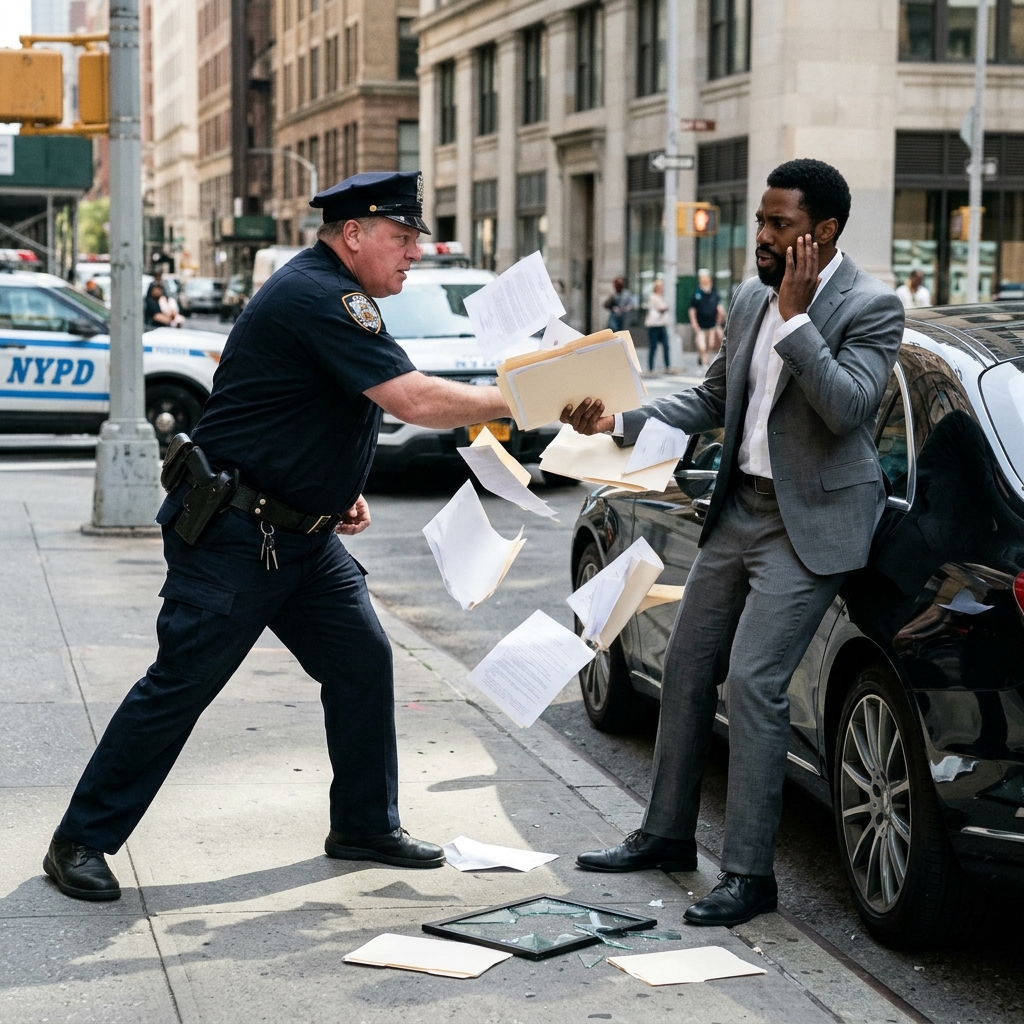
He stopped near the curb where his briefcase had spilled its contents onto the concrete weeks ago. The traffic camera mounted above the intersection still hummed quietly in its housing, panning slowly across the avenue below. The physical bruise on his cheek had completely healed, leaving behind only the invisible armor of hard-earned experience and unyielding resolve.
He thought about Thomas Callahan, currently awaiting trial in a federal holding facility upstate—a man who had traded twenty-five years of honorable service for the hollow comfort of corrupt power and institutional impunity. Callahan’s downfall was a tragic reminder that authority without accountability inevitably consumes the very people sworn to uphold it. But it was also proof that ordinary citizens, armed with truth, courage, and a refusal to be intimidated, could hold even the most entrenched systems accountable.
A young man in a grey suit, carrying a thick stack of manila folders, accidentally tripped over a crack in the pavement near where Marcus stood, sending several papers fluttering down onto the concrete. Without hesitation, Marcus knelt down, gathered the loose sheets, and handed them back to the surprised young lawyer with a reassuring nod.
“Careful with the footing here,” Marcus said with a faint, friendly smile. “The concrete has a way of catching you off guard when you least expect it.”
The young lawyer took the papers, blinking in surprise before offering a grateful grin. “Thanks. I appreciate it. First big case, and I’m already a nervous wreck.”
“Just keep your footing,” Marcus replied, standing up straight as the autumn wind caught his tie. “And don’t let anyone knock you off your path.”
The federal trial of Deputy Chief Harrison and Officer Thomas Callahan commenced in the U.S. District Court for the Southern District of New York in early November. The courtroom was packed to capacity with journalists, legal scholars, and representatives from community housing advocacy groups who had traveled from East Harlem to witness the proceedings.
Marcus Vance took the witness stand on the third day of the trial, his posture composed and professional in a sharply tailored navy blue suit. Assistant U.S. Attorney David Vance—no relation—guided Marcus through a precise, methodical reconstruction of the events leading up to the public confrontation on 52nd Street, entering into evidence the high-definition traffic camera footage, the financial wire ledgers, and the physical documents that Callahan had attempted to scatter across the pavement.
When defense counsel attempted to cross-examine Marcus by suggesting that his aggressive posture had provoked the initial physical altercation, Marcus met the lawyer’s gaze without flinching.
“I was standing on a public sidewalk holding legal documents pertaining to an active municipal fraud investigation,” Marcus stated clearly, his voice carrying effortlessly across the wood-paneled courtroom. “Officer Callahan did not ask for identification, did not issue a lawful order, and did not engage in professional police work. He assaulted me because the syndicate he was protecting was losing control of the narrative, and he wanted to intimidate an officer of the court into silence.”
The courtroom remained dead silent. The evidence presented over the course of the two-week trial was overwhelming and unassailable. The jury deliberated for less than four hours before returning unanimous guilty verdicts on all counts of racketeering, extortion, civil rights violations, and conspiracy against both Harrison and Callahan.
As the judge read the verdict, Marcus sat quietly in the gallery beside Sarah Lin and Elena Vasquez. There were no cheers, no triumphant shouting—only the quiet, profound dignity of justice delivered through the rigorous application of the law. The system had been tested, exposed, and ultimately forced to reform itself from within.
The final chapter of the trial concluded on a brisk December afternoon with the formal sentencing hearing in federal court. Judge Margaret Sterling delivered her rulings with solemn gravity, sentencing Deputy Chief Harrison to twelve years in federal prison without the possibility of parole, and Officer Thomas Callahan to eight years, noting in her remarks that abuse of public trust by those sworn to uphold the law constitutes a direct assault on the foundational principles of a free society.
As Marcus walked out of the federal courthouse steps into the bright afternoon sunlight, he paused to look down at the stone pavement beneath his feet. The city around him was moving forward with its relentless, vibrant energy—taxis streaming past, pedestrians laughing on their way to lunch, and the distant hum of subway trains vibrating through the urban bedrock.
Sarah Lin and Elena Vasquez stood beside him, watching the winter breeze catch the edges of their coats. They had achieved what many thought impossible: they had held power accountable, protected vulnerable communities from displacement, and restored integrity to institutions that had lost their way.
“So, Marcus,” Elena said with a faint, warm smile, sliding her hands into her coat pockets. “What’s next on the agenda? Another corporate merger, or are we dismantling another municipal syndicate before the holidays?”
Marcus chuckled, looking up at the sky as a flock of birds swept gracefully across the skyline between the glass towers. “I think for today, Elena, we just enjoy the walk down the sidewalk.”
He turned and began walking south toward his office, his strides confident, steady, and unyielding. The scars of the confrontation on 52nd Street had faded, but the lessons remained deeply etched into his character. Integrity was not a passive ideal waiting to be discovered; it was an active choice made every single day on the concrete streets where ordinary lives intersect with extraordinary challenges. And Marcus Vance was a man who walked his path with his head held high, ready for whatever lay ahead.





