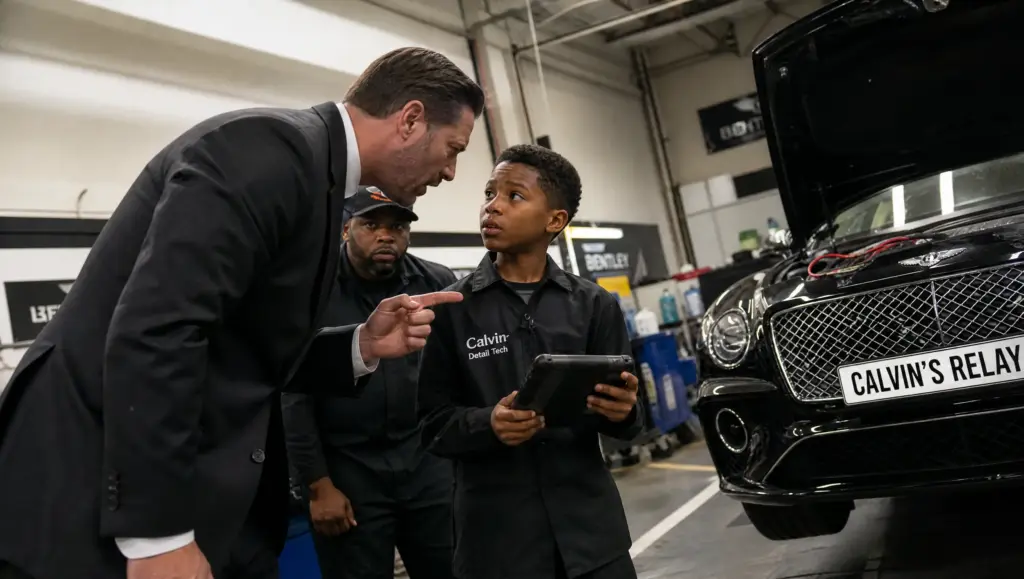
The floor at Larkspur Motorcars was so white that Ezra Toussaint could see the underside of his own chin in it.
He had noticed this at 7:40 that morning, when his mother walked him through the side door by the wash bay and down the service corridor and out into the showroom, holding his elbow the way she held a full cup of coffee. She had put him in the customer lounge, in a leather chair the color of caramel, beside a glass table with a bowl of green apples nobody was supposed to eat. Then she had crouched in front of him in her black prep-department polo, her braids tied up under a bandanna, and said the thing she had been saying in the car.
“Sit. Read. Be invisible.”
“I know.”
“Don’t touch anything. Don’t talk to anybody unless they talk to you, and if they talk to you, you say yes sir, no ma’am, my mother works in prep. That’s it.”
“I know, Mama.”
“I know you know. I’m saying it so I can hear myself say it.” She had looked over her shoulder at the glass offices along the far wall. “Eleven-thirty I’ll take lunch and we’ll go sit in the car and eat. Mr. Kessler doesn’t like family on the floor. If anybody asks, you’re waiting on a ride.”
“Am I?”
“You’re waiting on me,” she said, and squeezed his knee once, hard, and went back through the steel door that said EMPLOYEES ONLY, and the door hissed itself shut on its slow arm.
That was three hours ago. School had an in-service day, the kind of day teachers got and parents didn’t. Pop’s adult day program at Mount Pisgah closed when the schools closed, because half the volunteers were teachers. Aunt Bernice was working a double at the hospital. So here Ezra was, eleven years old, in a navy hoodie with nothing printed on it because his mother had made him change out of the one with the cartoon on it, reading a library copy of a book called Automotive Electrical Systems: Principles and Diagnosis, fourth edition, with somebody’s coffee ring on page 212.
The showroom was quiet in the expensive way. There was music somewhere, piano with no song to it. The espresso machine behind the hospitality counter sighed and spat. The air smelled like leather and lemon floor polish and, faintly, under all of it, like the tire shine his mother used in the back, which was the only thing in the room he recognized as hers. Through the floor-to-ceiling windows the October light came in flat and clean and lay across the cars like it had been paid to.
In the back, under a spotlight, sat a Porsche so dark it looked wet. Near it, two women in long coats were talking with a salesman in a slim gray suit. One of the women had silver hair cut very short and a scarf the color of rust. The other was younger, maybe her daughter, maybe not, and kept checking her phone and then looking at the front of the showroom with a small polite frown.
The front of the showroom was where the trouble was.
A silver Bentley Continental GT sat angled toward the windows, the delivery spot, a white ribbon folded on its roof that nobody had tied yet. Its hood was up. That was wrong in a room like this, Ezra could tell; it was like seeing a man in a tuxedo with his shirt untucked. A mechanic in a dark blue work shirt stood bent into the engine bay with a jump pack clamped to the remote positive post. His name patch said Julian. He had dark hair going gray at the edges and a beard he kept rubbing with the back of his wrist, because his hands were dirty and the car was not.
Every few minutes, the young salesman in the driver’s seat pressed the start button. Every few minutes, the same thing happened. The dash woke up. The center screen began to bloom into a picture. And then, from somewhere under the hood, came a small, dry, rhythmic ticking, tick—tick—tick—tick, steady as a turn signal, and the dash dropped out, and came back, and dropped out, and the starter never even tried.
The first time, Ezra had looked up from page 212 and then made himself look back down.
The fourth time, he had closed the book on his finger.
The seventh time, he had found that he was no longer in the caramel chair. He was standing at the edge of the lounge rug. Then he was on the white tile. Then he was at the front bumper of a car that cost more than his grandfather’s house, close enough to feel the warmth still coming off the engine from an hour of somebody trying, with his hands jammed in the pocket of his hoodie where they could not touch anything.
He didn’t decide to go. It was more that the sound pulled him the way a dropped coin pulls your eyes. Pop said a relay was a little man with one job: when the computer told him to, he closed a door so the big current could get through. A good relay closed the door once and held it. This one was opening and closing, opening and closing, like somebody couldn’t make up their mind. And every time the door opened, the dash died, and every time it closed, the dash came back.
Julian had his meter probes on the battery post. Twelve-point-four, the screen said, then twelve-point-three when the salesman hit the button, then twelve-point-four again. He swore under his breath, a soft, tired word, and reached for the jump pack’s dial as if more would help.
Ezra said, with his eyes on the engine, “Your battery isn’t dead.”
He did not say it loudly. He said it the way you’d tell somebody their shoe was untied.





