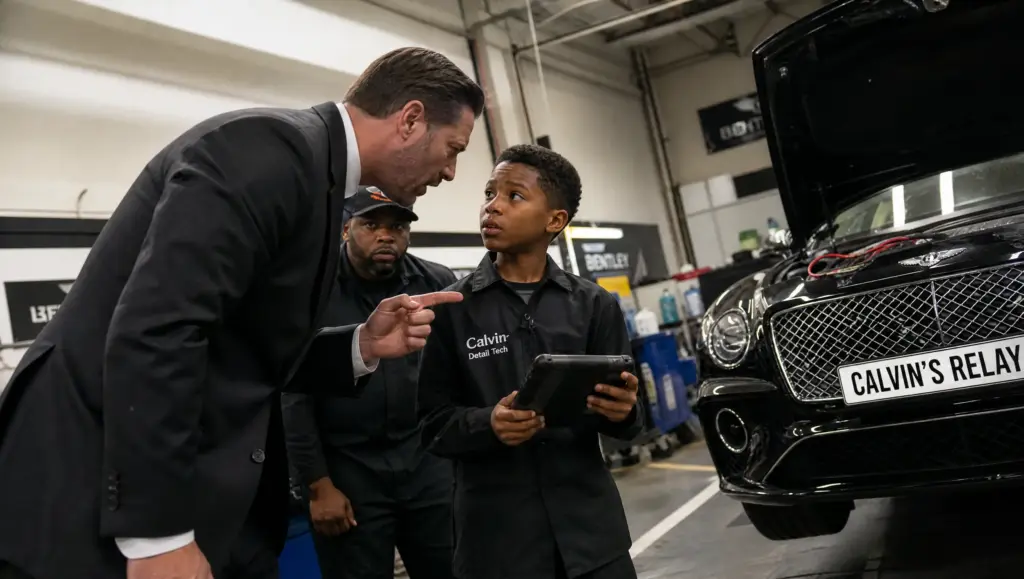
He let the car idle for two full minutes, watching the dash, waiting for it to falter. It didn’t. He had Brody shut it down and restart it four times. Four clean starts. Then he plugged his scan tool into the port under the dash, the factory unit in its yellow rubber boot, and let it walk the modules while the engine ran. The stored codes were still there from the morning, a pile of them like leaves after a storm: low voltage in four modules, a communication fault with the engine controller, a starter-circuit implausibility. That last one was why he’d replaced the starter relay at nine a.m. It had made sense. It was the code that pointed loudest.
It had not pointed at the cause. It had pointed at the symptom of the cause. He’d told apprentices that a hundred times.
He cleared the codes, ran it again, and got nothing. Clean.
Then he did what he should have done before he touched anything: he went back to the relay that was now sitting in the horn position. He had Brody press the horn pad. Nothing. Brody pressed it again. Under the hood, the relay ticked, tick—tick—tick, the same nervous little rhythm, and the horn stayed silent.
The fault had moved. Textbook.
When he looked up, the boy was gone from the bumper.
Julian found him a minute later back in the caramel chair in the lounge, the fat library book open on his knees, his face pointed at the page in a way that was too careful to be reading. Kessler was standing over him again. The two women from the Porsche were at the hospitality counter, pretending to choose between oat milk and almond, listening.
“I’m going to ask you one more time,” Kessler said, pleasantly, the way he said things on the phone to the regional office. “Who brought you in here?”
“I’m waiting on a ride, sir.”
“From whom?”
The boy closed the book. He had a short, neat fade and a face that had decided some time ago not to show things to people who hadn’t earned it. Julian recognized the look. His own daughter had it at fourteen, mostly for him.
“My mother works in prep,” the boy said.
Julian watched that land on Kessler’s face. Prep. The wash bay. The people in black polos who moved cars at five in the morning and vacuumed out the dog hair and gum wrappers and dried the water spots off the paint with a microfiber towel so a buyer could see himself in it. The people the customers never saw, by design.
“Which one?”
“Yolanda Toussaint.”
She didn’t look at Kessler first. She looked at her son. Julian saw the question pass between them — what did you do — and saw the boy answer it with nothing but a small lift of his chin.
“Ms. Toussaint,” Kessler said. “Can I borrow you for one minute?”
They went into his glass office. The glass was the problem with the glass offices; everyone could see everything and hear nothing. Julian, wiping down the fender with a microfiber so the women wouldn’t see his handprints on the silver, watched Kessler talk with his hands open and reasonable, watched Yolanda stand with her gloves balled in one fist. He watched her nod once. He watched her not sit down when Kessler gestured at the chair.
He knew what was being said, more or less, because he’d been at the all-staff meeting in March when Kessler introduced the new policies from the ownership group. Northgate Automotive Partners had bought Larkspur and four other stores the year before, and with Northgate had come laminated cards about the brand experience. No personal phone calls on the floor. No food outside the break room. No family or non-employee visitors in customer areas during business hours. Kessler had read that one out with special emphasis, because somebody’s kid had once spilled a slushie in a Bentayga.
Nine years, Julian thought. Nine years and he had never once spoken to Yolanda Toussaint about anything except where a car was parked.
When she came out of the office, her face was perfectly composed, and her eyes were wet, and she was not going to let one drop fall in that building. She went to the lounge, said something low to her son, and the boy stood and tucked the library book under his arm. Then the two of them walked across the white tile toward the side door, not the service corridor, the front, as if she wanted to use the customer exit once.
Julian could have said something then. He knew it. He could have walked up and said, Your son found the fault. Your son just saved the delivery. Kessler, she shouldn’t be written up for that, she should be — what? Thanked? Paid? He didn’t know the end of the sentence, and while he was looking for it, the door swung shut behind them, and the October light came in across the floor, and the older woman with the rust-colored scarf was standing beside him.
“That child,” she said, “knew exactly what he was talking about.”
“Yes, ma’am.”
“And now he is being sent out. Is that right?”
“I don’t know what’s happening, ma’am.” That was half true.
She studied him. “I’m Ingrid Sato-Bell. This is my car, or will be, once someone ties that ribbon. My late husband bought his first car from a boy about that age, you know. Well. The boy’s father. The boy did the talking.” She paused. “I think I’d like to write a letter.”
“To who?”





