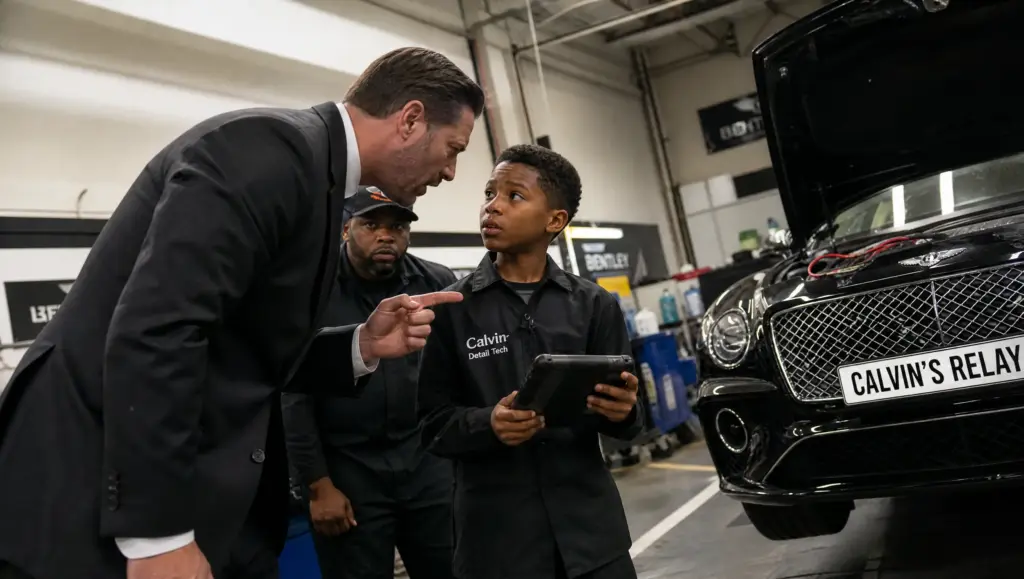
But the room heard it. The salesman in the driver’s seat stopped with his finger over the button. The women by the Porsche turned. And from the direction of the glass offices, a man came walking across the white floor with the particular speed of somebody who was used to arriving at problems and making them go away.
He was older, sixty maybe, with silver hair styled back off his forehead like a wave that had decided to stay. His navy suit fit him the way the light fit the cars. Light-blue shirt, patterned tie, a light-blue pocket square folded into three neat points. On his wrist, a silver watch with a face like a little moon. He came right up to the bumper and stood over Ezra so that Ezra had to tip his head back to see him, and he put his hand on the edge of the open hood as if it belonged to him, which it did.
Every part of Ezra that had been raised said: yes sir. Sorry, sir. Walk back to the chair.
But under the hood, the little man was still opening and closing his door, tick—tick—tick, because the salesman had forgotten to take his finger off the button, and the sound was so plain to Ezra that walking away from it felt like lying.
He looked up and met Mr. Kessler’s eyes, and then Julian’s.
“The relay is cycling.”
Julian straightened slowly, his back cracking. He looked at Ezra for the first time, really looked, the way you look at a gauge you didn’t know was there. “We already replaced it.”
“Then you replaced the wrong one.”
Mr. Kessler laughed, one short note through the nose. He folded his arms across his chest, and the watch caught the window light. “You repair Bentleys now?”
“I repair whatever’s broken,” Ezra said.
He hadn’t planned that either. It was a thing Pop used to say, back when Pop could say whole sentences, standing in the door of Gaines Auto Electric with a rag in his back pocket, when people came in with lawn mowers and box fans and once a church organ. I don’t repair brands. I repair whatever’s broken.
Julian wiped his hands on a red shop towel. He did not smile, but something in his face had gone still and interested. “Which relay?”
The relay box was open on the passenger side of the engine bay, its black lid propped against the strut tower, a neat grid of cubes in gray and black plastic. Ezra had been watching it for four tries. On the last two, he’d been close enough to hear exactly where the ticking came from, and to see, under the right light, the faintest jump in the wire loom behind it every time it clicked.
“Third row,” he said. “Second from the left.”
“That won’t fix anything,” Mr. Kessler said, and he said it with a kind of pity, as if he were sorry for everyone involved.
Julian looked at the box. Then he looked at the lid, at the printed legend on the underside, and ran a dirty fingertip down the columns. Ezra watched his lips move. Then Julian looked at the first row, at a relay labeled for the horn, and Ezra saw him check the part number stamped on top of it against the one in the third row. Same number. Same little gray cube.
“Swap ’em,” Ezra said quietly. “If it’s the relay, the problem moves to the horn.”
Julian’s eyebrows went up a fraction of an inch. He didn’t answer. He took a pair of relay pullers off his belt, plastic jaws worn smooth, and rocked the horn relay out of its socket, then the one in the third row, and changed their places, pressing each down with his thumb until it seated with a click you could feel more than hear.
“Brody,” he said to the salesman. “Try it.”
Mr. Kessler sighed. The women by the Porsche had drifted closer. The older one had her hands folded in front of her coat, watching Ezra, not the car.
Brody pressed the button.
The Bentley’s engine came alive all at once, a deep, rolling bark that filled the showroom and rattled the bowl of green apples and settled into an idle so smooth it was more a feeling in the floor than a sound. Inside, the dash bloomed and held: a yellow parking-brake light, a tidy 1.0 mi on the odometer, a glowing P, and on the center screen a slowly rotating picture of a white Bentley, perfect, turning in its own little sky.
Nobody said anything for a second. The engine just kept going, steady, a big animal breathing.
“It started,” Julian said. He sounded like a man who had walked into the wrong room of his own house.
Ezra let the corner of his mouth go up, just a little, just once. “I told you the battery was fine.”
Mr. Kessler’s arms were still crossed. But the smile was gone off his face like somebody had wiped a window, and for a moment, before he put something else there, he only looked old, and surprised, and caught.
II.
Julian Marek had been a Bentley-certified master technician for nine years, and for most of that time he had believed that the worst sound in the world was a customer saying it only does it sometimes.
Now he knew it was the sound of an eleven-year-old being right while you stood there holding the wrong part.





