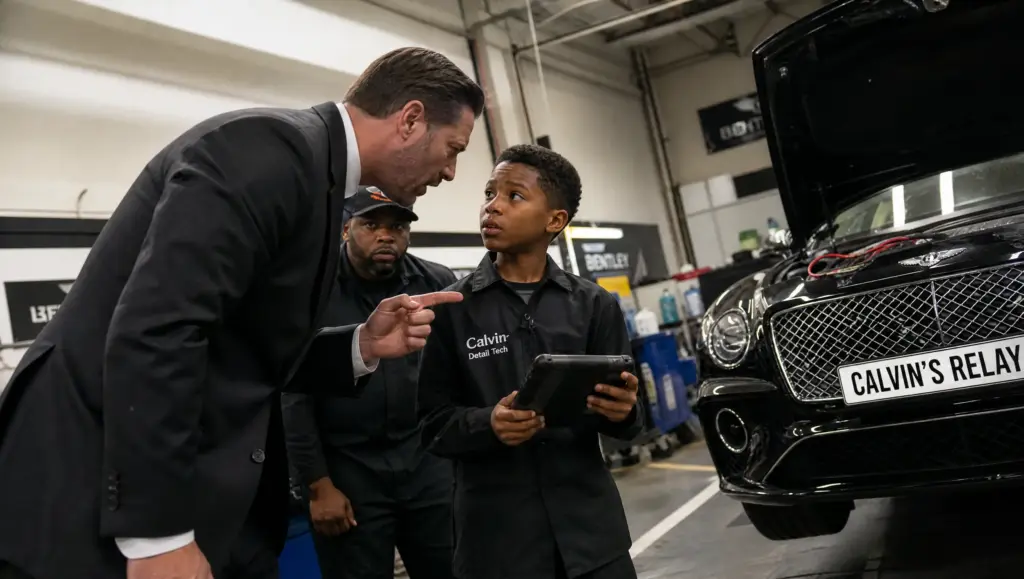
He had learned all of it here, on this stool. Before he could read well he’d sorted bolts by size into coffee cans for a quarter a can. At six he could tell a starter from an alternator by weight with his eyes closed. At eight, Pop had given him the yellow multimeter with the cracked case and taught him the three things: volts are pressure, amps are flow, ohms are how hard the wire fights you. They’d tested every outlet in the house. They’d tested the Christmas lights and found the one bulb. They’d tested Aunt Bernice’s dryer and found a thermal fuse the size of a vitamin.
After the stroke, the lessons got harder and better. Pop couldn’t explain anymore, so he showed. He’d put a part in Ezra’s hands and point at the manual, a fat repair book with grease thumbprints on the pages, and make Ezra read the diagram out loud until it made sense. Saturdays, before the money got too tight, Mama would drive them to Kearney’s U-Pull on the county road, eight dollars to walk the rows, and Pop would go along in his transport chair while Ezra pushed, and they would stop at cars with their hoods up and Pop would point: that one, that one, pull that. Ezra pulled relays out of a hundred dead cars — Fords, Hondas, a wrecked Audi that smelled like a wet dog, a burnt-out Mercedes with its seats melted — and brought them home in a coffee can, and they’d test them on the bench with a nine-volt battery and a test light. Good ones clicked once and held. Bad ones chattered, or did nothing, or held and dropped. Pop made him listen to hundreds. Listen. Listen. Listen. Until Ezra could tell a tired relay from a dying one the way his mother could tell from the hallway which of his coughs meant a real fever.
It was not magic. He wanted somebody to understand that. It was coffee cans and Saturdays and a cracked yellow meter and a man who couldn’t talk making him do it again.
Mama came out to the shop at nine with two plates of rice and smothered chicken covered in foil. She set them on the bench and stood in the doorway with her arms crossed, looking at the two of them in the hanging light, and for a minute she looked like she was going to say something sharp.
Instead she said, “Was it really the relay?”
“Yes, ma’am.”
“You’re sure.”
“The mechanic swapped it with the horn one and the horn stopped working. That’s how you know.”
Mama nodded. She looked at Pop. Pop looked back at her with his eyebrows up, and something passed between them that Ezra was not part of, something old, from before he was born, from when this shop was full and his grandmother was alive and his mother was the girl doing homework on this same stool.
“He used to do that,” Mama said finally, to nobody. “Walk up to people’s cars at the gas station and tell them what was wrong. Drove me crazy. I’d be fourteen in the passenger seat, dying.”
Pop laughed, a big wet laugh, and knocked his fist twice on the chair.
“I’m not mad you were right,” Mama said to Ezra. “I need you to hear that. I’m mad that being right doesn’t pay the light bill. And I’m mad at myself that I put you in that chair and told you to be invisible, like that was a thing a person should have to practice.” She pressed her lips together. “Eat your food.”
IV.
Warren Kessler’s father had sold used cars off a gravel lot on Halsey Street with plastic pennants strung from the light poles, and every night of Warren’s childhood he had come home smelling of cigarettes and Armor All and said the same thing at the dinner table, whether he’d sold four cars or none: Nobody buys a car from a man who looks like he needs the sale.
So Warren had spent forty years not looking like he needed anything.
He sat that night in his kitchen in the townhouse he had bought after the divorce, under pendant lights his ex-wife would have hated, with a glass of something brown he wasn’t drinking, and turned his watch over in his fingers. It had been a gift from the old owner, Mr. Larkin, at Warren’s twentieth anniversary, back when Larkspur was a family store and the family came to the Christmas party and Mr. Larkin made a speech in which he called Warren the best closer on the eastern seaboard and everyone laughed because it was probably true.
Mr. Larkin was dead. His children had sold to Northgate. Northgate had a regional vice president named Dana Whitfield who was forty-four and wore sneakers with her suits and spoke, in their monthly calls, about customer journey and frictionless delivery and the next-generation leadership pipeline. Warren had sat through enough of those calls to understand what pipeline meant. It meant someone younger standing at the end of it.
Dana Whitfield was coming on Tuesday for the quarterly review.
He thought about the boy.
He’d been doing that all evening, and he didn’t like it. He’d replayed it the way he replayed a deal that had gone sideways: there was the moment he could have stayed in his office; there was the moment he could have said, Well, young man, show us; there was the moment he’d said, You repair Bentleys now? and heard his own voice and thought, briefly, oh, before the engine turned over and the thought was swallowed up by the noise.