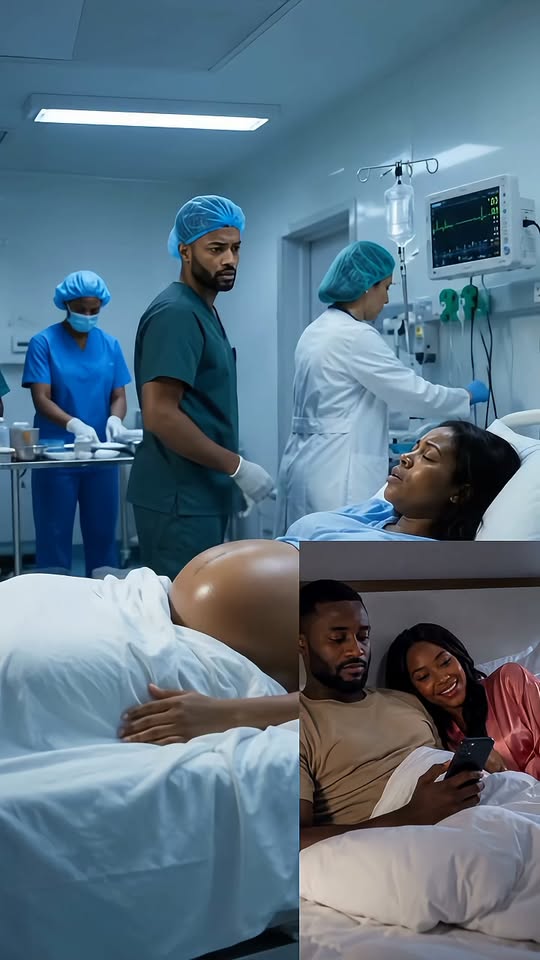
Eight minutes without oxygen in a severed womb. Eight minutes while he was pinning Chloe’s wrists to the headboard of Suite 814.
“And Angela?” he whispered.
Sarah took a step closer, her voice barely louder than the hum of the overhead fluorescent tubes. “Your wife lost four and a half liters of blood, Mr. Vance. The abruption was complete. When the uterus ruptured, the placenta sheared through the left uterine artery. They had to perform a bilateral hypogastric artery ligation and a total abdominal hysterectomy to control the hemorrhage. She is currently in the surgical intensive care unit under heavy sedation. She has not regained consciousness.”
Marcus buried his face in his hands.
His palms were rough, calloused from the gym, but they felt cold, alien, like two slabs of raw salt pressed against his eye sockets. He did not cry. He couldn’t find the moisture for tears; his throat was dry, his tongue swollen, his entire body shaking with an internal, subterranean vibration that felt like an engine tearing itself off its mounts.
“I need to see her,” he whispered.
“You can see her through the window,” Sarah said gently. “She isn’t stable enough for visitors inside the room. Follow me, please.”
The Surgical Intensive Care Unit on the fourth floor was dark.
Unlike the chaotic glare of the emergency bay, the hallway was illuminated only by the faint, greenish glow of telemetry monitors and the low, recessed footlights set into the baseboards. The air here was colder, smelling of plastic tubing, iodophor solution, and the dry, synthetic chill of central oxygen lines.
Sarah stopped before Room 408.
The door was heavy, double-paned glass with a narrow viewing strip in the center. Inside, framed by four towering racks of infusion pumps that pulsed with steady, rhythmic green LEDs, lay Angela.
She looked tiny.
In life, Angela had commanded rooms. She was five-foot-eight, broad-hipped, with an upright, athletic carriage that made her look like she was always walking toward a podium to deliver an opening statement. Now, under the white waffle-weave hospital blanket, she seemed to have collapsed into the mattress, her frame no thicker than a child’s.
Her head was turned slightly to the left. A clear plastic endotracheal tube was taped securely to her lower jaw with white cloth tape, the corrugated blue hose rising to a mechanical ventilator that hissed and clicked with every cycle: shhh-click… shhh-click…
Her face was swollen, pale as suet, covered in tiny, purplish petechiae from the violent pressure of her cardiac arrest. Both of her forearms were taped to rigid armboards, bristling with central venous lines, arterial monitors, and blood-transfusion tubes that carried thick, dark red fluid from suspended bags into her collapsed veins.
Marcus pressed his forehead against the cold glass of the viewing strip.
“Angela,” he breathed. His breath fogged the glass, obscuring her face, and he frantically wiped the condensation away with the sleeve of his coat. “Angela, it’s Marc. I’m here. I’m right here.”
Behind him, rubber-soled clogs squeaked against the linoleum.
Marcus turned.
Dr. Elena Chen stood four feet away, her surgical cap pushed back onto her graying curls, her blue paper mask hanging loosely beneath her chin. Her green scrubs were soaked through at the chest with a vast, rust-colored map of dried blood that had stiffened the cotton into rigid folds. Her arms, bare from the elbow down, were red and raw from the post-operative scrub brush.
She did not look at his face. She looked at his neck, where the collar of his t-shirt was torn, and then down at his trousers, where the gold band was missing from his hand.
“She’s in a medically induced coma,” Chen said. Her voice was flat, clinical, entirely devoid of the fury that had come through the phone an hour earlier. It was the voice of a surgeon who had nothing left to give the living. “Her core body temperature is ninety-five degrees. We’re running three pressor agents to keep her mean arterial pressure above sixty. If her kidneys don’t produce urine by four in the morning, we’ll have to initiate continuous renal replacement therapy.”
Marcus swallowed, his throat clicking dryly. “Will she… will she wake up?”
“I don’t know,” Chen said. “Her brain was without adequate perfusion for nearly ten minutes during the arrest. The EEG shows suppressed background activity, but there’s too much fentanyl and propofol in her system to perform a reliable neurological assessment. We won’t know the extent of the hypoxic injury until we attempt to wean her from the ventilator.”
Chen stepped forward, her eyes finally rising to meet his.
They were small, dark, and hard as river stones.
“The EMTs found her phone on the floor of the brownstone,” Chen said softly. “It was still connected to the video call log. She had tried to dial your private line forty-two times between nine and eleven o’clock, Mr. Vance.”
Marcus didn’t move. He couldn’t.
“When her water broke,” Chen continued, her cadence slow, measured, each syllable dropping like an iron weight into the quiet corridor, “she knew something was wrong. She had me on the pre-natal emergency line three days ago. She knew what an abruption felt like. She knew that if the bleeding started, she had less than fifteen minutes before the baby suffocated.”
Chen leaned in until she was six inches from his ear. She smelled of surgical smoke and dried iron.
“She stayed in that hallway for two hours because she thought you were on your way home. She didn’t call the ambulance until her systolic pressure dropped below eighty, because she kept telling the dispatcher that her husband was five minutes away with the car.”
Chen drew back. Her gaze dropped to the bruise on his cheekbone, then lingered for two seconds on the scent of tuberose that still drifted from the wool of his topcoat.





