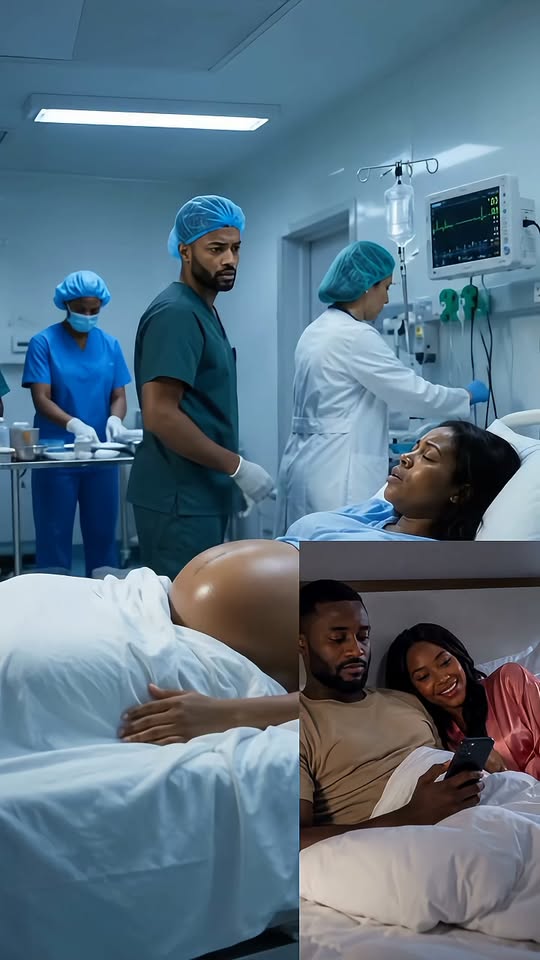
He burst through the door of Suite 814, his footsteps pounding down the carpeted hallway of the eighth floor. A night porter carrying an armful of pressed linens pressed himself against the wallpaper in terror as Marcus blew past him, his torn beige shirt fluttering like a sail, his eyes bloodshot, his jaw swollen where Chloe’s palm had struck him.
He didn’t wait for the brass elevators. He kicked open the heavy fire-exit door, throwing his weight against the iron bar, and hurled himself down the concrete staircase four steps at a time. The sound of his own breathing echoed in the concrete shaft—a wet, sobbing rasp that scraped the lining of his throat.
He burst into the lobby of the Mercer Grand like an escaped convict.
The night manager, an immaculate European in a three-piece suit, looked up from behind the marble reception counter with an expression of icy disdain. “Sir? Excuse me, sir, you cannot—”
Marcus ignored him, shoving past the revolving glass doors and plunging headlong into the deluge.
The rain was an icy wall of needles that struck his bare chest through the tear in his shirt, instantly soaking the cotton and plastering it to his ribs. Broadway was nearly empty at three in the morning, slick and black as polished basalt. A single yellow cab was idling at the red light on the corner of Prince Street, its roof-light glowing amber through the spray.
Marcus sprinted through the gutters, water splashing up to his shins, and threw himself against the passenger door, tearing it open and collapsing into the vinyl rear seat.
“New York-Presbyterian!” he screamed, his voice cracking into a ragged, bloody shriek as he pounded his fist against the plexiglass partition. “Lower Manhattan! Worth Street! Drive! Drive, you motherfucker, drive!“
The driver, an elderly West African man with hollow cheeks and tired eyes, took one look in the rearview mirror at Marcus’s wild, bleeding face and slammed his foot onto the accelerator.
The cab surged forward, tires spinning against the wet steel of the subway grates before biting into the asphalt, rocketing south into the howling belly of the storm.
VI. The White Rooms
The emergency entrance of New York-Presbyterian did not smell of vanilla or amber. It smelled of industrial chlorine, autoclaved steel, and the metallic residue of human plasma that had dried upon rubber floor mats.
The automatic doors had barely parted before Marcus threw his shoulder against the glass, stumbling into the triage lobby.
“Angela Vance!” he shouted, his voice echoing off the acoustic ceiling tiles, startling two police officers drinking coffee beside the security desk. “Where is she?! Angela Vance! I’m her husband! I’m the husband!”
An elderly triage nurse with silver hair pulled into a severe clip stepped around the plastic barrier, her eyes scanning his soaked, torn attire, the blood drying on his ear where Chloe’s rings had nicked the cartilage, and the wild, unmoored terror in his pupils.
“Are you Marcus Vance?” she asked. Her tone was not urgent. It was something far worse: heavy, flat, and chillingly still.
“Yes! Yes, goddammit! I was… I was on a business conference call, my phone lost reception, I came as fast as—”
“Fourth floor,” she interrupted, her voice devoid of inflection. “Intensive Care Unit, surgical recovery corridor. Dr. Ramos is still scrubbing out.”
Marcus didn’t wait for a visitor’s badge. He lunged toward the elevator bank, slapping his palm against the call button until the light engaged. The ascent was ninety seconds of pure, unadulterated sensory torture: the reflection of his own face in the polished steel doors, distorted, bloated, looking like the caricature of a man who had sold his soul for thirty minutes of counterfeit worship in a hotel bed, only to find the check had bounced before he could leave the room.
Ding.
The doors of the fourth floor parted into the muted hum of the surgical intensive care wing.
The lighting here was different from the emergency room. It was dimmed to an amber twilight designed to keep the dying from being startled by the glare of their own monitors. At the far end of the nursing station, standing before a circular scrub sink with her green paper cap dangling around her neck, was Dr. Elena Ramos.
She was leaning her forearms against the stainless steel rim of the basin, her head hanging low between her shoulder blades. Her surgical scrubs were stained with vast, dark maps of dried arterial blood across the chest and thighs. Her hands, raw and pink from the antiseptic scrub, were shaking slightly.
Marcus walked toward her. His footsteps were slow now, heavy, his loafers squelching with each step on the linoleum.
“Doctor,” he whispered.
Ramos did not turn around immediately. She reached for a paper towel, dried her hands with slow, methodical strokes, crumpled the paper into a tight ball, and tossed it into the biological hazard bin. Only then did she turn her head to look at him.
Her eyes were sunken, rimmed with dark, bruised rings of exhaustion and pure, clinical contempt.
“You’re twenty-two minutes late, Mr. Vance,” she said.
Marcus felt his knees turn to water. He reached out, his fingers catching the edge of the nurse’s station counter to keep from collapsing to the floor. “Is she… Angela… did you…”
“We had to perform the crash section without general anesthesia on board,” Ramos said, her voice dropping into a rhythmic, terrifying monotone. “There was no time to intubate before the fetal heart tone dropped to zero. I made the midline incision while the nurse was still holding the mask to her face.”
Marcus’s chest hitched. He could not breathe. “The baby?”





