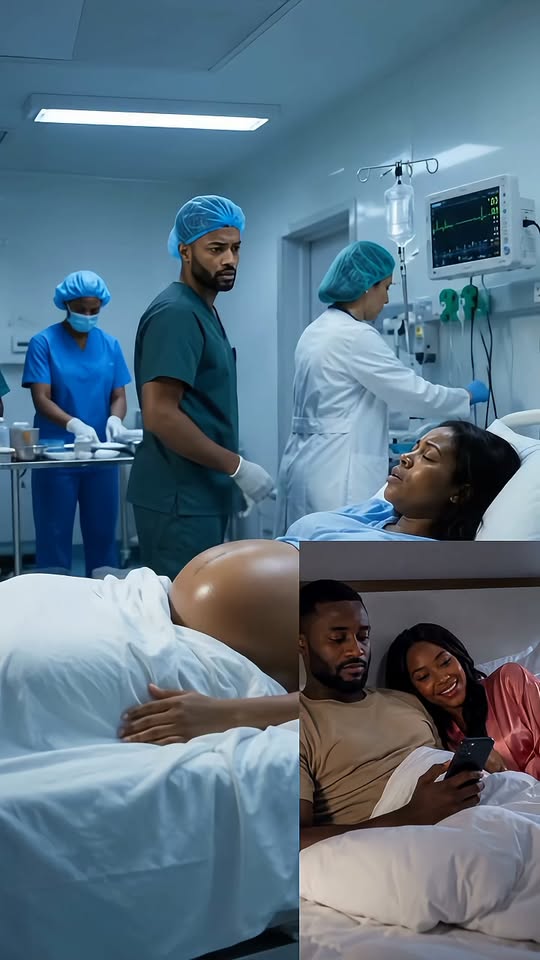
Marcus went rigid. His fingers around Chloe’s wrists went completely slack, as if every nerve ending in his forearms had been severed by an axe.
Chloe stopped fighting. Her thrashing ceased so abruptly that the silence inside the room became an active, physical pressure. She stared at Marcus, then looked down between their bodies to where the phone lay face-up on the white linen, illuminated by the harsh, blue-white glare of an active surgical feed.
The camera on the other end was mounted to the ceiling boom of Trauma Bay 4 at Mount Sinai.
On the screen, Angela Vance was barely recognizable.
Her skin, usually the rich, warm mahogany of polished cedar, had turned the color of damp newsprint. Her eyes were rolled back beneath her lids, showing thin, white crescents that fluttered in time with the rhythmic convulsions of her upper body. She was stripped to the waist, her swollen, thirty-eight-week belly exposed under the halogen operating lights—taut, bruised with purple subcutaneous pooling, and glistening with a wash of orange iodine that a nurse was frantically slapping over her abdomen with large gauze sponges.
Two residents in blood-splattered green scrubs were holding her shoulders down while an anesthesiologist jammed a plastic laryngoscope blade into the back of her throat, suctioning brown amniotic fluid from her windpipe.
“Marcus!” Dr. Elena Chen was screaming directly into the lens, her face shield misted with breath and flecked with bright red droplets of arterial blood. “Your wife suffered an acute placental abruption twelve minutes ago in the back of an Uber! She has a grade-four uterine rupture! The fetus has been without maternal perfusion for seven minutes!”
The screen hitched as Chen turned to bark an order over her shoulder: “Push four units of O-negative! Where the fuck is the cell saver?! Charge to two hundred!”
Then her face lunged back toward the lens, her eyes wide with a cold, terrifying fury that seemed to reach across seventy blocks and grab Marcus by the throat.
“She’s in full disseminated intravascular coagulation! Her blood isn’t clotting! I need surgical authorization for a perimortem hysterectomy right now, or both of them are going to be corpses before the elevator reaches the fourth floor! Where are you, Marcus?! Why aren’t you at the hospital?!“
The room did not echo. The sound was too heavy for echoes; it simply fell onto the carpet like wet sand.
Your wife.
Your wife suffered an acute placental abruption.
Both of them are going to be corpses.
Chloe did not scream. The breath left her body in a long, whistling hiss, like an inner tube punctured by a nail. She backed away across the bed on her elbows and knees, her eyes fixed on the screen, her mouth open in a soundless, horrified grimace. When her bare back hit the edge of the mattress, she tumbled off, striking the floor with a dull thud of bone against wool, scrambling backward until her spine slammed into the closed door of the walk-in closet.
“She’s having your baby,” Chloe whispered. The words were small, thin, completely stripped of her previous rage. “She’s dying. And you were… you were lying here telling me about Cobble Hill.”
Marcus didn’t answer. He couldn’t speak. His tongue felt like a piece of salted leather wedged against his palate.
“Marcus!” Dr. Chen’s voice ripped through the speaker again, competing with the flat, unbroken scream of the heart monitor. “Authorize the incision! The voice-biometric protocol requires an affirmative from the legal proxy! Say the word, you coward! Say proceed!”
“Proceed,” Marcus croaked.
The word barely made it past his teeth.
“Speak into the microphone!” Chen yelled. “Say proceed!”
“Proceed!” Marcus screamed, his voice breaking into a ragged, bloody rasp that tore the lining of his throat. “Proceed! Cut her! Cut her open!”
“Incision time: twelve-fourteen,” Chen snapped to her scrub nurse.
The camera tilted as someone moved the boom. For half a second, the lens caught the lower half of the table: a ten-blade scalpel sinking into the orange-stained flesh of Angela’s abdomen, followed by an immediate, terrifying geyser of dark, venous blood that hit the surgeon’s paper gown before the suction tip could find the field.
Then the screen died.
COMMUNICATION DISCONNECTED BY REMOTE STATION: EMERGENCY PROTOCOL ACTIVE.
The city outside the taxi window did not look like Manhattan. It looked like an abandoned quarry carved out of granite, the streetlights reflecting off the black puddles in long, jaundiced smears that blurred together as the cab took the turn onto West End Avenue at forty-five miles an hour.
Marcus had not put on socks. He had shoved his bare feet into his unlaced leather loafers, grabbed his camel-hair topcoat without buttoning it, and sprinted through the revolving doors of the Mercer into the rain. He had left his wallet on the nightstand. He had only the black titanium Amex card he kept in his phone case and seventy dollars in crumpled twenty-dollar bills he had found in the pocket of his trousers.
The cab driver, an elderly Ghanaian man with a faded prayer cap pulled low over his ears, kept glancing in the rearview mirror.
Marcus sat in the center of the vinyl bench seat, his knees pressed together, his hands flat on his thighs. He was shivering, but his skin was hot, covered in a greasy, cold film of sweat that smelled of sulfur and fear. Across his left cheek, the imprint of Chloe’s fingers had darkened into a deep, plum-colored bruise that made it painful to open his mouth more than an inch.
“Can you go faster?” Marcus asked. His voice didn’t sound like his own; it sounded like the voice of an old man who had spent forty years in a limestone cellar.
“There is a road crew on Seventy-Second, sir,” the driver said, his voice rhythmic and calm. “The steam pipe broke. We have to go around by Amsterdam.”





