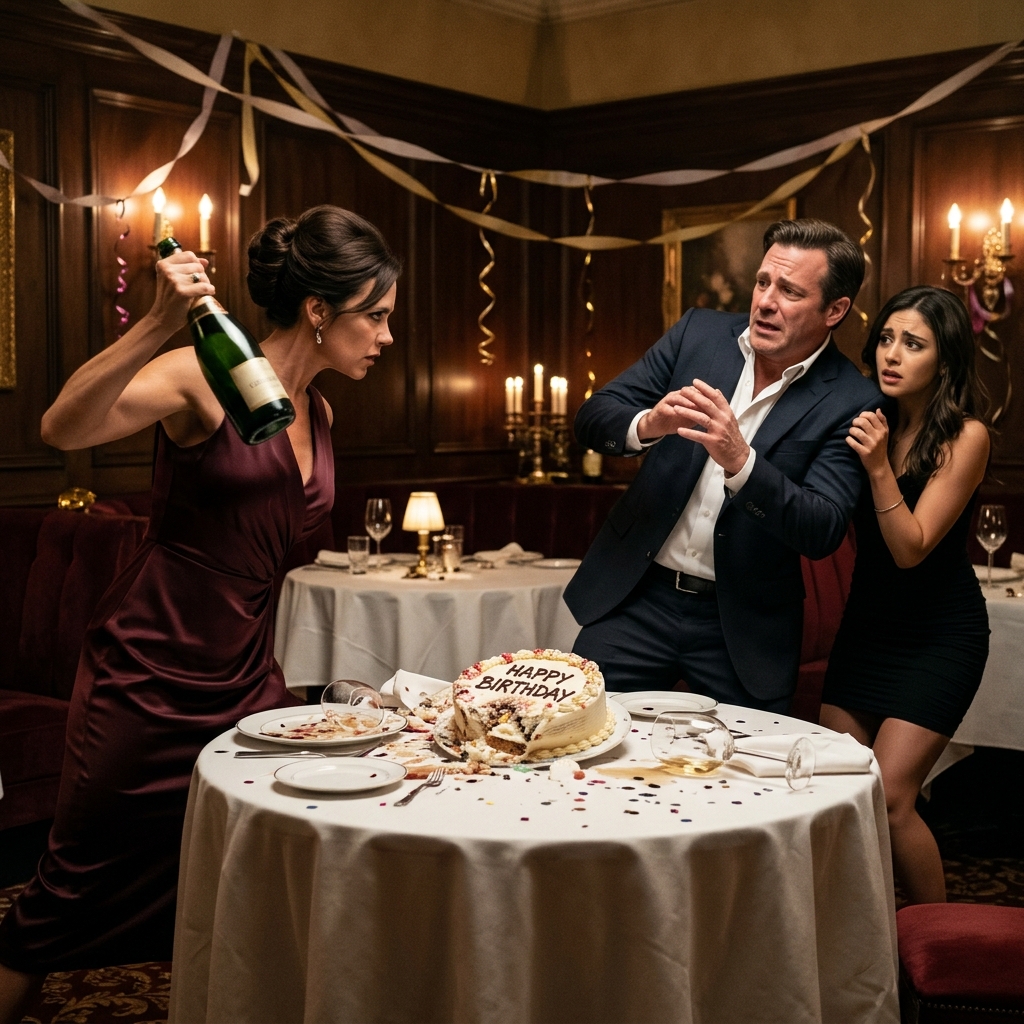
Act I: The Geometry of a Spill
The silver cake board had begun to bend beneath the weight of hazelnut butter cream and three layers of genoise sponge. It bit into the flesh of my thumbs through the thin waxy paper of the patisserie box. A dull, rhythmic pulse beat against my temples, timed to the low murmur of rain tapping against the leaded glass transom above the entrance of Le Cadran.
I knew the room before I turned the handle. Private Dining Room B was long, narrow, paneled in dark walnut, and smelling perpetually of beeswax and dry sherry. I had booked it six weeks ago for my thirty-eighth birthday, settling the deposit with my own debit card because Daniel always forgot the administrative tax of joy.
He was fond of saying he loved my competence. You are my anchor, Victoria, he would say, pressing his lips to the hollow behind my ear while I cross-referenced flight itineraries, tax liabilities, or the quarterly reports for Mercer Capital.
I had worn the burgundy wool dress he bought me in Milan three winters ago. It had a discreet cowl neck and long sleeves that tapered tightly at the wrists, the kind of garment designed to make a woman feel architectural—armored, yet fluid. In the cab on the way over, I had even retouched my lipstick in the rearview mirror, checking the silver strands weaving through the dark wave at my left temple with an indulgent sort of pride. Thirty-eight felt earned. We had survived the startup phase of his firm; we had survived my second miscarriage; we had survived the quiet, desiccating chill that settles into a suburban brownstone when two people become too polite to confess they are lonely.
The brass latch of the private dining room did not click; it drifted open on oiled hinges.
The room smelled of tuberose.
It was a heavy, suffocating scent—the signature perfume of Sophia Vance, our junior partner in acquisitions, whom I had personally interviewed nine months earlier in our breakfast nook while Daniel made French press coffee and nodded at her references from Wharton.
They were not sitting. They stood against the mahogany sideboard beneath the soft amber cone of an art-deco sconce.
Daniel had his palms flat against the wood on either side of her hips, his head dipped low. His fingers were curled slightly into the edge of the veneer, his coat already discarded on the back of an armchair. Sophia’s fingers were buried in the graying hair at his nape, her face tilted upward at an angle of practiced, ravenous surrender. Her small, sharp mouth was fused to his.
It was not a tentative crossing of boundaries. It had the synchronized, greedy cadence of an appetite indulged so often that manners had ceased to exist. His thumb rose, tracing the curve of her jawline, brushing the pale skin beneath her ear with a thumb-stroke I recognized in my marrow. He had touched me like that on the stone steps of the Sacré-Cœur when we were twenty-five and owned nothing but two passports and a shared umbrella.
My shoes made no sound on the deep Persian runner. The world did not shatter; it simply contracted until the air felt thin and vitreous, like water freezing under an icebreaker’s bow.
The gold foil lettering on the top of the box caught the yellow light: Joyeux Anniversaire, Victoria.
I stood there for three seconds, perhaps four, holding eight pounds of confectioner’s sugar and butter, waiting for the scene to reorganize itself into something permissible. A trick of shadow. A sudden fainting spell he was gallantly arresting. Some absurdity my mind could digest without tearing along the seams.
Then Sophia opened her eyes.
Her gaze shifted over Daniel’s shoulder, lazily at first, heavy-lidded with heat, before snapping wide. The pupils dilated until the pale hazel of her irises turned black. She stiffened, her hands dropping from his collar with the dry rustle of silk.
Daniel pulled back, a question forming on his mouth, his lips still slick and pink from hers. He turned, half-laughing, expecting a waiter.
When his eyes met mine, his jaw went slack. The flush on his throat did not fade; it darkened into an ugly, mottled crimson that spread toward his ears.
“Victoria,” he breathed.
I looked down at my hands. The silver cake board was cutting deep into my palms now, leaving white half-moons in the skin. The absurd, domestic urge to preserve the pastry took over. I could not drop it. To drop it would be theatrical, and I had spent fifteen years being the woman who did not make scenes.
I walked to the oval table. The linen was fresh, starched so stiffly it held the sharp crease of the iron. I set the cake down in the exact center, between two unlit taper candles, adjusting the cardboard edges until they were square with the place settings.
My breathing sounded extraordinarily loud in the small room.
“Explain this,” I said.
The words did not sound like mine. They were flat, dried out, shorn of resonance—the voice of an actuary reading a total-loss assessment over a crackling telephone line.
Daniel stepped away from the sideboard. His hands came up in a reflexive, placating gesture, the fingers spread wide as if he were trying to talk a jumper down from a ledge.
“Victoria, wait. Please. Just… let me get the door.”
“Don’t touch the door,” I said.
He froze. In fifteen years of marriage, I had raised my voice three times. This was not one of them, yet his foot hovered over the carpet, arrested by the sheer, cold gravity of the tone.
“This isn’t what it looks like,” he stammered. The phrase was pathetic in its antiquity. A man who managed forty million dollars in mid-market equities had nothing better to offer than the stale line of a third-rate farce. “We were—we were discussing the quarterly audit, and things got emotional. Sophia was upset about the restructuring—”





