The refrigerator hummed its steady, indifferent note. I opened the door and stood there in the cold white light, looking at the neatly labeled containers of soup, the carton of eggs, the half-empty jar of Dijon mustard, the bottle of white wine chilling on the middle shelf.
Everything was in its place. The domestic machine was functioning perfectly, even as the engineer was being booked into a holding cell in lower Manhattan.
My phone vibrated in my purse.
It was not Marcus. It was not the firm. It was an automated delivery notification from the bakery on Lexington Avenue:
Thank you for your order, Mrs. Mercer. We hope you enjoyed your celebration. Please rate your experience.
I let out a sound that was half-laugh, half-sob—a dry, sharp bark that echoed off the subway tiles of the kitchen backsplash.
I walked back into the hall, picked up my coat from the banister, and left the front door unlocked. The house was no longer a sanctuary; it was an exhibit in a case that would take two years to settle.
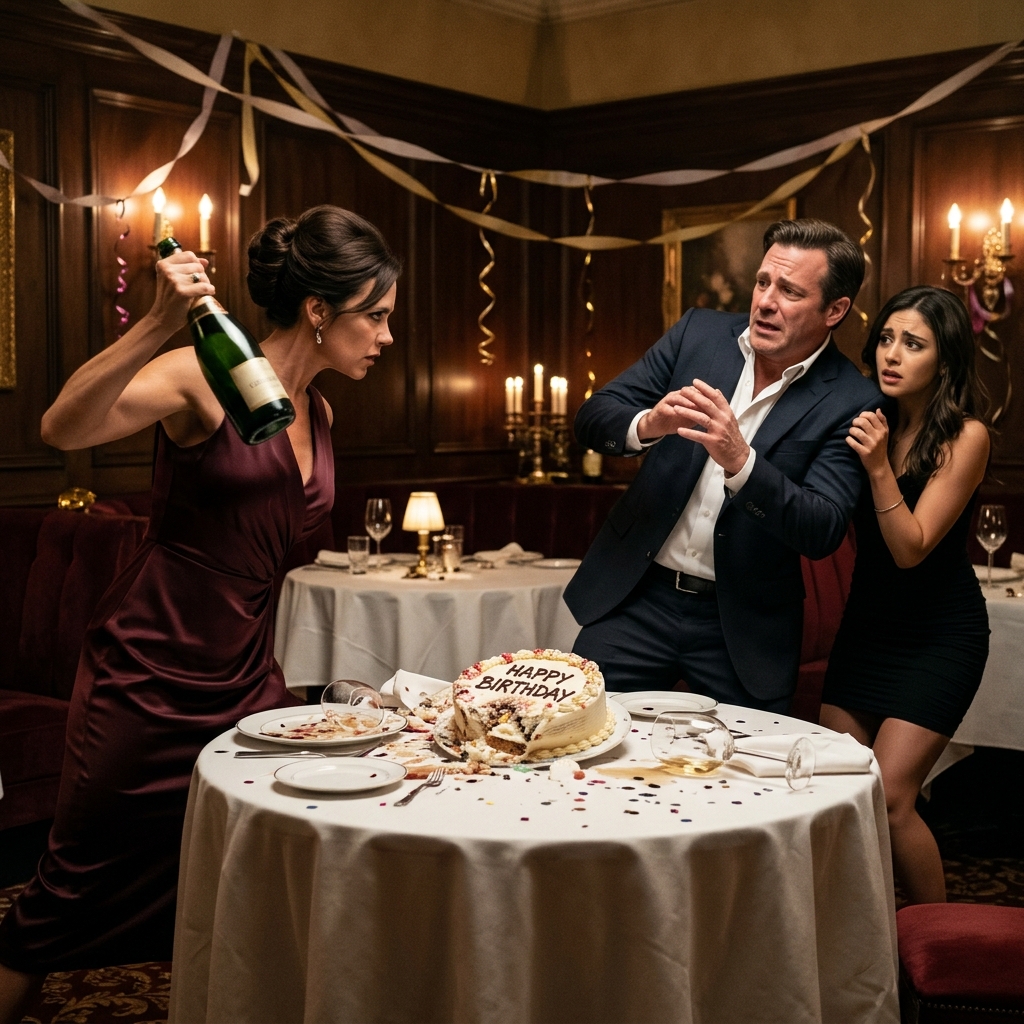
I took the subway uptown, bypassing the taxis, bypassing the cars, sitting among the morning commuters who smelled of wet wool, damp newsprint, and cheap coffee. None of them looked at me. None of them knew that eight hours ago, I had held a four-pound champagne bottle six inches from my husband’s face, weighing the precise difference between vengeance and survival.
I got off at 77th Street and walked toward the park.
The Ramble was nearly empty in the cold November light. The trees had dropped their leaves, leaving their black branches bare and sharp against the pale sky, like veins drawn in iron gall ink. The air was cold enough to bite through the wool of my burgundy dress, but for the first time in five years, the tightness in my chest had loosened.
I found a wooden bench overlooking the gray, wind-ruffled surface of the lake.
I sat down, pulled my leather gloves from my pockets, and smoothed them over my fingers.
I thought about the bottle.
I thought about the cold, greasy weight of it in my palm. The urge to break things is so human, so seductive; it promises an end to pain by turning it outward, by converting shame into glass shards and splintered bone. If I had swung it, I would have felt the brief, blinding satisfaction of the blow—the animal relief of watching him bleed for what he had done to the fifteen years we had built.
And then the police would have come for me.
The story would have been about the hysterical wife who attacked the handsome fund manager in an expensive restaurant. The forgery would have been buried in the tabloid noise. The embezzlement would have been an afterthought. Daniel would have been the victim, Sophia would have been the witness, and I would have been the monster who couldn’t govern her own grief.
By setting it down, I had kept the knife.
I had forced him to stand in the cold light of his own architecture, unsupported by my rage, unshielded by my violence. He had built his own scaffold, board by board, transfer by transfer, kiss by kiss, and all I had done was refuse to hold up the trapdoor.
A sparrow landed on the edge of the gravel path, cocking its head, looking at my leather boots for crumbs.
“Nothing today,” I whispered to it.
The bird flicked its tail and rose into the pale sky, disappearing among the bare oaks toward the reservoir.
I leaned back against the cold wooden slats of the bench. The clock on the tower of the Arsenal struck eleven—eleven long, resonant chimes that rolled across the park, clear and cold as water falling over stone.
Thirty-eight years old.
The cake was gone. The marriage was gone. The firm was an ash-heap on the desk of a federal magistrate.
I reached into my pocket, found my wedding ring, and slid it off my finger. It came away easily, the skin beneath it pale and unlined, marked only by the thin white indentation where the platinum had rested for fourteen years.
I didn’t throw it into the water. That would have been a gesture for an audience, and I was finished with audiences.
I slipped it into my purse, right beside the SIM card and the office keys, and closed the brass zipper with a firm, decisive click.
The wind off the lake was picking up, smelling of winter, of coming snow, of clean, empty distances. I stood up, smoothed down the front of my burgundy coat, and turned toward Fifth Avenue, walking at a steady, measured pace into the morning, entirely my own.





