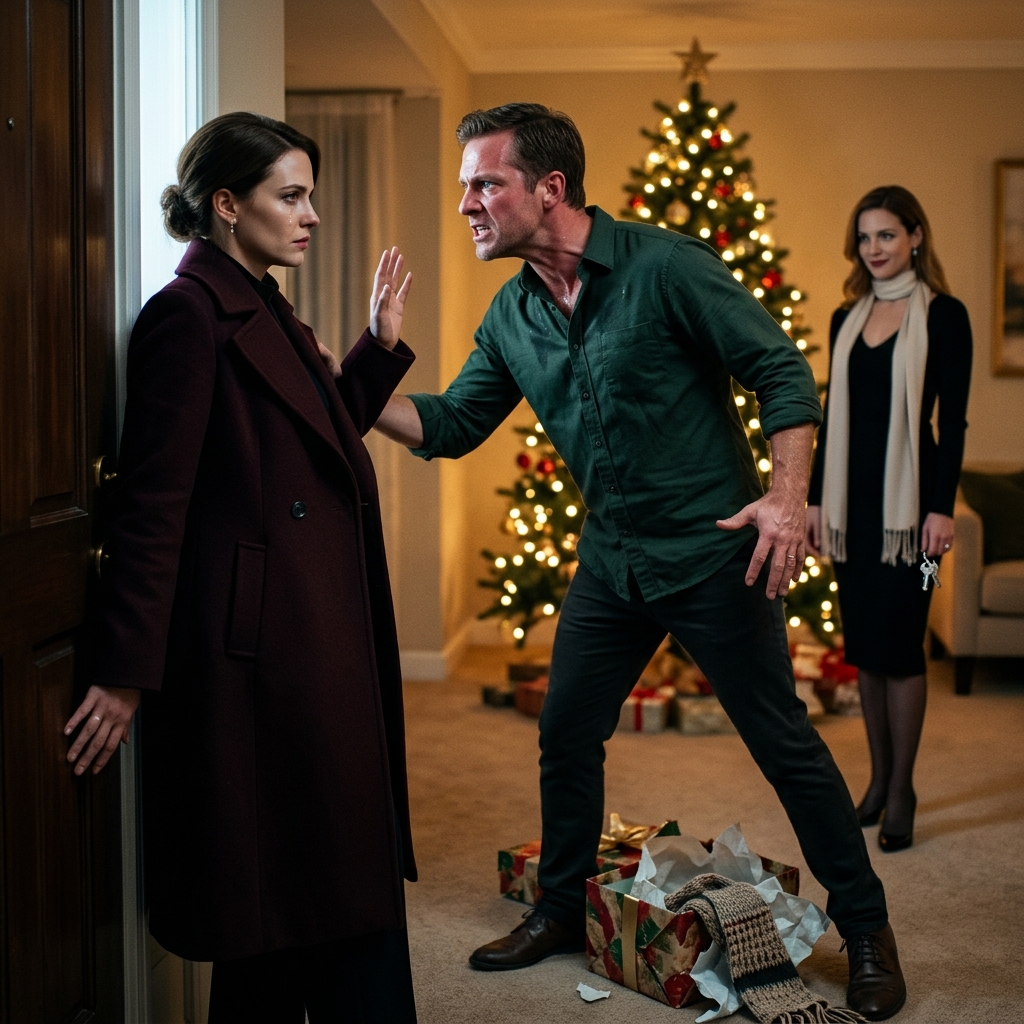
The woman stumbled backward, her hips catching the iron fire screen, causing the brass tongs to rattle against the masonry with a sharp, ugly clatter. Her hair was tousled, her silk blouse pulled taut across her collarbone where the top two mother-of-pearl buttons had come undone.
It was Emily.
Emily Vance. The twenty-six-year-old junior project manager whose grandfather’s name was the Vance on the brass shingle outside Matthew’s firm. Sarah had stood beside her eight months earlier at the spring benefit gala at the yacht club, holding a flute of lukewarm prosecco while Matthew explained the municipal zoning restrictions on historic waterfront warehouses. Sarah remembered the way Emily had laughed then—too loud, tilting her head back to show the long, pale column of her throat, her eyes never once leaving the line of Matthew’s mouth.
Matthew turned slowly.
His face was flushed an unnatural, mottled scarlet, but his eyes were wide, glassy, and completely vacant, the pupils dilated until the hazel of his irises was almost black. He looked at Sarah’s boots. He looked at her wool coat. He looked at the wrapped parcel pressed against her chest.
“Sarah,” he said. The word was a dry husk, lacking air. “Wait. Sarah—”
“What are you doing?” Sarah heard herself say.
The sound was not her own. It belonged to an older woman, a stranger standing behind her in the cold room, hollowed out and ruined. Her vision began to narrow, the edges of the room blurring into dark, vibrating vignette rings. “What is this? What is this in my house?”
“Sarah, please,” Matthew took a step toward her, his palms raised outward in a placating, defensive gesture. He looked wildly around the room as if searching for a dropped prop, a script, an alternate reality where he was not standing beside an unbuttoned heiress under his own mistletoe. “It isn’t—it’s not what it looks like. We were… we were working on the harbor master’s files. Emily drove down to drop off the deed transfers—”
“With her mouth on yours?” Sarah screamed.
The sound tore through the quiet room, vicious and raw, stripping the lining from her throat.
Emily flinched as though struck. She kept her back pressed hard against the cedar mantle, her eyes darting between the front door and the small leather clutch sitting on the coffee table. She looked terrified, but beneath the terror was a sharp, calculating vigilance that made Sarah’s stomach heave with bile.
Matthew reached out, his hand lunging toward the parcel in Sarah’s arms. “Let me take that. Put the box down. Let’s sit down, Sarah, please, just let me get you a glass of water—”
“Don’t touch me!”
Sarah whipped the box back, then hurled it with all the force in her torso down onto the Persian rug between them.
The heavy cardboard hit the floor with a dull, hollow thud. The green paper split along the bottom seam, the crimson ribbon gave way, and the tissue paper tore open like a wound. From within the white folds, the charcoal lambswool spilled out across the indigo wool of the carpet.
One end lay curled against the toe of Matthew’s polished leather shoe. In the amber glow of the tree lights, the uneven rows of the moss stitch were plainly visible—the three dropped loops she had meant to mend, laid bare under the dust of the hearth.
Matthew looked down at the scarf. He stared at it for four seconds, his mouth opening and closing without sound. He recognized the yarn. He had seen the wooden needles sitting on her nightstand three weeks ago, wrapped in an old pillowcase.
“Sarah…” he whispered, his voice cracking down the middle.
“Get out,” she said.
She did not shout this time. She pointed her index finger toward the heavy oak door behind her. Her hand was shaking so violently that her gold wedding band clicked against her knuckle. “Get out of this house. Both of you.”
Emily didn’t hesitate. She moved with a quick, predatory efficiency, sweeping her leather clutch off the table and darting toward the sofa. She snatched the pale cashmere scarf from the cushion, wrapping it around her throat with trembling, defensive fingers, her eyes fixed on the floorboards as she skirted the edge of the rug, giving Sarah a wide, six-foot berth.
“I’m sorry,” Emily whispered as she passed the archway. Her voice was thin, reedy, entirely devoid of blood. “Sarah, I’m… I am so sorry.”
“Don’t speak my name,” Sarah said, her voice flat, dead, and level. “If you speak to me, I will tear that coat off your back.”
The front door opened. A rush of sub-zero air and swirling white flakes swept through the foyer, chilling Sarah’s damp cheeks. The door clicked shut, the heavy brass latch settling back into the strike plate with a finality that sounded like a rifle shot.
Matthew remained standing by the tree.
He had not moved an inch from the spot where the green paper lay torn. His head was down, his shoulders hunched within his jacket, looking suddenly ten years older, stripped of the crisp, architectural vanity that had carried him through the executive dining rooms of Boston and Providence.
“Sarah, we have to talk about this,” he said to the carpet. “You can’t just throw me out into a storm. We have twelve years together. You have to let me explain why she was here—”
“You have thirty seconds to take your coat and your car keys,” Sarah said. She was not crying anymore; the tears had dried into tight, salt tracks that pulled at the skin of her cheekbones. A cold, mineral stillness had moved into her chest, settling over her ribs like winter frost over iron. “If you are still in this room when the clock strikes five, I am calling your father. And then I am calling the county sheriff.”
Matthew’s head snapped up. “My father has a heart condition, Sarah! Don’t drag him into this!”





