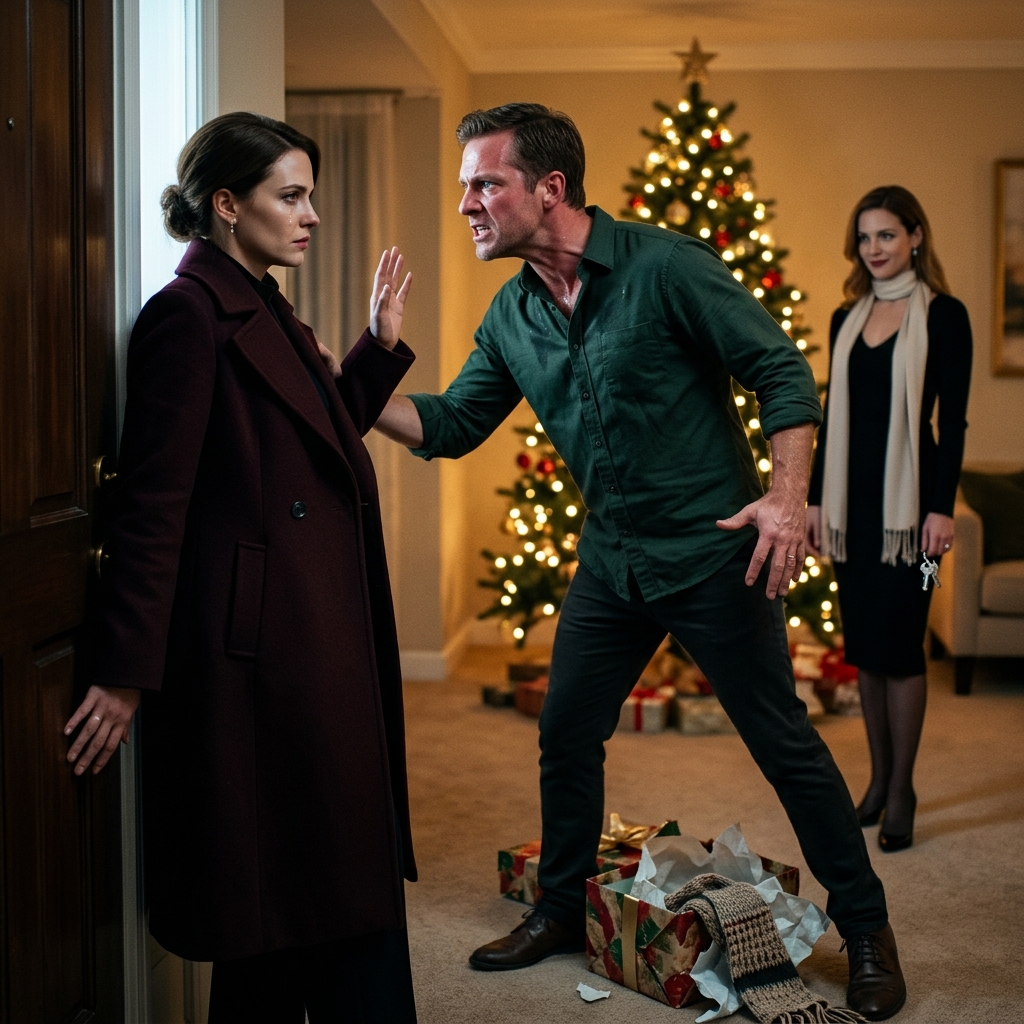
“Then you had better start walking,” she said.
He stared at her, searching her face for the woman who had brought him chamomile tea when his tenders were rejected, the woman who had rubbed his temples through two straight weeks of the Atlantic City audit. He found nothing. There was only a pale, dark-eyed stranger pointing an arm toward the snow.
Slowly, with the dragging, broken gait of an old man, Matthew walked to the hall console table. He picked up his key fob and his gloves. He paused for half a second, his back to her, as if waiting for a reprieve, a sob, a broken sentence that would give him license to turn around and wrap her in his arms.
Sarah did not blink. She did not lower her arm.
“The roads are freezing over, Sarah,” he said quietly.
“Drive slow,” she replied.
The front door opened again. The cold wind howled through the hall, fluttering the corners of the torn green paper on the rug. Matthew stepped out onto the porch.
The heavy wood closed. The deadbolt slid home with a solid, metallic chunk.
Sarah pressed her forehead against the cool oak panel of the door, her hands flat against the grain. Outside, the gravel crunched under tires; an engine turned over, caught, and hummed. Headlights swept across the frosted transom above her head, throwing long, skeletal shadows of the hemlock trees across the ceiling of the hall, before the sound of the car receded down Blackwood Lane, swallowed by the rising blizzard.
Her knees gave way.
She slid down the door until she was sitting on the bottom step of the staircase, her wool skirt bunched around her shins. In the great room, the tree lights continued their mindless, cheerful rotation: red, gold, emerald, blue.
Her phone buzzed inside her coat pocket. Once. Twice.
She pulled it out with numb fingers.
It meant nothing, the screen read. She came to the house because of the firm’s audit. It was a moment of weakness, Sarah. I swear to God on everything we built, it was only a moment. I love you. Please answer me.
Sarah read the text once. Then she read it again.
Her thumb hovered over the glass.
The firm’s audit.
In twelve years of marriage, Matthew had never brought an associate to the house without three days’ warning and a clean cedar chest in the guest suite. He had never discussed the firm’s audits outside his study. And most importantly, Vance & Sterling’s fiscal year ended in September, not December.
She lowered the phone. She looked at the charcoal scarf lying abandoned on the rug like a shed skin.
Why had Emily Vance driven forty miles through a gale on Christmas Eve to deliver files that could have been sent over a encrypted server in four seconds?
The house did not warm up, even after Sarah threw three split logs of dry birch onto the embers and pulled the iron fire screen shut.
The silence was physical. It had weight and mass, pressing down on the crown of her head until her neck ached. She did not take off her coat. She sat on the second step of the staircase for an hour, watching the snow pile against the lower panes of the bay window, four inches deep and climbing.
At six-fifteen, her phone rang.
It was not Matthew. The display read: VANCE, ARTHUR (OFFICE).
Arthur Vance was seventy-four years old, the senior founding partner of the firm, and Emily’s grandfather. He was a man who still wore three-piece tweed suits to municipal hearings and spoke with the clipped, patrician drawl of old Beacon Hill money.
Sarah stared at the vibrating screen. Her first instinct was to let it die into the dark. But the cold clarity that had taken root in her ribs nudged her thumb forward.
She pressed the green button and brought the receiver to her ear.
“Arthur?” she said.
There was a long pause on the other end, punctuated by the faint, rhythmic ticking of a desktop grandfather clock and the dry rustle of paper.
“Sarah,” the old man said. His voice was unusually strained, stripped of its customary dry polish. “I am sorry to disturb you at home on Christmas Eve. Truly. But I have been attempting to reach Matthew on his mobile for forty minutes, and his office terminal has been disconnected from the server.”
Sarah closed her eyes, leaning her head back against the spindle of the banister. “Matthew isn’t here, Arthur.”
Another silence, heavier this time.
“I see,” Arthur said softly. “Did… did my granddaughter happen to accompany him?”
Sarah felt the skin across her forehead tighten. “She left here twenty minutes ago in her own car. Why are you looking for them, Arthur?”
A dry, rattling breath came through the line. “Sarah, are you at your desk? Do you have your home computer open?”
“No. I’m in the hall.”
“Go to Matthew’s study,” the old man said, his voice dropping into a register that made the hair on the back of Sarah’s arms rise. “Go to his study, open his floor safe, and tell me if the blue ledger binder for the Newburyport Harbor project is still there.”
“Arthur, what is going on?”
“The state attorney general’s office served an emergency injunction on our Boston office at two o’clock this afternoon, Sarah,” Arthur Vance said, each word falling like lead shot. “They have frozen our operating accounts. They are alleging four point six million dollars in municipal preservation funds have been diverted through an offshore subsidiary registered in Matthew’s name. And my granddaughter’s signature is on thirty-two separate authorization vouchers.”
The line hummed with low-frequency static.
Sarah looked toward the small corridor leading to Matthew’s study at the back of the ground floor. The door stood half-open, just as he had left it when he had come out to meet Emily by the tree.
“Sarah? Are you there?”
“I’m here,” she whispered.





