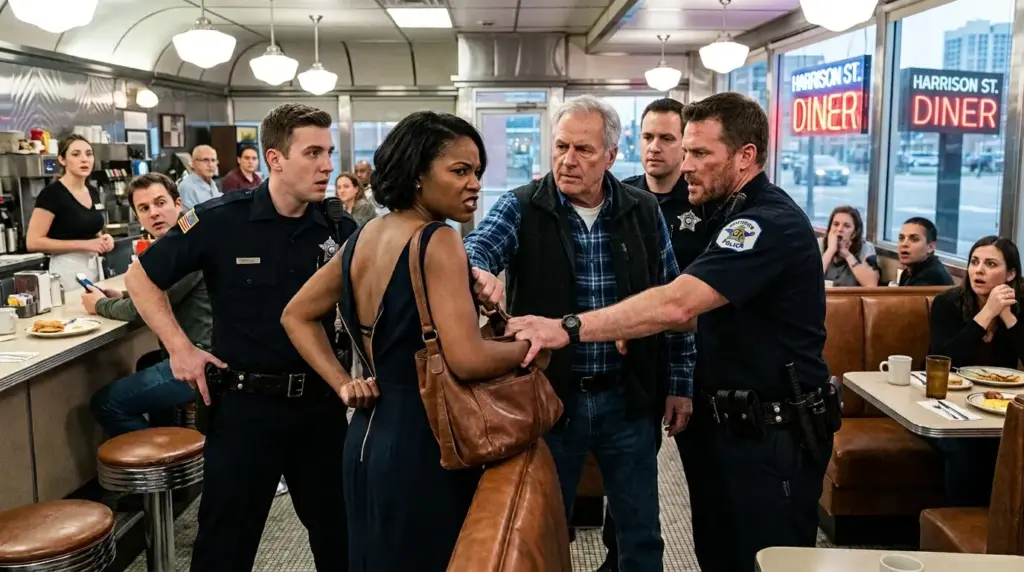
“Then signing a statement that says otherwise would not protect the company you built. It would protect its address, payroll, and logo.” Maya looked at him. Raymond continued, “The part worth keeping is the reason people trusted the name in the first place.”
Before Maya could respond, Marcus Reed appeared at the office door holding a tablet. “I think we found something.”
Maya motioned him in. Marcus placed the tablet on her desk. “There’s an older cold image at the backup facility outside the city. It predates the current administrator changes.”
Maya studied the record. “Why wasn’t it in the active recovery set?”
“Different architecture. It was retained for legacy verification, not normal restoration.”
“Can it prove the original state?”
“Not by itself.”
“Why?”
“The current manifest was altered. The image is still there, but the document that proves when it was created is no longer trustworthy.”
Raymond asked, “So you have the box, but not the original seal?”
Marcus nodded. “Exactly.”
Maya looked at the metal case locked inside her secure drawer. “The memory card has the original root hashes.”
Marcus looked at her. “If those hashes match the cold image, we can prove the image existed before the disputed credential activity.”
“Can Sloan argue we created the image afterward?”
“Not if enough independent blocks match the original hashmap. Not credibly.”
For the first time since the diner, Maya saw a path that did not depend on someone believing her version of events. She opened the drawer and looked at the metal case.
Raymond stood. “What do you need?”
Maya answered without hesitation: “A verification process nobody on either side can control alone.”
By Thursday afternoon, Maya’s conference room had become a controlled planning space: outside counsel sat at one end of the table; Marcus Reed occupied the opposite side with two secured laptops; Lena Brooks joined through an encrypted federal connection.
Maya placed the metal case containing the memory card in the center of the table. “If the cold image matches this card, I want the result to stand without WDI asking anyone to trust us.”
Lena nodded. “Then WDI cannot be the only party validating it.”
Marcus opened a diagram of the proposed process: “The cold image stays at the backup facility. We access it in read-only mode. Maya’s card provides the original hashmap. The system compares the stored blocks against those hashes without changing the image.”
Raymond sat near the wall with his coffee. “Explain it without the engineering language.”
Marcus looked at Maya.
She answered, “A hash works like a fingerprint. If the data changes, the fingerprint changes. The card contains fingerprints created before the disputed activity. If the old backup still has the same fingerprints, we can show it existed before someone started using my name.”
Raymond nodded. “That I understand.”
Maya’s attorney asked, “What prevents Sloan from claiming WDI created the comparison result?”
Marcus changed the display: “We don’t keep the only result. Each verification step is logged locally, witnessed at the facility, and transmitted through an authorized channel to independent federal recipients.”
Lena added, “Only verification material goes through that channel unless investigators separately authorize protected content. No public distribution and no press contact.”
Maya agreed immediately. “Nothing leaves the controlled environment except what is necessary to prove integrity.”
Her attorney looked at her. “That distinction matters. Sloan is already describing the memory card as extracted security data. We cannot give him an argument that you distributed protected material after receiving notice of the investigation.”
“He won’t get one.”
Marcus continued, “The facility cameras will record the session. Their staff will document when Maya arrives, what equipment she brings in, which terminal she uses, and who is present. We also create a hash of the memory card before and after verification.”
Raymond asked, “Meaning you prove the card itself wasn’t changed during the process?”
“Exactly.”
Maya looked at Lena. “Who controls the federal endpoint?”
“My office can arrange an authorized receiving system, but I want another independent recipient on the government side. If this becomes a dispute between WDI and Sloan’s office, neither one should be able to say the other controlled the only verified result.”
“That’s the whole point,” Maya said.
Raymond looked at her: she had spent years building systems designed to protect evidence from accidental corruption; now she was using those same principles to protect herself from deliberate manipulation.
Lena turned toward Raymond. “One more condition.”
He already knew the subject.
“You’re a witness,” she said. “Not an investigator.”
“Works for me.”
“No, it doesn’t.”
A slight smile appeared on Maya’s face.
Raymond looked at Lena. “You think I’m going to start interviewing data center employees?”
“I think you spent enough years believing a retired credential still came with opinions.”
“It does come with opinions.”
“Keep them legal.”
Raymond lifted his coffee. “Yes, ma’am.”
Lena returned to the technical discussion. The verification session was scheduled for the next day. There was no emergency deadline attached to it: Maya still had lawful access to the backup environment, and counsel confirmed she could perform a documented integrity check under the company’s existing custodial responsibilities. What mattered was doing it before any further dispute over access complicated the evidence.
Dana Ellis entered carrying a stack of signed facility forms. “They confirmed the visitor list: Maya, Marcus, the compliance representative, and Mr. Williams.”
Raymond looked up. “Why am I on the technical access list?”
“You’re not,” Dana said. “You’re listed as an independent civilian witness accompanying Maya.”
“That sounds less impressive.”
“That was intentional.”





