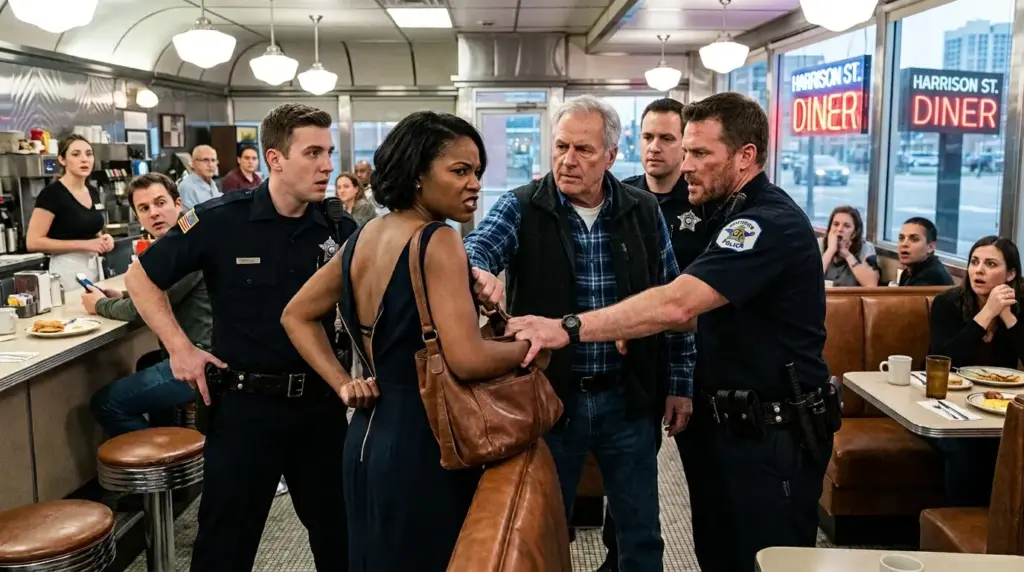
Maya signed the documents. Her phone vibrated beside her. The message came through the secure route Cole had been using. She opened it: Cole had traced another portion of the payment chain associated with Keller and Trent; the funds passed through a shell contractor before reaching an intermediary account; he had also recovered communications showing Keller asking for confirmation that the storage device was still expected to be with Maya on Monday evening. There was still no direct instruction from Sloan.
Maya read the message aloud to Lena.
Lena said, “Useful, but not enough.”
“I know.” Cole’s evidence showed organization and payment; it did not yet prove who had authorized the operation. Maya forwarded the material to counsel through the protected channel.
Raymond asked, “Does it help Adrien?”
“It helps establish that Keller wasn’t acting on impulse,” Maya said. “Adrien’s leak shows how they knew where I would be and what I carried. We still need the bridge between those facts and Sloan.”
Marcus looked at the cold storage documentation. “If the old image verifies, we may get part of that bridge from the administrator history.”
Maya closed the Cole message. “Then tomorrow we verify first. We interpret afterward.”
Lena nodded with approval. “That order will save you trouble.”
The meeting continued through the afternoon as every step was assigned to a person who could be identified later: nobody was allowed to control both the source and the verification record; every change required a second approval. By the time counsel finished, the process had become slower than Maya would normally tolerate and more defensible than anything Adrien had left behind.
Raymond checked his stainless steel watch. Maya noticed.
“Still works better than I do some mornings.”
“You say that every time you don’t want anyone asking how tired you are.”
“It remains useful.”
She smiled briefly and returned to the forms.
Before leaving WDI, Maya placed the memory card back inside the metal case and sealed it under the newly documented custody procedure. For the first time since Harrison Street, her plan did not depend on identifying the most trustworthy person in the room: it depended on building a process that would still work if one of them was not trustworthy.
Friday morning, Raymond picked Maya up outside WDI in his dark gray Ford Explorer. She carried the sealed metal case in a document bag along with the access forms and verification paperwork approved the previous afternoon. Marcus Reed had already gone ahead with the compliance representative to prepare the technical environment at the backup facility. Lena Brooks remained in contact through the federal channel and would not enter the process unless the receiving system or chain of custody required her authority.
Maya fastened her seatbelt and placed the document bag between her feet.
Raymond looked at it. “You planning to hold that the entire drive?”
“Yes.”
“It’s not going anywhere.”
“I know.”
He started the engine. They left the West Loop and moved northwest through morning traffic. Neither of them discussed Keller, Sloan, or Adrien for the first twenty minutes. Maya answered two calls from counsel and one from Dana Ellis, confirming that WDI’s normal operations were continuing under the restrictions already in place.
When the last call ended, Raymond said, “You’re still running the company from the passenger seat.”
“I’m still the CEO.”
“You’re also allowed to sit in a car.”
Maya looked at him. “That sounds like retirement talking.”
“It sounds like someone who learned too late that every problem does not improve because you stare at it longer.”
She put the phone facedown.
Traffic slowed near an interchange. After several minutes, Raymond exited and pulled into a small coffee shop beside a gas station.
“We’re early,” Maya said.
“I know.”
“I’m not hungry.”
“I didn’t ask.”
Inside, Raymond ordered black coffee; Maya asked for hot tea; Raymond added two breakfast sandwiches.
She looked at him. “I said I wasn’t hungry.”
“And I heard you.”
“That usually means don’t buy me food.”
“At my age, it means buy two and see what happens.”
They returned to the Explorer. Maya left the sandwich unopened for several miles before finally taking it from the bag. Raymond did not comment. She took a few bites, then looked out at the commercial buildings along the road.
“If the verification works, WDI could still lose contracts.”
“Yes.”
“If it doesn’t work, the company may not survive at all.”
“Yes.”
“You’re very helpful this morning.”
“You already know the answer you want from me.”
“I want you to tell me everything will be fine.”
Raymond shook his head. “No.”
Maya looked at him. “At least you’re consistent.”
“A career can be rebuilt.”
“At thirty-four, maybe.” She turned toward him. “Would you say that at sixty-two?”
Raymond kept his attention on the road. “At sixty-two, I’d say the part worth rebuilding is the part you can live with.”
Maya was quiet for a moment. “You ever regret leaving the Bureau?”
“Sometimes.”
“That isn’t what I asked.”
Raymond glanced at her. “You’ve been using that line a lot lately.”
“You taught it to me.”
He considered the question again. “I don’t regret leaving. I miss parts of the work. Those aren’t the same thing.”
Maya nodded. She finished half the sandwich and wrapped the rest.
The data center sat in an industrial area near Elk Grove Village, surrounded by low commercial buildings, fenced lots, and service roads. Nothing outside identified WDI or the type of information stored inside. Raymond parked in the visitor section.
Before getting out, Maya checked the seal on the document bag: still intact.
Inside the building, a security employee examined their identification and compared their names with the approved visitor list. “Miss Williams, Mr. Williams, you’re both cleared for reception. Mr. Williams, your access is restricted to the verification area as a civilian witness.”
Raymond nodded. “Understood.”
The employee looked at Maya’s bag. “The verification device needs to be logged before entry.”





