Maya placed it on the counter. The security employee recorded the case number, seal number, time of entry, and the identity of the custodian. Maya signed the record; the compliance representative signed after her.
Marcus met them beyond reception. “System is ready. Read-only access is confirmed.”
“Any changes since yesterday?” Maya asked.
“One.” She stopped. “What?”
“The cold image is still physically present, but the manifest attached to it no longer verifies.”
Maya looked at him carefully. “Was the image altered?”
“We don’t know yet. That’s what the hash comparison will tell us.”
Raymond asked, “The manifest is the part that says when the image was created and what it contains?”
Marcus nodded. “Yes.”
“So the data may still be original, but the label that proves its history can’t be trusted.”
“Exactly.”
They entered the verification room. It contained two secured terminals, a wall-mounted camera, a logging station, and a separate workstation operated by the facility’s compliance representative.
Maya checked the camera indicator. “Recording?”
The representative nodded. “Continuous from the moment you entered.”
“Good.”
Marcus handed Maya the access form. She reviewed every line before signing. Raymond sat several feet behind her. Maya looked over her shoulder. “You chose the chair facing the door.”
He looked toward the entrance. “It was available.”
“There are four chairs.”
“This one has a better back.”
She almost smiled.
The compliance representative began reading the procedure aloud for the record: Maya’s identity was confirmed; her access authority was confirmed; the purpose of the session was stated as independent integrity verification of an existing cold storage image.
The metal case remained sealed until all parties confirmed the log. Marcus opened the cold storage interface. A directory appeared: the image was there; its creation record, however, could no longer be independently trusted because the manifest signature had been changed.
Maya studied the screen: Adrien had reached far enough into the system to damage the proof around the image, but he had not removed the image itself.
Marcus said, “If the original blocks still match your root hashes, we can establish that the underlying data existed before the disputed credential activity.”
“And if they don’t?”
“Then we document that, too.”
Maya nodded. “No assumptions.”
“No assumptions.”
She placed the metal case on the table. The facility representative verified the seal number one more time. Maya broke the seal, opened the case, and looked at the encrypted memory card she had carried since Harrison Street. For several days, the card had been treated as stolen material, protected evidence, and a threat to her company. Now it had one purpose: it had to prove whether the surviving cold image was real.
Maya inserted the card into the isolated verification reader. Marcus opened the comparison tool. The first authentication request appeared on the screen. Raymond remained silent behind her. Maya entered her authorization and began the verification.
The first verification sequence appeared on Maya’s screen as a list of stored data blocks beside the root hashes from the encrypted card. Marcus stood at the second terminal while the facility compliance representative monitored the session log.
Maya selected the first verification group: the system compared the stored blocks against the fingerprints created before the disputed activity; the first group matched.
Marcus checked the independent log. “Confirmed.”
Maya continued: a second group matched, followed by a third. She did not react. A few successful comparisons proved very little: the cold image contained thousands of blocks, and the important sections had not yet been reached.
Raymond remained seated behind her. “How many have to match?” he asked.
“It isn’t about a single number,” Maya said. “The original map describes the structure of the entire image. If someone rebuilt this later, they would have to reproduce the same verified structure from before the credential changes.”
“So you’re checking whether the data existed before someone started using your name.”
“Yes.”
Marcus looked at the screen. “And whether the underlying image remained unchanged after that.”
The next verification group completed: another match. The compliance representative stated the result for the recording and entered it into the facility log. Maya continued methodically.
Several minutes later, Marcus leaned closer to his monitor. “We’re entering the first section connected to the disputed audit records.”
Maya slowed down. These blocks mattered more than the general system data: if the hashes failed here, Sloan could argue that the image had been altered after Maya created the memory card. She started the comparison: the first section matched, then the next.
Marcus checked the independent system before speaking. “Same result.”
Maya released a breath. Raymond noticed, but said nothing.
She moved to the next group: the match held. For the first time, there was technical support for what Maya had been saying since the false credentials appeared: the data associated with the original audit existed before the activity later attributed to her. It did not yet prove who had manipulated the system; it proved something equally necessary: the original evidence was real.
Maya reached for the next verification command when the facility door opened. A security employee entered. “Miss Williams, there are three visitors requesting access under an evidence preservation order.”
Maya stopped. “Names?”
“Deputy Chief Everett Sloan, Officer Ryan Keller, Officer Mason Trent.”
Raymond stood.
Marcus looked at Maya. “Do we suspend?”
“No. We continue until someone with lawful authority directs the facility to stop the approved verification session.”
The compliance representative checked his records. “Your authorization is still active.”
“Then continue logging.”
The security employee left. Raymond moved closer to Maya, but stayed away from the terminal. “You expected him?”
“I expected resistance. I didn’t know what form.”
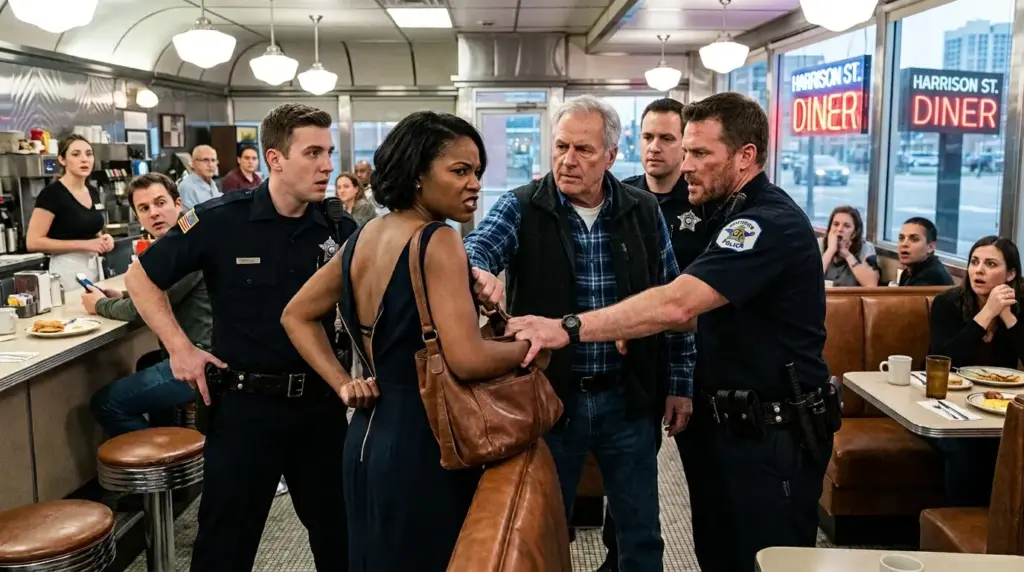
A few minutes later, Sloan entered with Keller and Trent. All three had been processed through facility security. Sloan carried a document folder. Keller and Trent wore department uniforms, but neither spoke.
Sloan addressed Maya first: “Miss Williams, step away from the terminal.”





