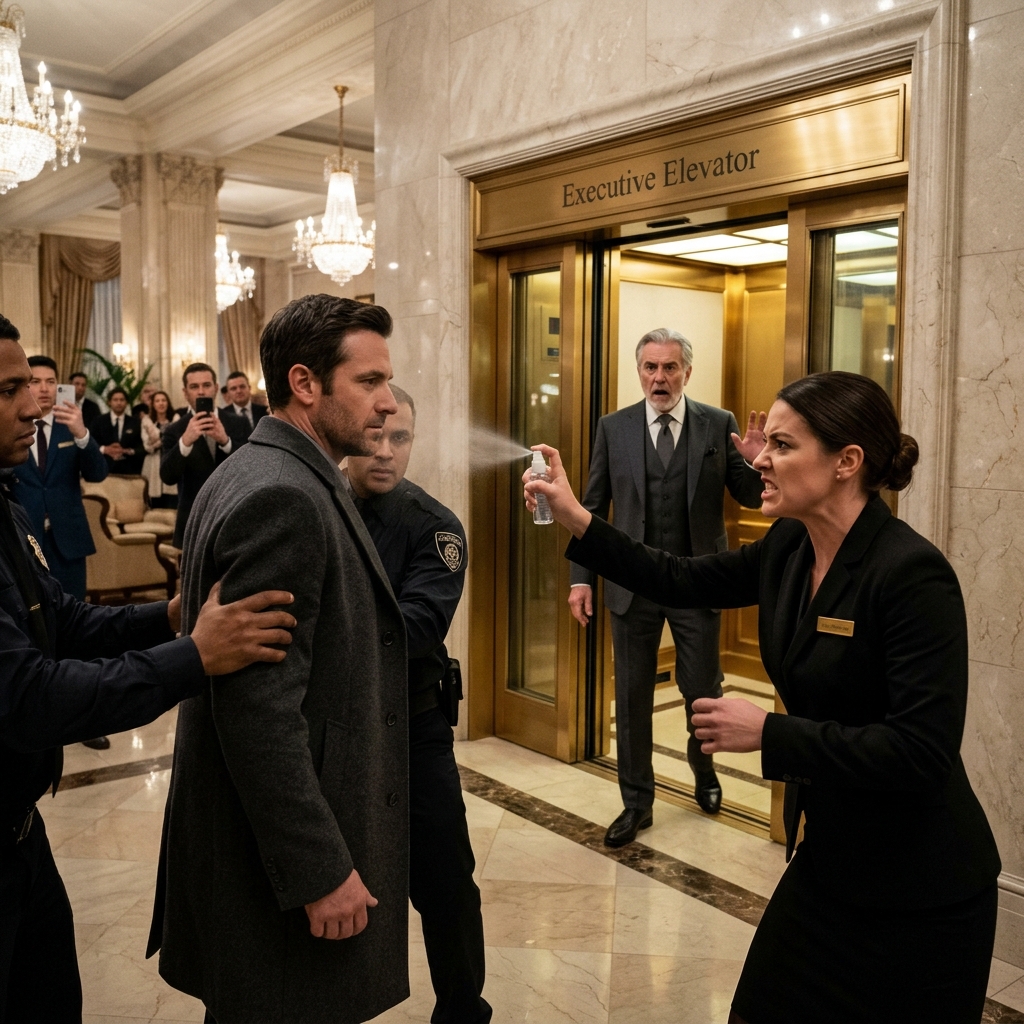
The sanitizer hit my eyes before anyone asked my name. Beneath the crystal chandeliers of a hotel I owned, I staggered backward while the front desk manager shouted for security.
“Get this filthy intruder out of my hotel!” Rebecca Miller screamed. Around us, conversations stopped, and a businessman lowered his coffee without taking a sip.
My eyes burned, but the humiliation cut deeper. Eighteen months earlier, I had purchased this struggling property, financed its renovation, and approved better benefits for every employee.
My name is David Thompson. That afternoon, I had arrived with a confirmed reservation and a simple plan: experience the hotel as an ordinary guest before my private board meeting at three.
I wore an elegant wool coat and a Patek Philippe watch worth nearly fifty thousand dollars. Yet Rebecca had decided I did not belong before I could introduce myself.
“You’re contaminating our beautiful lobby,” she snapped, pointing toward the revolving doors. I took out a clean handkerchief, carefully blotting my face while trying to understand what had provoked her.
“I have a reservation,” I said. “Please check the name Thompson.”
She laughed loudly enough for the nearest guests to hear. “Of course you do, sweetheart.”
For a moment, I nearly told her exactly who I was. Then I wondered how this conversation would end for someone who had no authority to reveal.
Rebecca stepped around the counter, blocking my path. She accused me of sneaking inside to use the rooftop gym, the bathrooms, or the complimentary lounge.
I opened my wallet and offered my identification, my black American Express card visible beside it. She refused to look at either.
“Thompson,” I repeated. “Your system should have my confirmation.”
Assistant Manager Janet Davis approached, and I felt a brief flicker of relief. It vanished when she listened to Rebecca, glanced at me, and suggested a cheap motel three miles away.
“That place would be more your speed,” Janet said. Neither woman touched the keyboard.
My phone vibrated with a reminder about the board meeting. “I can show you the confirmation,” I said, reaching slowly toward my coat pocket.
Rebecca stumbled backward. “He’s reaching for something!”
Head of Security Steve Wilson hurried across the marble floor with another officer behind him. “Keep your hands where I can see them,” he ordered.
I raised both hands immediately. My phone remained in my pocket, inches from the proof nobody wanted to examine.
Near the velvet lounge chairs, a young woman lifted her own phone and began livestreaming. “He keeps asking them to check his reservation,” she whispered.
Other guests started recording. Through watering eyes, I watched Rebecca straighten her jacket, apparently pleased to have an audience.
“We have standards here,” she announced. “Steve, escort him outside.”
“Before you touch me,” I said, “will someone please verify my reservation?” Steve hesitated, but Rebecca answered for him.
“We’re finished discussing this.” She pointed toward the doors again.
Fifteen minutes after I entered, the executive elevator opened. Chairman Charles Bennett stepped into the lobby with several board members, then stopped so abruptly that the man behind him nearly collided with him.
“David?” His gaze moved from my reddened eyes to the security officers surrounding me.
Rebecca hurried forward with a polished smile. “An unauthorized visitor, Mr. Bennett.”
Charles looked at her without answering. Then he asked, “Rebecca, do you have any idea who this gentleman is?”
Her smile faltered as Steve lowered his arm. I folded my damp handkerchief and finally spoke.
“Yes, Charles,” I said, my voice carrying across the silent lobby. “Your staff was just explaining why the owner is being thrown out of his own hotel.”
The sleet came off Lake Michigan sideways, needle-sharp and gray as zinc, turning the granite facade of the Saint-Germain Grand into a sheer, weeping cliff.
David Thompson paused under the green bronze canopy on Michigan Avenue, letting his driver merge back into the creeping afternoon traffic. He had told Arthur to take the Maybach around to the subterranean garage and wait by the freight lifts, where nobody asked questions. In his pocket, the flat rectangle of his phone buzzed once—a short, rhythmic pulse indicating a message from the mezzanine: Bennett’s arrived early. He’s with the audit committee in the Salon des Glaces.
David did not answer it. He looked up at the pediment where stone cherubs held up a clock that had not lost a second since 1912. Eighteen months ago, that same clock had been choked with pigeon droppings, its hands seized at twenty past four, while the carpets in the main dining room moldered beneath leaky copper flashing. The Saint-Germain had been an insolvent ruin—a grand dowager preserved only by the stubbornness of its union contracts and the mounting debts of its founder’s dissolute grandchildren.
He had bought the notes for sixty-two million dollars, injected another forty into the mechanicals, the lead abatement, and the mahogany wainscoting, and placed Charles Bennett—a consummate patrician whose grandfather had belonged to the same country club as the original builders—in the chairman’s seat to keep the city historic commission quiet. David had remained in the background, a name on the Delaware registration, a signature at the foot of capital-expenditure authorizations, and little else. He preferred it that way. In real estate, the man who built the stage was usually forgotten once the curtain went up, and David had never suffered from a need for applause.
What he did require, however, was clarity.
For three months, the internal reports crossing his desk in Boston had displayed a curious discrepancy. While the Saint-Germain’s RevPAR—revenue per available room—had climbed forty percent since the grand reopening, the customer satisfaction indices from the loyalty program had plateaued into a hard, defensive trough. Even more perplexing were the incident logs: fourteen trespass warnings issued to guests during check-in over a seventy-day period, every single one logged as undesirable non-patron by the afternoon shift.





