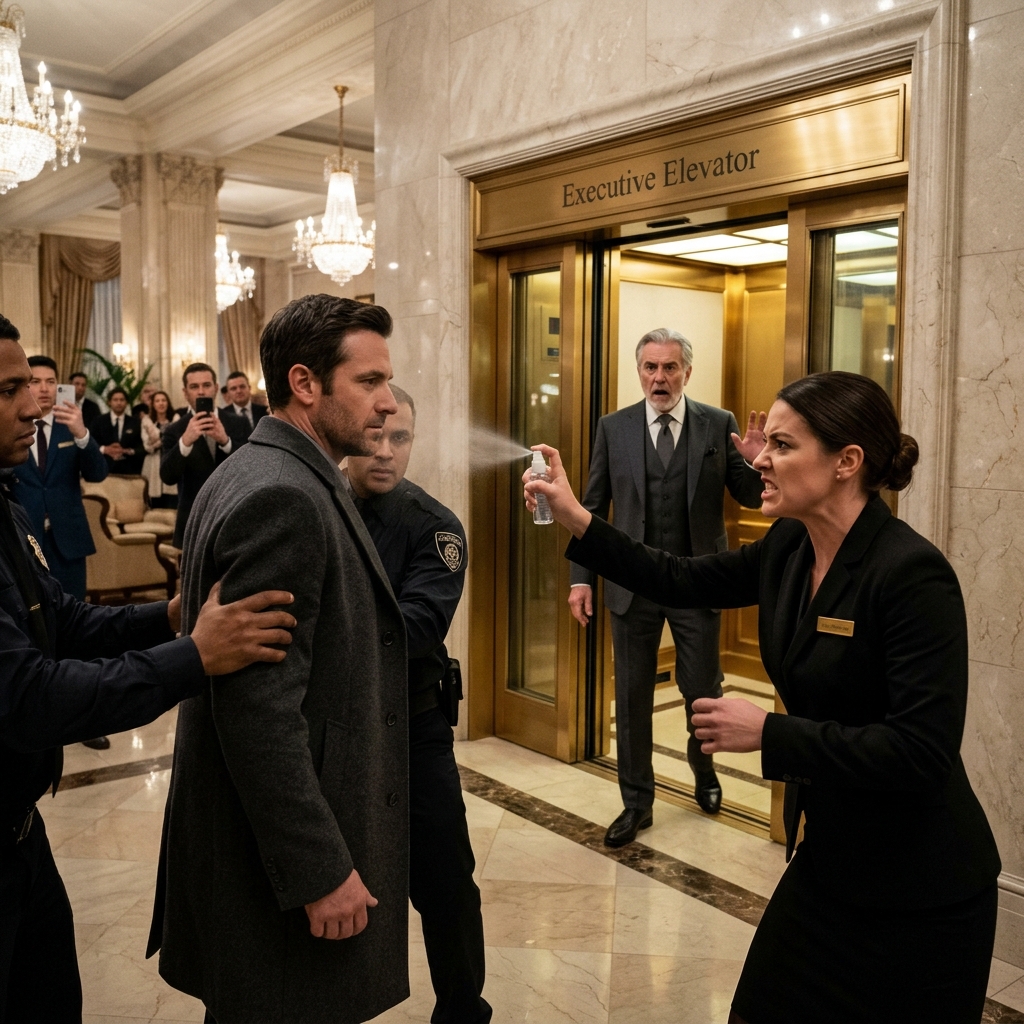
She didn’t uncap it; she lifted the spray nozzle. Whether it was the reflex of a woman who had spent two years of post-pandemic hospitality treating every unvetted body as a biohazard, or the pure, spiteful panic of a petty bureaucrat whose boundary had been challenged, her finger clamped down on the trigger.
The jet of high-concentration benzalkonium mist caught David across the bridge of his nose and the lower lids of both eyes.
The chemical stung instantly—a ferocious, biting heat that felt like ground glass rubbed against the conjunctiva. The breath left his lungs in a sharp hiss. He staggered back three paces, his heel catching the corner of his Valextra bag, his left hand coming up instinctively to shield his face while his right found a pillar of cold verde antique marble to keep from falling.
“Get out!” Rebecca’s voice had broken its register now; it shrilled across the forty-foot ceiling, echoing off the plaster rosettes. “Steve! Security to the desk! Front desk now!”
Around them, the lobby ceased to function. The tea cups stopped clinking. A young associate from Goldman Sachs, carrying an armload of presentation folders toward the elevators, froze mid-stride. A woman in a gray cashmere dress near the grand piano pulled out an iPhone, her thumb sliding across the screen with the practiced cruelty of someone who smelled viral content.
“My eyes,” David said through his teeth.
He pulled a white linen handkerchief from his pocket with fingers that had begun to shake from pure, cold adrenaline. The cloth came away wet with the yellow-tinted liquid, smelling sharply of hospital-grade pine and ammonia. The burning was intense, a blinding wash that turned the magnificent chandeliers into bloated, throbbing halos of orange light.
“He’s drunk,” Janet Davis declared, coming around the end of the counter to stand behind Rebecca like a second at a duel. Her arms were folded across her chest. “Look at him. He’s swaying. He probably came in off the red line to get out of the storm.”
David wiped his forehead, blotting the liquid before it could seep further into his tear ducts. Through the blurring wash of tears, he could see Rebecca’s silhouette, her chest heaving, her fingers still curled around the bottle like a weapon.
“You used… industrial chemical… on a guest,” David said. He was forcing each syllable through his teeth, struggling to keep his voice from rising. “You didn’t check the manifest. You didn’t ask for identification.”
“You are not a guest,” Rebecca spat. Her voice had dropped back into that venomous, low hiss that she believed conveyed mastery. “Guests do not look like you. Guests do not carry bags with scuffed corners. You’re one of those grifters who sits in the lobby to steal the complimentary breakfast buffet and sneak into the rooftop sauna.”
David pulled his wallet from his coat. It was alligator, decades old, its edges softened by years of use. With blurred vision, he thumbed out his Massachusetts driver’s license and the heavy, black titanium Centurion card that had no spending limit on any continent on earth. He held them out toward Janet Davis.
“Look at the name,” he whispered. “Look at the card.”
Janet glanced at them for half a second. Then she gave a soft, pitying cluck of her tongue.
“Sir, you can buy fake titanium cards on the internet for thirty dollars,” she said, her voice dripping with the patronizing sweetness one uses on a demented child. “There’s a Travelodge on North Clark. It’s about three miles up. If you walk along the bus line, you’ll find it. That’s much more… appropriate for your situation.”
“Janet,” David said, his vision clearing just enough to see her name pin. “If you don’t take these cards and run them through that machine, you will not have an office to sit in by five o’clock.”
“Is that a threat?” Rebecca interjected, her chin coming up. “Did you hear that, Janet? A direct threat to staff.”
From the arched corridor leading to the administrative offices, two men in midnight-blue blazers with gold shoulder epaulets arrived at a rapid, heavy jog. The foremost was a man of fifty-five with the thick neck and broken nose of a former transit cop, his belt loaded with a Motorola walkie-talkie, handcuffs, and a small can of pepper foam.
“What’s the situation, Miss Miller?” Steve Wilson, Head of Internal Security, asked. He had not drawn a weapon, but his hand rested with heavy familiarity on the leather pouch at his hip.
“He refused to leave when directed,” Rebecca said, pointing the disinfectant bottle like an indictment. “He tried to force his way behind the desk, he made verbal threats against the management, and he’s carrying counterfeit instruments. I had to use the sanitizing wash to keep him off me.”
David straightened his back. The pain in his eyes was settling into a dull, thumping ache behind his temples, but the dizziness had passed. He stood six feet two inches tall, and though his hair was silvered at the temples, there was nothing frail about the way his shoulders filled the Loro Piana coat.
“Mr. Wilson,” David said, reading the security director’s nameplate with his clear, reddened gaze. “I am David Thompson. I own sixty percent of the equity in this building through the Saint-Germain Operating Partnership. I have a room reserved on the fourteenth floor. This woman just sprayed surface cleaner into my face without opening the reservation portal.”
Wilson blinked. His eyes drifted from David’s face down to the heavy leather bag, then to the clean, razor-straight crease of his trousers. Unlike the two women behind the desk, Wilson had spent twenty years in the Chicago Police Department’s financial crimes unit before taking the private security contract. He knew what five-thousand-dollar coats looked like when they were old; he knew what men who held sixty million dollars looked like when they were being insulted.
A flicker of doubt crossed Wilson’s face.





