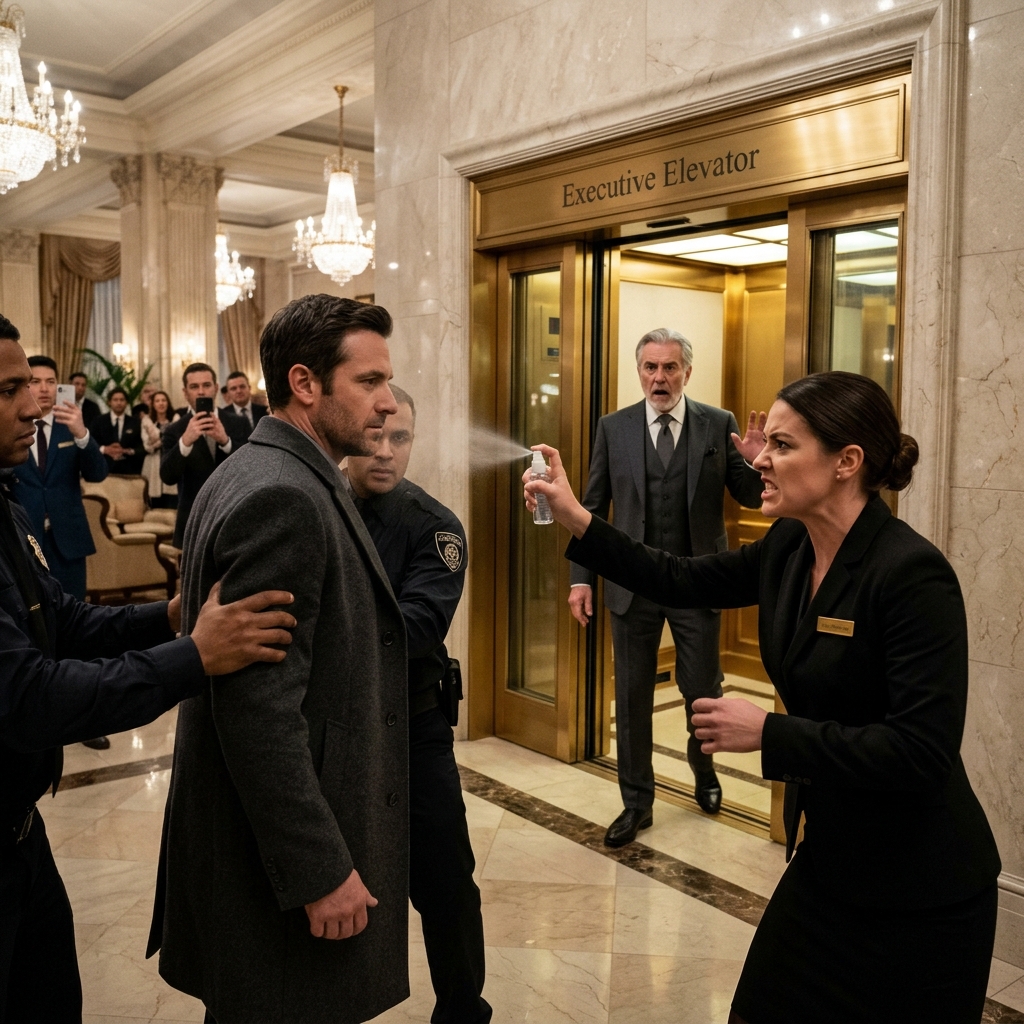
“Sir,” Wilson said, his voice dropping into a professional, non-confrontational register. “Do you have your confirmation number?”
“It’s on my phone,” David said. He moved his hand slowly, deliberately, toward the interior breast pocket of his coat.
“Steve, look out!” Rebecca shrieked. “He’s reaching!”
Wilson didn’t draw, but his second officer—a younger man with broad shoulders and the twitchy eagerness of an amateur—lunged forward, catching David’s right arm at the elbow and twisting it back with enough torque to strain the shoulder joint.
“Hands on the counter!” the younger guard barked. “Keep them where we can see them!”
David did not struggle. To struggle with private security in a public lobby was to concede the terms of the engagement to the lowest common denominator. He allowed his arm to be pinned, his left hand remaining flat against the cold marble of the desk, his palm pressed against the wood.
“Steve,” David said, his voice entirely flat, without a single inflection of panic. “If this officer does not remove his fingers from my sleeve within five seconds, he will spend the next four years paying off the civil judgment from his pension.”
“Hold on, Miller,” Wilson said, his hand coming down hard on the young guard’s shoulder. “Back off. Just back off.”
“Steve, he’s an intruder!” Rebecca shouted, her face now mottled with anger. “Look at the guests! They’re watching this! Are you going to let him intimidate us in our own lobby?”
Near the velvet lounge chairs, the woman with the iPhone had risen to her feet, holding the lens high. Her voice carried across the room, breathless with synthetic outrage: “…live at the Saint-Germain Grand, where security has just restrained an older gentleman who appears to be claiming he owns the hotel while refusing to leave the check-in area…”
“We have standards of decorum here,” Rebecca said, her voice rising to meet the camera, playing to the room with an oily, practiced righteousness. “The Saint-Germain is an exclusive environment. We do not tolerate vagrants, we do not tolerate fraudulent claims, and we do not permit our staff to be subjected to verbal abuse by individuals who cannot afford to be here.”
“Are you finished?” David asked.
“No,” Rebecca said, crossing her arms. “I’m not. Steve, escort him through the Garland Court exit. Not the front doors. Take him through the service hall so the arriving guests don’t have to look at him.”
Wilson looked at the black Centurion card lying on the marble counter. He reached out two fingers to pick it up, his face grim.
Before his skin touched the plastic, the heavy brass indicator above the private elevator bank chimed—a deep, bronze tone that sounded like a ship’s bell in fog.
The doors of Car One, which were paneled in burled walnut and reserved exclusively for the board of directors and the penthouse suites, slid open with an almost hydraulic sigh.
Three men stepped out onto the Fior di Pesco marble.
The man in the center was seventy-one years old, dressed in a three-piece suit of English chalk-stripe flannel, a silk handkerchief blooming from his pocket like an orchid. His mustache was trimmed to the millimeter, and he walked with the effortless, languid grace of someone whose family had owned three banks before the Great Fire.
It was Charles Bennett.
Beside him walked Marcus Vance, the general counsel for the operating group, and Dr. Aris Thorne, the representative for the secondary pension funds that held the Saint-Germain’s mezzanine debt. They were laughing—a dry, comfortable sound that belonged in wood-paneled libraries where brandy was poured from crystal decanters.
Bennett took three steps into the rotunda, his mouth open to make some observation about the chandeliers, when his eyes fell upon the tableau at the desk.
He stopped so suddenly that Vance nearly walked into the small of his back.
“Good God,” Bennett muttered.
Rebecca Miller saw him. The irritation vanished from her features, replaced in an instant by the brilliant, subservient radiance of an employee greeting the sun. She smoothed the lapels of her blazer with two quick, bird-like motions and hurried around the counter, her heels clicking smartly against the stone.
“Mr. Bennett,” she said, her voice dropping into a rich, respectful purr. “I apologize for the disturbance. We had an unfortunate security incident with an unauthorized individual who forced his way past the bell stand. Steve is handling it right now. We’ll have the lobby cleared before the rest of the board arrives from the club.”
Bennett didn’t look at her.
His eyes had traveled from her face, past her outstretched hand, and settled on the man standing by the verde antique pillar. He took in the damp handkerchief clutched in David’s fingers, the red, swollen rims of his eyelids, the black card lying untouched on the desk, and the young security guard whose hand was still hovering inches from David’s coat.
Bennett’s face went the color of skimmed milk.
“Charles,” David said. His voice was not loud, but it cut through the rotunda with the terrible, heavy finality of an iron door closing in an empty vault.
Rebecca turned back toward David, her brow furrowing with disgust. “Do not address the Chairman by his first name! Steve, get him out—”
“Shut up,” Bennett whispered.
Rebecca blinked, her smile faltering like a loose bulb. “Excuse me, Mr. Bennett?”
“I said shut up, Rebecca,” Bennett said, his voice rising, cracked with an emotion that sounded terrifyingly like pure terror. He pushed past her so violently that the shoulder of his flannel coat brushed hers, sending her off-balance by half a step.
He crossed the twenty feet of marble with long, frantic strides, his hand outstretched, his face twisted into an expression of agonized disbelief.
“David,” Bennett breathed, stopping two feet from him. “David, what… in heaven’s name… what is this?”





