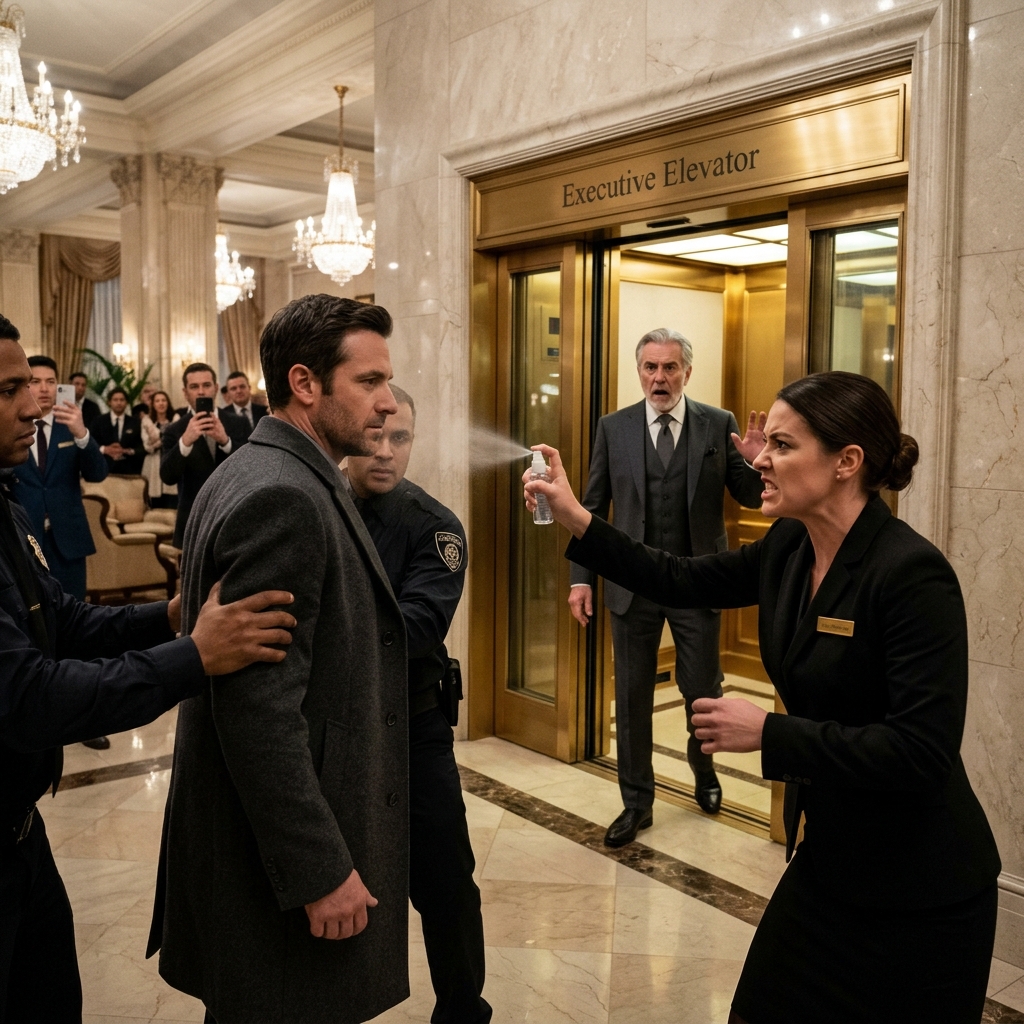
David pulled the collar of his coat up against the wind. It was an eight-thousand-dollar piece of charcoal Loro Piana cashmere, entirely devoid of exterior logos, the cuffs lined with un-dyed beaver fur. Beneath it he wore an Italian wool turtleneck that had cost more than an average month’s mortgage in the suburbs, and on his wrist, tucked discreetly under the double-faced sleeve, sat a platinum Patek Philippe Calatrava with a lacquered white dial. He looked precisely like what he was: an exceptionally wealthy man who had stopped dressing to prove anything to anyone thirty years ago.
He pushed through the brass revolving doors.
The transition from the raw Chicago November to the Saint-Germain’s grand rotunda was supposed to feel like stepping into a private salon in the Faubourg Saint-Germain. Two hundred feet of polished Fior di Pesco marble stretched toward a twin imperial staircase; forty feet overhead, three Waterford chandeliers, each holding twelve thousand hand-cut teardrops, threw a honeyed, refracted light across the damask-covered armchairs. A fire of split birch cracked softly inside a hearth carved from Istrian limestone.
Behind the walnut check-in counter, backed by a bank of five hundred small, brass-rimmed pigeonholes for keys that were no longer used, stood two women.
The taller of the two—a blonde with her hair pulled into a knot so tight it pulled at the corners of her eyes—wore the tailored black blazer of a front desk manager. A nametag pinned with military precision above her left breast read: Rebecca Miller. Guest Experience Manager. Beside her, tapping a manicured finger against an iPad, was a younger woman whose tag identified her as Janet Davis, Assistant Manager.
David approached the counter with the quiet, measured pace of a man who spent his life on carpets so thick they muffled footsteps. His black leather weekender bag—an unbranded Valextra piece that had traveled with him to Zurich, Singapore, and London—rested lightly in his left hand.
Rebecca did not look up from her screen as he stopped five feet from the polished brass counter.
“Check-out is on the left,” she said. Her voice had the thin, laminated brightness of a recording. “Key drop is in the bronze urn.”
“Good afternoon,” David said. His voice was low, carrying the flat, neutral cadence of the Massachusetts seaboard. “I’m checking in.”
Rebecca’s fingers paused on the keyboard. Her eyes traveled upward—not to his face, but to the hem of his trousers, where a single rim of gray slush from the street had dried to salt along the cuff of his dark trousers, and then to his shoes. They were John Lobb oxfords, crafted from black calfskin, but they had walked two blocks from the curb through wet gravel. To an eye trained only by modern fashion magazines, they were simply dark shoes with muddy welts.
Her gaze flicked past his coat, dismissed the absence of a silk scarf or an oversized designer belt buckle, and settled on the leather bag.
“The delivery entrance is on Garland Court,” she said flatly. The artificial warmth had vanished, replaced by an abrasive chill that seemed drawn directly from the lake. “You’ll have to speak to the service dock manager.”
David did not move. He set the Valextra on the marble floor beside his right boot. “I’m not making a delivery, Miss Miller. I have a reservation.”
Janet Davis looked up from her tablet, her eyebrows twitching with a mixture of amusement and irritation. She murmured something behind her hand to Rebecca, who gave a sharp, nasal exhale that might have been a laugh.
“Sir,” Rebecca said, leaning over the counter so that her voice dropped into that stage whisper designed to humiliate by pretending to protect. “This is the Grand Rotunda. The rooms here begin at twelve hundred dollars a night. We don’t take cash at this desk, we don’t accept debit cards from out-of-state regional banks, and we do not hold rooms for people without an advance deposit.”
“I am aware of your rate structure,” David said mildly. He reached into his coat for his wallet. “The name is David Thompson. It was booked through the private client desk three weeks ago.”
“There is no Thompson,” Rebecca said without touching the keyboard. Her eyes were fixed on his hands. “We are fully committed for the private equity symposium.”
“You haven’t checked the terminal.”
“I don’t need to check the terminal, Mr… whatever you said. I know my house count. I suggest you turn around before I have to call someone who will make you turn around.”
“Miss Miller,” David said, his tone still perfectly level, though a small muscle along the hinge of his jaw had begun to tighten. “If you open your system, input the letters T-H-O-M-P-S-O-N, and cross-reference it with the allocation for the King Penthouse on the fourteenth floor, you will find both the reservation and the authorization for all incidentals. I would like the keycard, please. I have an engagement at three.”
Across the lobby, a couple in matching vicuña coats who had been sitting by the fire lowered their silver tea service. The man, an attorney David recognized from a firm he had retained in London ten years prior, frowned at the disturbance, then looked away with the characteristic distaste of the very comfortable when confronted with the untidy reality of other people’s friction.
Rebecca’s face flushed pink beneath her matte foundation. Her authority, exercised for six months over room attendants, valets, and junior concierges, was being examined in front of the house guests.
“You’re being disruptive,” she said. Her hand went beneath the desk counter, where an industrial pump-bottle of pharmaceutical-grade quaternary surface disinfectant stood on a shelf between the spare key-encoders and the receipt paper. She brought it up with a hard, plastic thud. “You smell like the street, you’re tracking salt across the Italian stone, and you are harassing my staff.”
“I have asked you for a room key,” David said.





