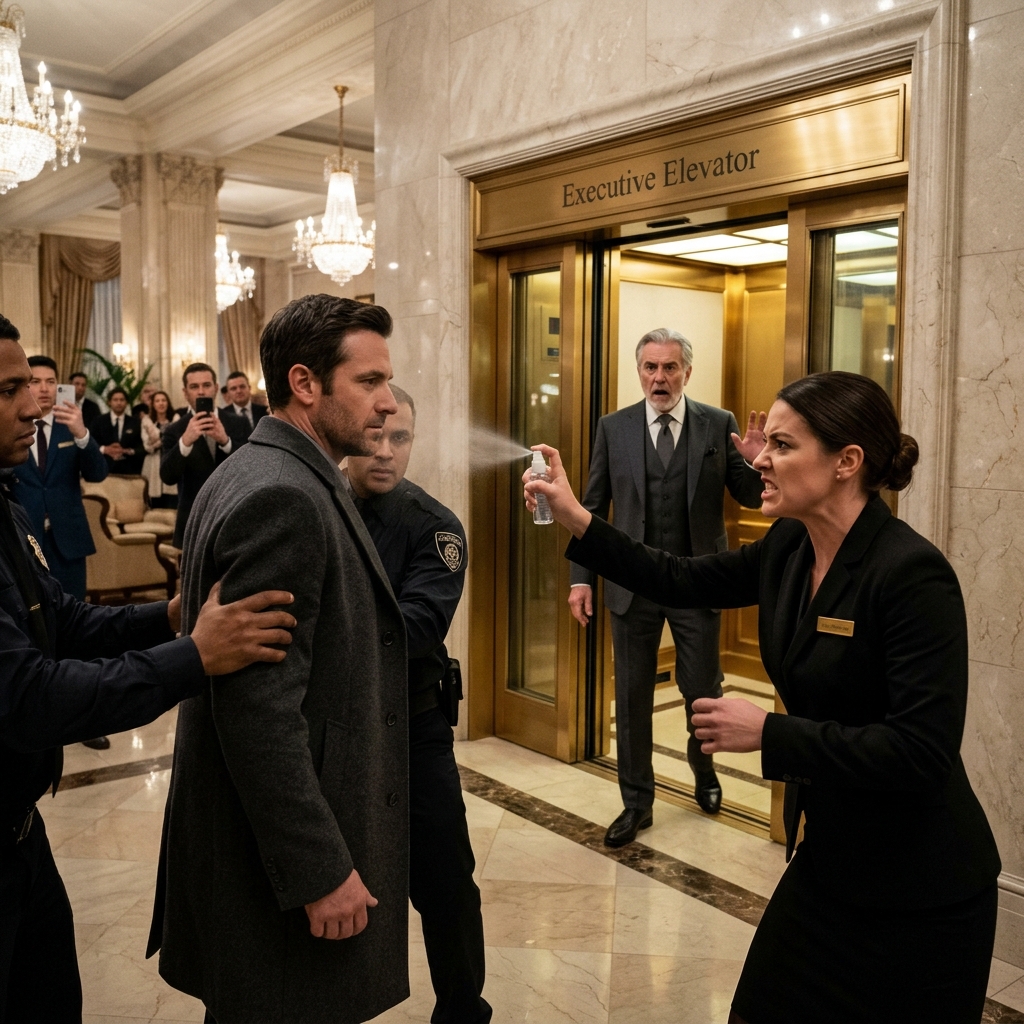
David Thompson did not take the offered hand. He folded his damp linen handkerchief with slow, mechanical care, pressing the four corners together until it was a neat, flat square, and tucked it back into the breast pocket of his coat.
“Your Guest Experience Manager,” David said, his voice carrying clearly to the back of the rotunda, where the woman with the phone had stopped speaking and was now staring in frozen silence, “has just spent the last twelve minutes explaining the Saint-Germain’s standards of decorum.”
Vance, the attorney, had reached the counter. He took one look at the driver’s license lying on the marble, read the name David A. Thompson, looked at the disinfectant bottle standing between the monitors, and turned to Janet Davis.
“Did someone spray him?” Vance’s voice was barely audible, but it carried the cold, razor-edged panic of a man who saw eight-figure lawsuits floating like dark shapes under water. “Did you spray him with quaternary ammonia?”
Janet Davis backed up until her hips struck the credenza behind the desk. Her mouth worked, but no sound came out.
“Mr. Bennett,” Rebecca said, her voice rising in a thin, frantic squeak from five feet away. “There’s… there must be an understanding. This man had no reservation. He was aggressive. He had no credentials—”
“He bought the mortgage, Rebecca,” Bennett said. He did not turn around to face her; his eyes remained locked on David’s reddened, weeping face, his own hands trembling against his thighs. “He paid sixty-two million dollars for the paper in April. He authorized the forty million for the restoration you’ve been bragging about on LinkedIn for six months. He owns the floor you are standing on. He owns the chair you sit in. He owns the nametag on your chest.”
The rotunda went so quiet that the hiss of the birch log in the fireplace sounded like an engine venting steam.
Across the lobby, the woman with the iPhone slowly, almost reverently, lowered her arm. The attorney in the vicuña coat set his tea cup down with a sharp clink that seemed to rattle the chandeliers.
Rebecca Miller did not speak. The blood had rushed out of her face, leaving her features a dull, lard-like yellow. Her fingers twitched against the seam of her trousers as if searching for something to grasp.
“There was a reservation,” David said mildly. He reached out, his long fingers picking up the titanium card from the desk and slipping it back into his wallet. “I made it myself through the Boston office. Under my own name. Because I wanted to see what happened to an ordinary traveler who arrived at this house without an entourage, without a press agent, and with a spot of slush on his trousers.”
He stepped toward the desk. Janet Davis shrank back against the key boxes as if she were trying to flatten herself into the wood.
“You have fourteen incident logs in the system for this quarter,” David said, his eyes settling on her. “Fourteen people who were turned out into the cold because they didn’t meet the aesthetic requirements of the afternoon shift. Were any of them checked into the system?”
Neither woman answered.
“No,” David said. “Of course they weren’t. Because once you enter the name, the machine creates a record. And if you create a record, you have to account for the vacancy. But if you simply tell them they don’t belong, if you call them filthy intruders and douse them with floor cleaner, they simply go away. They go to the Travelodge on North Clark, don’t they, Janet?”
Janet’s throat made a wet, swallowing noise. Tears of pure humiliation began to cut tracks through her powder.
“Mr. Thompson,” Steve Wilson said, stepping forward, his shoulders dropped, his voice heavy with contrition. “I had no idea—”
“You didn’t verify, Wilson,” David said, cutting him off without looking at him. “You’re the head of security for an eighty-million-dollar property, and you took an operational directive from a woman holding a spray bottle without asking to see a single piece of documentation. You have thirty days to find another post. Mr. Vance will handle the severance according to the contract, but you will not be on this floor when the evening shift arrives.”
Wilson took a deep, shuddering breath, looked at the floor, and nodded once. “Yes, sir.”
David turned to Charles Bennett. The Chairman looked as though he had aged ten years in five minutes; the crisp, aristocratic confidence had vanished, replaced by the hollow, defensive posture of a board member whose fiduciary negligence had just been laid out on the marble in front of sixty witnesses.
“Charles,” David said.
“David, please. Let’s go up to the suite. We can have Dr. Thorne look at your eyes immediately. We have a medical kit in the office—”
“The audit committee meeting is canceled,” David said.
Bennett blinked. “Canceled? But the mezzanine refi—”
“The mezzanine debt will be settled with my own funds on Monday morning,” David said. “Which means I will no longer require your services as Chairman of the Operating Committee. You will step down at the end of the month. Marcus will prepare the announcement: personal reasons, health, whatever allows you to keep your memberships in good standing.”
Bennett’s mouth opened, then closed. He looked at Vance, who simply shook his head once—a small, definitive movement of the chin that signaled there was no legal shelter to be found.
Finally, David walked back to the center of the desk.
He looked down at Rebecca Miller. She was trembling visibly now, her hands clutched against her stomach as if she had been struck.





