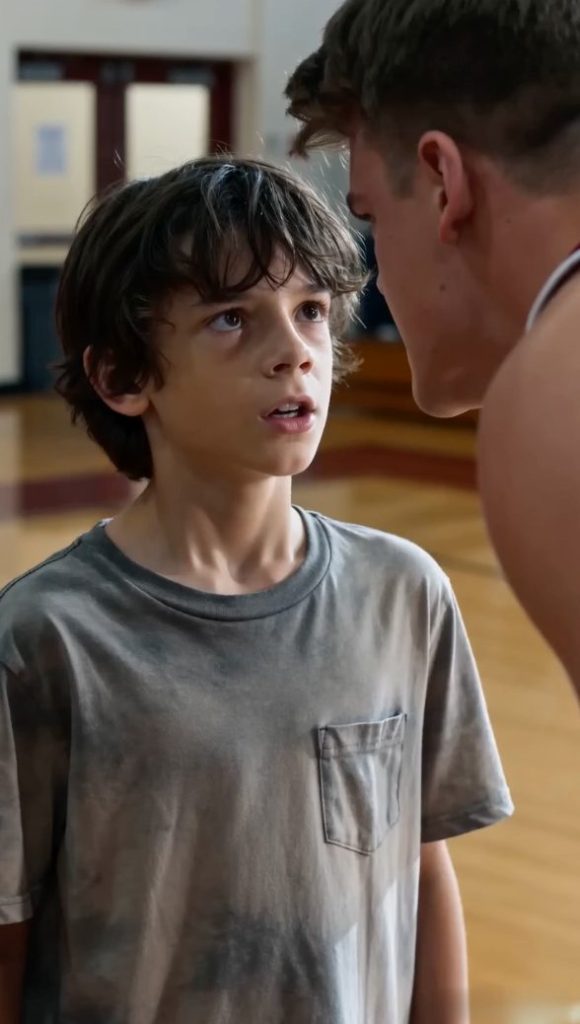
The basketball hit the polished hardwood floor with a sharp, hollow sound, but sixteen-year-old Mason barely noticed it.
He was standing near the gymnasium entrance at Lincoln High School, watching his father push a mop across the court while a group of varsity basketball players laughed among themselves.
At the center of that group stood Trevor, the eighteen-year-old captain, whose attention had settled on the gray plastic bucket beside Mason’s father.
Mason knew that look.
He had seen it too many times before.
Trevor walked toward the bucket with a basketball tucked beneath one arm, wearing the careless smile of someone who had never expected to answer for anything he did.
His expensive sneakers squeaked against the floor as he stopped beside the older man.
“Still working, huh?”
Trevor asked.
Mason’s father straightened slightly, resting both hands on the mop handle.
“Just finishing this section,” he replied.
“You boys can use the other end of the court.”
Trevor looked around at his teammates, smiling as though the janitor had told a particularly amusing joke.
“Listen to that.
He’s giving us instructions now.”
A few players chuckled.
The older man lowered his gaze and resumed mopping.
He had learned that arguing with teenagers rarely made his work easier, particularly when those teenagers believed the school gymnasium belonged to them.
But Trevor wasn’t finished.
He shifted his weight, extended one foot, and deliberately knocked the bucket sideways.
Cloudy water spilled across the polished floor.
The bucket rolled several feet before striking the bottom row of the bleachers.
The sound echoed through the gym, followed by an abrupt silence that lasted just long enough for everyone to recognize that the accident had been intentional.
Then Trevor laughed.
“Better tell your daddy he missed a spot!”
His teammates burst into laughter.
Mason felt something tighten painfully inside his chest.
For months, he had heard Trevor make jokes about his father’s work.
He had endured comments about dirty floors, garbage cans, cleaning supplies, and the old sneakers he wore to school.
Usually, Mason lowered his head and walked away.
But his father was standing in the middle of the mess, holding a dripping mop, looking at the spilled water with the tired expression of a man who knew he would have to clean it again.
And Trevor was laughing at him.
Mason stepped forward.
“Leave my father alone.”
His voice wasn’t particularly loud.
It didn’t need to be.
The laughter stopped as several players turned toward him.
Trevor slowly looked over his shoulder.
For a moment, he seemed genuinely surprised.
Then his expression changed into one of delighted disbelief.
“Well, look at that,” he said.
“The little janitor finally decided to defend himself?”
Mason didn’t move.
Trevor looked him up and down, taking in his thin arms, faded gray shirt, dark athletic pants, and battered sneakers.
Then he laughed again.
What happened next would become the most talked-about event at Lincoln High, although nobody standing in that gymnasium understood it yet.
Because the boy Trevor had spent months humiliating was about to step onto the basketball court.

And for the first time in his life, Trevor was going to discover what it felt like when everyone else was laughing at him.
Mason had never been the kind of student people noticed for the right reasons.
At sixteen, he was shorter than most boys in his grade, unusually thin, and quiet enough that teachers sometimes forgot he was sitting near the back of the classroom.
His dark brown hair was rarely combed into anything resembling a proper style, and his clothes were ordinary enough to disappear into the crowd.
His sneakers were another matter.
They were old, gray around the edges, and worn nearly smooth along the soles.
One shoe had a faint crease across its toe where the material had started to separate, and the other had a frayed lace that Mason kept tying into increasingly small knots.
They were the same sneakers he wore every day.
Some students never noticed.
Others noticed only because Trevor had made certain they did.
At Lincoln High, clothes mattered more than anyone cared to admit.
Students compared shoes, jackets, phones, and everything else that could suggest who had money and who didn’t.
Mason had none of the things that attracted attention or admiration.
What he did have was a father who worked long hours keeping the school clean.
His father arrived before some students and often remained until long after the last athletes had gone home.
He swept hallways, emptied trash cans, cleaned restrooms, and mopped the gymnasium floor that hundreds of expensive sneakers crossed each day.
It was honest work, and Mason had never been ashamed of it.
His father was the person who made sure there was food on the table, who patched things instead of replacing them, and who never complained about being tired even when his shoulders were stiff from working.
Sometimes, when Mason finished his homework, he helped straighten chairs or gather stray paper from beneath the bleachers.
His father always insisted that he didn’t need to.
“School is your job,” he would say.
“Let me do mine.”
But Mason knew how much effort his father’s job required.
He had watched him arrive home with aching feet.
He had seen him fall asleep in his chair before finishing dinner.
He knew that when his father said he was fine, it usually meant he was too tired to explain otherwise.
The job was not something to be mocked.
It was something Mason respected.
Unfortunately, Trevor saw things differently.
Trevor was the kind of student whose name seemed to belong to the school itself.
He was tall, broad-shouldered, athletic, and confident, with short blond hair and a smile that made teachers forgive his occasional arrogance more readily than they should have.
He wore the captain’s jersey for Lincoln High’s varsity basketball team.
During games, students shouted his name from the bleachers.





