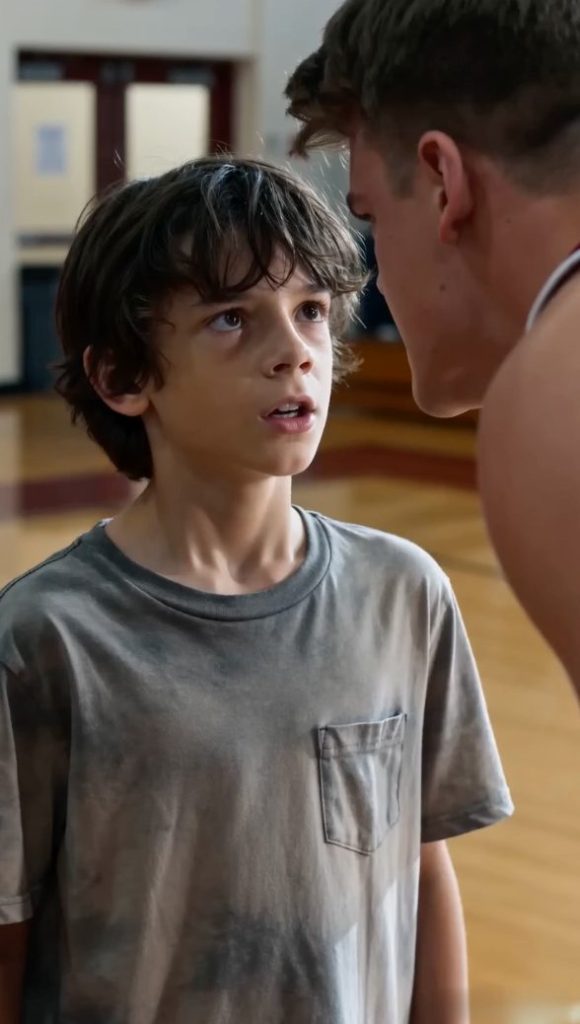
His teammates slapped the bleachers and shouted encouragement.
One student near the front row laughed so hard that he nearly dropped his phone.
“That’s it?”
Trevor called.
“I thought you wanted to play!”
Mason stood beneath the basket.
He could feel his heartbeat.
The captain was strong.
He was fast.
And although Mason had seen his habits, recognizing them from the sideline was different from reacting while Trevor was moving directly toward him.
He looked at the scoreboard.
2–0.
Three more baskets would end the game.
The bet would be over.
He would spend the rest of the evening cleaning the gymnasium while Trevor enjoyed his victory.
Mason imagined the captain telling the story in the cafeteria on Monday.
He imagined the same old jokes becoming louder.
He imagined his father pretending not to mind.
Something inside him settled.
He wasn’t going to play angry.
Anger would only make him predictable.
He had spent too many evenings learning how to move carefully, how to hold his balance, and how to turn the smallest opening into an advantage.
He couldn’t suddenly become taller.
He couldn’t become stronger than Trevor in a few seconds.
But he could be smarter.
Trevor tossed him the ball.
“Come on, janitor boy!”
Mason caught it.
The captain spread his arms dramatically.
“Show everybody what you’ve got.”
Mason didn’t answer.
He bounced the basketball twice.
The first bounce was firm.
The second was softer.
He shifted his feet.
Trevor leaned forward, still smiling.
And the game began to change.
Mason moved without warning.
He dipped his shoulder toward the left, drawing Trevor across his path, then switched the ball to his right hand.
The movement was quick, but not frantic.
Trevor reached to block him.
His hand found empty space.
Mason slipped past his outstretched arm and accelerated toward the basket.
A surprised sound came from the bleachers.
Trevor spun around.
“Hey!”
Mason was already moving.
He took his final steps carefully, keeping his body between Trevor and the ball.
Then he lifted it toward the backboard.
For a brief instant, the basketball seemed to hang against the bright gymnasium lights.
It touched the glass.
Dropped against the rim.
And fell through the net.
2–1.
The crowd made a completely different sound.
It wasn’t the confident laughter that had followed Trevor’s first two baskets.
It was surprise.
A sharp collective reaction from people who had not expected the skinny boy to score at all.
Mason landed lightly and turned toward the court.
He didn’t raise his arms.
He didn’t smile at the crowd.
He simply retrieved the ball and walked back toward the starting position.
Trevor stared at him.
Then the captain laughed.
“All right.
Lucky move.”
Mason tossed him the ball.
Trevor caught it harder than necessary.
“Do it again.”
Mason said nothing.
But he noticed something important.
Trevor had stopped looking toward the crowd.
His attention was finally on the opponent in front of him.
Near the scoreboard, the coach had straightened from his relaxed stance.
His arms remained folded, but his eyes followed Mason more closely.
The coach had watched hundreds of students play basketball.
He could recognize the difference between an accidental opening and a deliberate move.
What Mason had just done was deliberate.
The younger boy had changed direction at exactly the right moment, protected the ball, and finished without allowing Trevor’s size to disrupt him.
It was a simple basket.
But there was nothing careless about it.
Mason’s father saw the coach watching.
For a moment, he looked from the man to his son.
Then his eyes returned to the court.
He knew Mason could play.
He had witnessed more quiet practice sessions than he could count.
But he had never seen his son perform against Trevor, with so many students watching.
The realization filled him with pride and fear at the same time.
Trevor was not accustomed to losing control of a game.
And Mason had just shown everyone that it was possible.
The next possession began with the captain holding the basketball near the three-point line.
He dribbled aggressively.
Mason moved with him.
Trevor drove right.
Mason matched his direction.
The captain stopped, turned, and tried to spin back toward the basket.
Mason stayed close.
For the first time, Trevor couldn’t find the easy path he expected.
His jaw tightened.
“Move.”
Mason kept his arms raised.
Trevor attempted a difficult shot.
The ball struck the rim and bounced away.
A murmur swept through the bleachers.
Mason caught the rebound.
Trevor rushed toward him.
But Mason had already seen the captain’s frustration.
He knew Trevor would try to recover the moment through force and speed.
So he didn’t challenge him directly.
He stepped backward, gave himself space, and brought the ball under control.
Trevor came forward.
Mason shifted his shoulders as though preparing to drive right.
Trevor reacted.
Mason changed direction.
The older boy’s momentum carried him a half step too far.
Mason went left, crossed back toward the middle, and reached the basket before Trevor could recover.
He lifted the ball.
The shot was smooth.
The net moved.
2–2.
For a moment, no one said anything.
Then several students shouted at once.
“Wait, what?”
“He’s actually good!”
“Did you see that?”
Trevor turned and stared at the hoop.
He looked as though he expected the ball to somehow come back out.
But it had already landed on the floor.
The scoreboard showed the truth.
2–2.
Mason walked toward the ball.
His breathing was steady.
He could feel the warmth of exertion in his arms and legs, but he was no longer nervous about the crowd.
The game had become familiar.
The noise still surrounded him, but it no longer seemed important.
What mattered was Trevor’s position, the movement of the ball, and the space between the defender and the basket.
Mason had spent years practicing those things.
Now they were all he needed.
The captain looked toward his teammates.
Nobody was laughing anymore.
One of them tried to smile.





