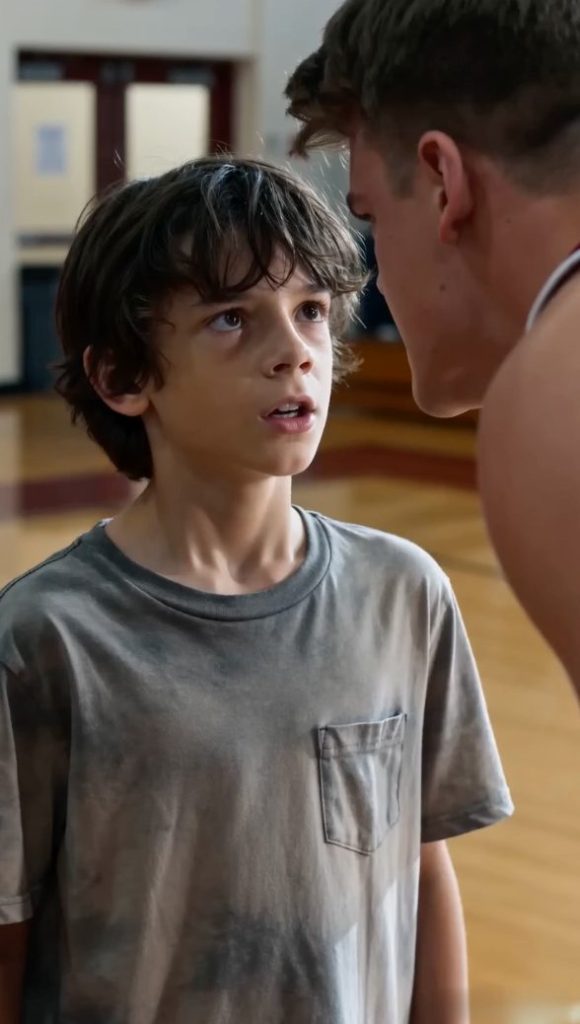
“Come on, Trevor.
Lock in.”
Another called, “Don’t let him get past you.”
Trevor’s expression hardened.
He walked toward Mason and held out his hands.
“Ball.”
Mason passed it to him.
Trevor took a long breath.
Then he lowered his shoulders.
The game was tied.
And for the first time, the captain looked worried.
Mason’s father had stopped cleaning.
The mop remained beside the cart, and the overturned bucket had been set upright.
The wet section of floor was safely away from the playing area, but the older man had not returned to work.
He was watching his son.
There was something strange about seeing Mason on that court in front of everyone.
At home, Mason was usually quiet.
He carried groceries without being asked.
He washed dishes after dinner and sometimes stayed awake reading until his father reminded him that school started early.
When his father came home exhausted, Mason never complained about money or demanded things they couldn’t afford.
He was a good boy.
But good boys could still carry heavy feelings.
His father knew that.
He had noticed the way Mason sometimes grew quiet after passing the basketball players in the hallway.
He had seen his son adjust his backpack and lower his gaze when Trevor called out.
He had asked questions.
Mason had answered gently, usually saying that everything was fine.
His father wanted to believe him.
But he understood more than Mason realized.
Working in a school meant seeing students when they believed adults weren’t paying attention.
He had watched teenagers do generous things and thoughtless things.
He had heard cruel jokes made casually, as though words carried no weight after they were spoken.
He understood that some students regarded his work as beneath them.
What troubled him was not their opinion of his job.
It was the possibility that those opinions might convince his son he deserved less than other people.
Now Mason stood beneath the bright gymnasium lights, facing the same boy who had tried so hard to make him feel small.
And he was no longer looking down.
The older man felt a painful mixture of pride and concern.
He wanted Mason to win.
He also wanted the afternoon to end without his son being hurt.
Trevor was powerful, frustrated, and surrounded by an audience.
Those were not comforting circumstances.
The father glanced toward the coach.
The man was watching intently.
He had spoken to Mason before, usually during quiet moments when the school day was over.
The older man had never paid much attention to those brief conversations, but he knew the coach respected his son.
He hoped that respect would be enough to keep the game fair.
On the court, Trevor was bouncing the basketball with unusual force.
The sound echoed through the gym.
Mason lowered into a defensive stance.
Trevor stared at him.
“You’re enjoying this, aren’t you?”
Mason answered quietly.
“I’m playing basketball.”
The captain gave a humorless laugh.
“Don’t get comfortable.”
He drove forward.
Mason moved to meet him.
Trevor changed direction and tried to bring the ball across his body.
That was the opening Mason had been watching for.
He reached in.
His fingertips touched the ball.
Trevor pulled it back.
But Mason had anticipated the movement.
He shifted his weight, brought his other hand forward, and knocked the ball loose.
It bounced toward the sideline.
Both boys reacted.
Trevor lunged.
Mason moved first.
His smaller frame slipped around the captain’s body, and he gathered the ball before it rolled out of reach.
A shout rose from the bleachers.
“HE STOLE IT!”
Trevor spun around.
Mason was already moving toward the basket.
The captain chased him, but Mason changed pace before reaching the paint.
He slowed, making Trevor hesitate.
Then he stepped backward.
Behind the three-point line.
The crowd seemed to recognize what he was about to do at the same instant.
Several students rose from their seats.
Trevor rushed forward with one arm extended.
“NO!”
Mason lifted the basketball.
His feet were set.
His shoulders were square.
He released the shot.
The ball sailed in a high, smooth arc toward the hoop.
For a moment, the only clear sound Mason could hear was his own breath.
Then the basketball passed through the center of the net.
Swish.
The gymnasium erupted.
3–2.
Students sprang from the bleachers.
Phones lifted higher.
Some shouted in disbelief while others cheered as though they had been supporting Mason from the beginning.
The scoreboard changed again.
Mason was winning.
And Trevor was no longer smiling.
The captain stared at the basket with his mouth slightly open.
Then he looked at Mason.
His face flushed.
“THAT WAS NOTHING BUT LUCK!”
The words rang through the gym.
Mason lowered his arms.
He had no desire to embarrass Trevor.
He had entered the game because he was tired of being mocked and tired of watching his father treated like someone who didn’t matter.
But he was beginning to understand something about the boy standing opposite him.
Trevor could handle making mistakes when nobody cared.
What he couldn’t handle was having those mistakes witnessed.
Every laugh from the bleachers sounded different now.
When students cheered for Trevor, he had heard admiration.
When they cheered for Mason, he heard rejection.
The younger boy could see it in the captain’s expression.
He thought about saying something reassuring.
Then he remembered the spilled bucket.
He remembered his father’s face.
He decided the kindest thing he could do was continue playing fairly.
Trevor snatched the ball from beneath the basket.
“Again.”
Mason nodded.
The captain approached him.
“You’re not beating me.”
Mason remained silent.
“Did you hear me?”
“Yes.”
Trevor narrowed his eyes.
“Then say something.”
Mason looked at the scoreboard.
“Let’s play.”
The captain’s jaw tightened.
Near the sideline, one of his teammates shifted uncomfortably.
The students had begun looking at Trevor differently.
They were still watching the same tall, powerful athlete, wearing the same varsity jersey, standing on the same court.





