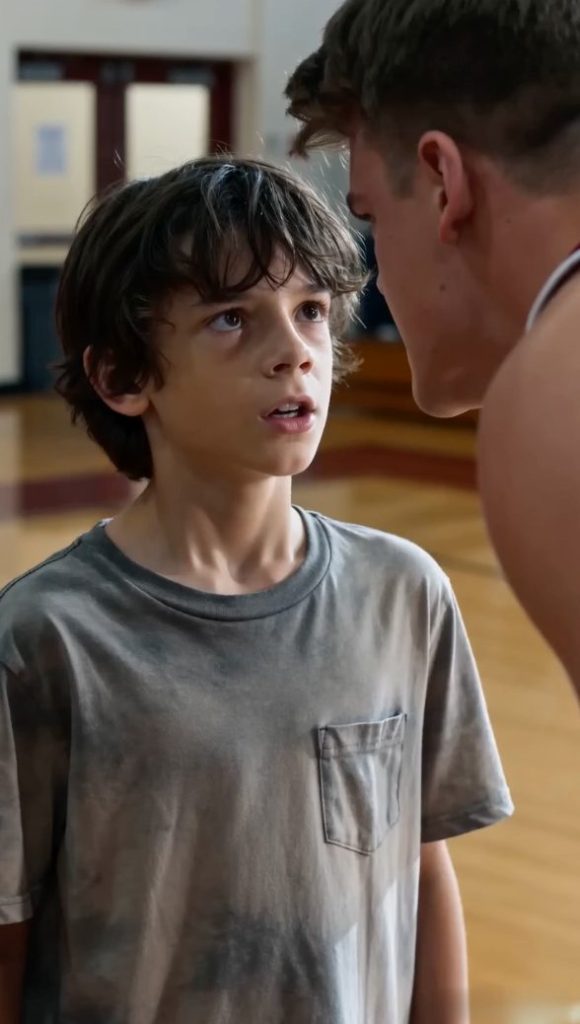
He could tolerate people walking across a floor he had just cleaned, leaving muddy footprints without apologizing.
What hurt him was the possibility that his son might be judged for his job.
Mason wanted desperately to make him understand that the opposite was true.
The job made him proud.
The way people treated his father was what hurt.

By lunchtime Friday, Mason had already heard Trevor’s voice twice.
The first time was in the hallway outside the cafeteria.
“Careful where you walk, janitor boy.
Somebody has to clean up after you.”
The second time was when Trevor passed Mason’s table with two teammates.
He looked down at Mason’s sneakers.
“Those things still alive?”
One of the players laughed.
Mason continued eating.
Trevor shook his head in exaggerated disappointment.
“Guess the cleaning business doesn’t pay much.”
Mason’s fingers tightened around his fork, but he didn’t answer.
The silence seemed to disappoint Trevor more than an argument would have.
“Seriously, do you ever say anything?”
Mason glanced up briefly.
“Only when I have something worth saying.”
Trevor stared at him.
One of his teammates made a small surprised sound.
Then Trevor smiled.
“That’s cute.”
He walked away, still laughing.
Mason looked down at his lunch.
His appetite was gone.
For the rest of the afternoon, he tried to concentrate on his classes, but the words kept coming back to him.
Only when I have something worth saying.
He wondered whether silence had really been helping.
Sometimes it felt like maturity.
Other times it felt as though every insult he ignored became permission for the next one.
He could tolerate jokes about himself.
He had learned that much.
But he was beginning to feel that ignoring insults about his father meant allowing Trevor to make honest work seem shameful.
The thought followed him through the final bell.
When school ended, the hallways filled with students heading toward buses, parking lots, and weekend plans.
Mason walked in the opposite direction, toward the gymnasium.
He knew his father would be there.
He could hear basketballs bouncing before he reached the doors.
The varsity team had finished most of its scheduled practice, but several players remained on the court.
Trevor stood beneath one basket, casually making shots while the others watched.
Mason entered quietly.
His father was near the center of the gymnasium, pushing a mop across the floor.
“Hey,” Mason called.
His father’s face brightened.
“Hey, yourself.
School all right?”
“Yeah.”
“Homework?”
“Some.”
“That’s what I like to hear.”
Mason smiled and set his backpack near the bleachers, well away from the damp floor.
He might have stayed there until his father finished.
He might have quietly watched the last few minutes of basketball and gone home as he had done so many evenings before.
But Trevor noticed him.
“Look who’s here.”
Mason felt the familiar tension return.
Trevor bounced the ball once.
“Come to help Daddy clean?”
His father kept mopping.
Mason said nothing.
Trevor took a step closer.
“You know, there’s probably enough work here for both of you.”
The captain glanced at his teammates.
“Your dad spends his nights cleaning my sweat off this court.
Maybe you should learn how to make yourself useful, too.”
The boys laughed.
Mason looked at his father.
His father’s expression barely changed, but the mop slowed slightly.
That small movement hurt more than the laughter.

Mason knew his father had heard every word.
He also knew his father had chosen not to answer.
The older man had spent years learning how to remain polite in situations where other people made politeness difficult.
He understood that his work depended on keeping the school clean and avoiding unnecessary confrontation.
He did not expect Mason to fight his battles.
He only wanted to finish the floor and take his son home.
Trevor, however, was enjoying himself.
He walked closer to the bucket.
“Guess we’ll have to give him more to do.”
The bucket tipped.
Water spread across the floor.
His father stared at the mess.
The laughter erupted.
And Mason finally stepped forward.
“Leave my father alone.”
The words hung in the gymnasium.
Trevor turned toward him with an incredulous smile.
For several seconds, he simply stared, as though he couldn’t decide whether Mason was serious.
Then he laughed.
“Well, look at that!
The little janitor finally decided to defend himself?”
Mason stood between Trevor and the spilled water.
He was close enough to see the smug confidence in the captain’s expression and the slight amusement in his eyes.
“I’m asking you to stop,” Mason said.
Trevor lifted his eyebrows.
“You’re asking me?”
“Yes.”
“And what happens if I don’t?”
Mason didn’t answer immediately.
He looked back at his father, who was setting the mop against the wall.
The older man seemed worried now.
“Mason,” he said quietly.
Mason turned.
“It’s okay, Dad.”
But his father shook his head.
“Leave it.”
Those two words were familiar.
His father had said them before, usually when a student or athlete made an unnecessary mess or spoke to him disrespectfully.
Leave it.
Keep working.
Go home.
Don’t make trouble.
Mason had followed that advice for months.
Standing in the gymnasium, he suddenly understood how much effort it had cost both of them.
Trevor noticed the exchange and smiled wider.
“That’s right.
Listen to your dad.”
Mason looked back at him.
“He’s asking us not to make things worse.”
Trevor shrugged.
“Then maybe you should listen.”
Mason took a slow breath.
“Maybe you should have listened when he asked you to stay off the wet floor.”
A teammate near the bleachers stopped laughing.
Trevor’s smile tightened.
“What did you say?”
“You heard me.”
It was not an insult.
Mason hadn’t raised his voice.
But Trevor was accustomed to people stepping aside when he spoke, and Mason was standing exactly where he didn’t want him.
The captain shifted the basketball into both hands.
“You think you’re pretty tough?”
“No.”
“Then why are you standing there?”





