His teammates followed his lead, and younger players studied the way he moved, hoping someday to earn a little of the same attention.
Trevor had worked hard to become a strong basketball player, and nobody could fairly deny his ability.

But success had gradually become something he used to measure other people.
He admired those who could help him win and looked down on those who couldn’t.
He liked being the strongest person on the court and the loudest voice in the room.
When somebody laughed at his jokes, he took it as confirmation that he was right.
Mason became one of his favorite targets.
It started with small comments.
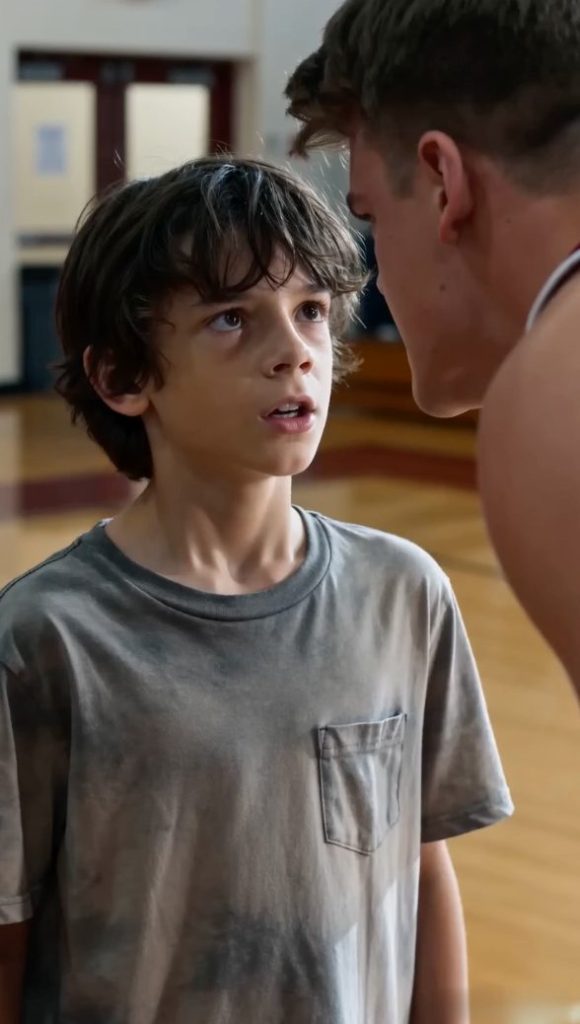
One afternoon, Trevor saw Mason waiting beside the gymnasium doors while his father finished cleaning.
“Hey, janitor boy.
Waiting for your shift?”
His teammates laughed.
Mason ignored him.
Another day, Trevor walked past while Mason carried a bottle of water from a vending machine.
“Shouldn’t you be carrying a mop instead?”
Again, Mason said nothing.
Trevor mistook the silence for weakness.
Soon the comments became routine.
He called Mason “janitor boy” in the hallway, in the cafeteria, and outside the locker rooms.
Sometimes he asked whether Mason’s father had washed his clothes with floor cleaner.
Other times he pointed at Mason’s shoes and announced that they looked as if they had come out of a trash can.
Mason rarely reacted.
He was not afraid of conversation, and he was not incapable of defending himself.
He simply understood that a confrontation with Trevor would become a spectacle, and his father was already working hard enough without having to worry about what happened to him at school.
There was another reason.
Mason knew something about Trevor that Trevor didn’t know about Mason.
He knew what kind of basketball player Trevor was.
He had watched the captain practice hundreds of times.
When the varsity team finished training, Mason sometimes remained near the bleachers while his father began cleaning.
He watched the drills, listened to the coaches, and noticed the way certain players moved when they were comfortable or frustrated.
Trevor was powerful, quick, and an excellent scorer.
But he had habits.
When he drove toward the basket, he often shifted his shoulders before changing direction.
When someone challenged his favorite move, he tended to repeat it harder rather than choose something different.
When he believed he had already won, his attention wandered toward the crowd.
Mason noticed these things because basketball had been part of his life for years.
He loved the game with an intensity he rarely discussed.
The court was the one place where his small size did not always feel like a disadvantage.
He could not overpower taller players, but he could move, anticipate, and recognize openings before they fully appeared.
He had learned to trust his feet.
He had learned that a basketball could move faster than the strongest person trying to guard it.
And he had learned that patience sometimes mattered more than strength.
His father knew this side of him better than anyone.
On quiet evenings, when the gymnasium was empty and the floor was clean, Mason occasionally asked whether he could shoot a few baskets before they left.
His father usually smiled.
“Only if you don’t make me chase that ball all night.”

Mason would grin, pick up the basketball, and begin.
Sometimes he practiced until his shirt clung to his back.
Other evenings, he worked on the same movement repeatedly, changing his foot placement or the angle of his release until it felt natural.
His father watched whenever he could.
He didn’t understand every technique or rule, but he understood his son’s expression when a difficult shot finally fell through the hoop.
It was one of the few times Mason looked completely free.
There was no Trevor on those evenings.
No laughter.
No one commenting on his shoes.
There was only the sound of the basketball touching the floor, the quiet squeak of old sneakers, and his father’s occasional applause from the sideline.
Sometimes his father would say, “You make that look easy.”
Mason always answered, “It isn’t.”
Then he would try again.
The game gave Mason something he had never found in the school hallways: a sense that who he was mattered more than what he wore.
But he kept that part of himself private.
He didn’t play for the varsity team.
He didn’t boast about the baskets he made after school.
And he never challenged Trevor to prove anything.
Until that Friday afternoon.
The day had begun like most Fridays.
Mason arrived at school carrying a worn backpack with one strap that had started to fray.
His father had left for work earlier, promising they could have dinner together once the gymnasium was finished.
“Don’t wait around too long,” his father had told him that morning.
Mason had smiled.
“You always say that.”
“Because you always wait.”
“I don’t mind.”
His father paused near the front door, holding his work jacket.
“I know you don’t,” he said gently.
“But you should have things to do besides waiting for me.”
Mason understood what he meant.
His father wanted him to spend time with friends, enjoy school, and have the ordinary experiences that other teenagers seemed to take for granted.
He didn’t want Mason measuring every afternoon against the school cleaning schedule.
But Mason also understood the part his father didn’t say.
His father worried that the job embarrassed him.
Once, several months earlier, Mason had overheard a student laughing about the janitor who stayed after basketball practice.
When he came home unusually quiet, his father noticed.
“Somebody say something?”
Mason shook his head.
His father studied him.
“You know there’s nothing wrong with the work I do.”
“I know.”
“I’m not ashamed of it.”
“Neither am I.”
The older man had looked at him for a moment, then nodded.
Still, Mason saw the worry in his eyes.
His father could tolerate being overlooked.





