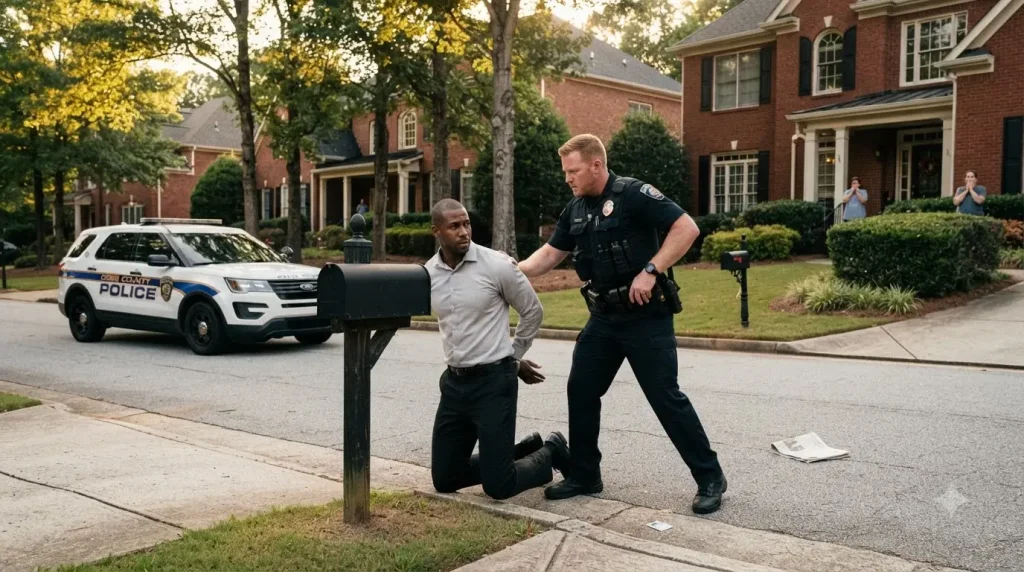
He had been outside for less than thirty seconds.
One hand held the folded Saturday paper. The other rested loosely at his side. Behind him stood the brick colonial he had owned for six years, its dark shutters open against the late-afternoon sunlight, the front lawn freshly cut, and three unfamiliar vehicles parked along the street because several of his guests had arrived early.
Nothing about the moment should have mattered.
He had walked from his own front door to his own mailbox.
He had reached inside.
He had taken out his own newspaper.
Then the patrol cruiser stopped.
The officer stepped out before the engine had fully settled.
“Sir. Step away from the residence.”
The homeowner turned slowly.
He was forty-one, tall and athletic, wearing dark trousers and a light-gray button-down shirt with the sleeves rolled neatly to his forearms. His laptop bag was still inside near the front door, along with the presentation materials he planned to use in less than ten minutes.
He looked behind himself once, almost expecting the officer to be speaking to somebody else.
There was nobody there.
“This is my residence.”
The white patrol officer stared at him.
Short reddish-blond hair.
Broad shoulders.
Dark uniform.
One hand resting close enough to his duty belt that the homeowner immediately noticed.
“What are you doing here?”
The homeowner glanced at the newspaper.
“Getting my paper.”
“Identification.”
“For what?”
The officer’s face changed.
Barely.
But enough.
The homeowner had spent years investigating civil-rights complaints before leaving government work for executive consulting. He knew escalation often began long before shouting, force, or handcuffs.
Sometimes it began with a question an officer did not expect someone to ask.
“Because I asked you for it.”
The homeowner remained still.
“Did somebody report a crime?”
“We had a suspicious-person call.”
“At this address?”
“Yes.”
The homeowner looked toward the house.
Through the front windows, he could see the faint silhouettes of people moving in the living room.
Twelve senior law-enforcement leaders had been invited that afternoon.
Deputy chiefs.
Commanders.
Training supervisors.
One police chief.
They had come for a closed workshop on bias, discretionary judgment, escalation, and public trust.
The irony had not yet occurred to him.
He was still assuming the encounter would last perhaps ninety seconds.
“My wallet is in my back pocket,” he said. “I’m going to reach for it.”
The officer stepped closer.
“Slow.”
The homeowner took out the wallet.
He removed his license with two fingers and handed it over.
The officer studied the card.
Then looked at the house.
Then back at the card.
The homeowner waited.
The address printed on the license was the address directly behind him.
The officer checked again.
Instead of returning it, he asked, “How long you been staying here?”
The homeowner’s expression changed.
“Staying?”
“You heard me.”
“I’ve owned this house for six years.”
The officer looked toward the brick facade.
Then slowly back toward him.
“An address on a license doesn’t prove ownership.”
The homeowner stared.
“No. But it does make your burglary theory significantly less persuasive.”
The officer’s jaw tightened.
“I didn’t say burglary.”
“You said suspicious person at a residence.”
“Don’t get smart with me.”
The homeowner glanced toward the officer’s body camera.
The indicator was active.
Good.
He looked toward the patrol cruiser.
Dash camera.
Mobile terminal.
Potential witnesses.
Good.
He took one breath and kept his voice neutral.
“My vehicle is in the driveway. Its registration matches this address. Property records are public. People inside the house can identify me. What exactly would you like verified?”
The officer looked him up and down.
Shoes.
Trousers.
Shirt.
Face.
Then the house.
“I know this neighborhood.”
The homeowner said nothing.
The officer continued.
“You don’t look like you belong here.”
There it was.
Not subtle.
Not inferred.
Not buried inside procedure.
A sentence.
The homeowner tilted his head slightly.
“What does someone who belongs here look like?”
The officer’s hand moved closer to his belt.
“Don’t turn this into a race thing.”
The homeowner almost laughed.
Not because it was funny.
Because he had never said the word race.
Across the street, a curtain moved.
On the corner porch, a neighbor stepped outside with a phone in her hand.
The officer saw her.
That seemed to make him more irritated rather than more cautious.
“Put the newspaper down.”
“Why?”
“Because I said so.”
The homeowner looked at the folded paper in his hand.
Then lowered it toward the top of the mailbox.
The officer reached out first.
He slapped it away.
The newspaper hit the driveway and unfolded across the concrete.
Several pages scattered in the breeze.
The homeowner’s eyes moved toward them.
Then back to the officer.
“That was unnecessary.”
“What did I say about telling me how to do my job?”
“You told me not to get smart.”
The officer stepped into his space.
The homeowner could smell coffee on his breath.
“You think this is funny?”
“No.”
“Hands out.”
The homeowner extended them.
The officer held his license in one hand.
He looked at it once more.
Then dropped it.
Not handed.
Dropped.
The license bounced once beside the newspaper.
For the first time, genuine anger entered the homeowner’s chest.
He contained it.
Years of investigations had taught him something most people learned only after terrible encounters.
Anger and action were separate.
Feeling insulted did not require moving.
Feeling afraid did not require retreating.
He remained still.
The officer said, “Pick it up.”
The homeowner stared.
“You just told me to keep my hands where you can see them.”
The officer smiled faintly.
“Now I’m telling you to pick it up.”
The homeowner understood.
Contradictory commands.
A simple but dangerous mechanism.
Whichever instruction he chose could later be described as violating the other.
He looked directly at the body camera.





